
Real Estate Tokenization Development in 2027: Could Automated Investor Rights Change the Structure of Property Ownership?
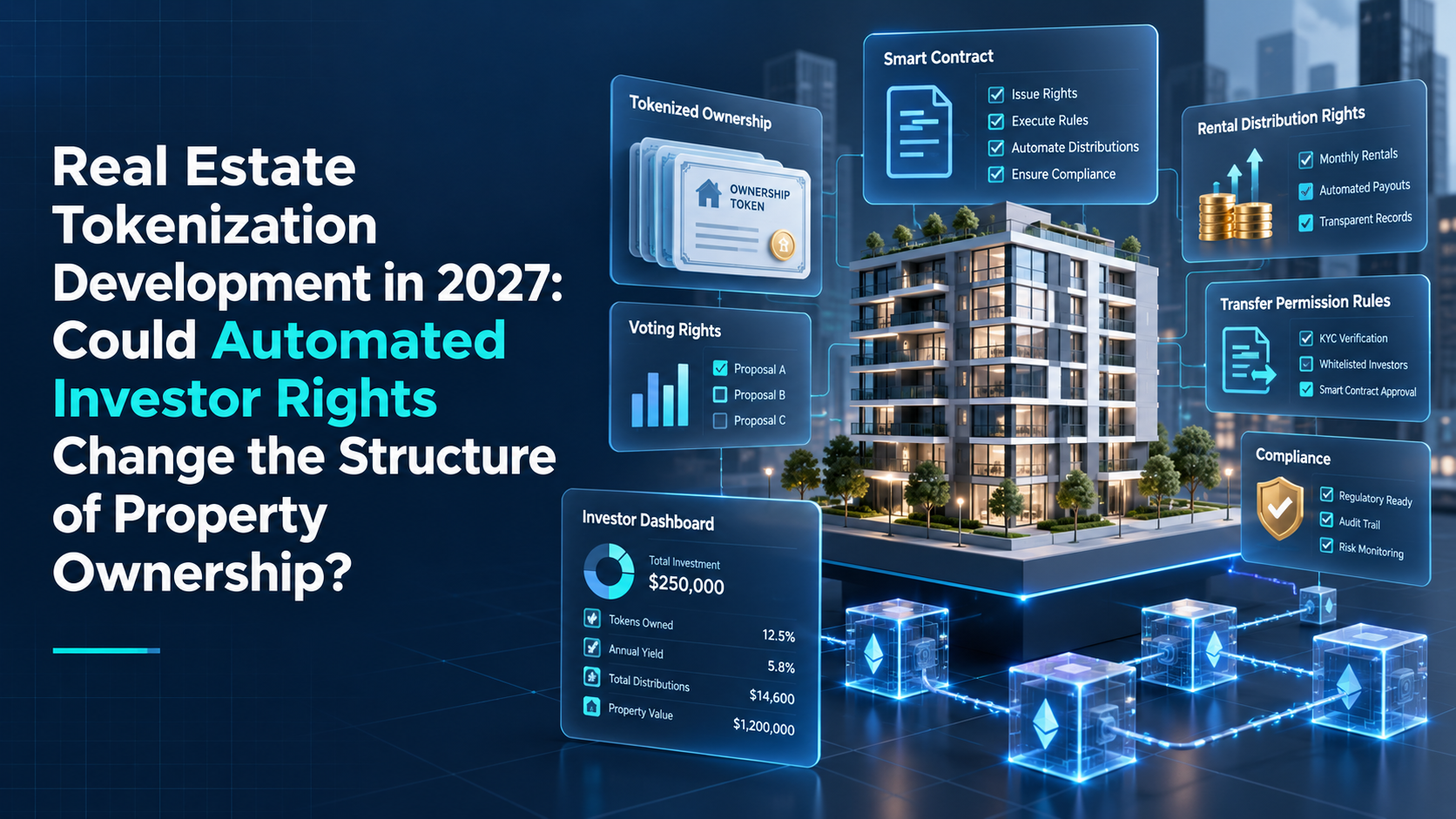
Property ownership has traditionally depended on legal documents, registries, intermediaries, banks, property managers, and contractual agreements. These systems have supported real estate markets for decades, but they can make ownership administration complicated when many investors participate in the same property. Real estate tokenization introduces another approach by representing ownership interests through blockchain-based tokens.
By 2027, the discussion around real estate tokenization may move beyond fractional ownership. One area receiving greater attention is automated investor rights. Instead of using tokens only to represent an economic interest, platforms could connect them with voting rights, distribution rules, information access, transfer conditions, and other investor privileges.
This could affect how property ownership is organized. Investors may hold digital representations of interests in an entity that owns a property, while smart contracts manage specific actions according to predefined rules. The legal ownership of the property would still depend on the relevant jurisdiction and ownership structure, but digital systems could manage many activities associated with investor participation.
What Could Automated Investor Rights Mean for Property Ownership?
Automated investor rights refer to rights or permissions that can be triggered according to predefined conditions in a digital system. In a tokenized property structure, these rights might include voting on selected matters, receiving rental distributions, accessing property reports, or participating in certain decisions.
For example, consider a commercial property owned by a special purpose vehicle. Investors hold tokens representing interests in that entity. A platform could record eligible token holders and provide voting access when a predefined decision is presented. Once the voting period ends, the result could be calculated according to the applicable rules.
The important point is that automation does not necessarily replace legal agreements. Instead, it can provide a digital mechanism for handling activities that are already defined within the legal and contractual framework.
Method 1: Connecting Tokens With Legal Ownership Structures
One of the first considerations in real estate tokenization development is determining what the token actually represents. A token could represent shares in a legal entity, a beneficial interest, a debt claim, revenue participation, or another contractual right.
For property ownership, a special purpose vehicle can hold the property while investors hold interests in that entity. The token can then represent those interests within the digital platform. This approach can separate the physical property from the digital record used to manage investor participation.
A real estate tokenization company needs to consider the relationship between blockchain records and legal documents. The system should not assume that holding a blockchain token automatically creates legal ownership. The legal structure, investor agreements, jurisdiction, and applicable securities rules remain important.
Method 2: Automating Voting Rights
Voting is one area where automated investor rights could have a practical role. Property investors may need to vote on matters such as refinancing, major repairs, property sales, changes in management, or other decisions specified in their agreements.
A tokenization platform could identify eligible investors based on token holdings and voting rules. Smart contracts could calculate voting power and record participation during a defined voting period.
Suppose an investor owns 5% of the eligible tokens. The platform may assign voting power according to the applicable agreement. Another property may use one-token-one-vote rules, while a different structure could place limits on individual voting power.
The important factor is that the voting model must match the legal and commercial arrangement. Technology can process the rules, but the rules themselves must come from the underlying ownership and investment structure.
Method 3: Linking Rental Income With Investor Rights
Rental income is another area where automation could influence property investment operations. In a conventional arrangement, rental payments may pass through property managers, accounting teams, banks, and other intermediaries before investors receive their share.
A tokenized structure could calculate distributions based on predefined ownership records. If an entity receives rental income and the legal arrangement permits digital distribution, the platform could calculate each investor's allocation.
For instance, if a property generates distributable income of $100,000 and an investor holds 2% of the relevant ownership interest, the system could calculate a $2,000 allocation before considering applicable fees, taxes, reserves, and other contractual deductions.
This does not mean every property token platform will automatically distribute rent. Banking regulations, tax rules, custody arrangements, and investor agreements can affect how payments are handled.
Method 4: Creating Rules for Investor Eligibility
Automated rights also depend on knowing who is permitted to hold or transfer a token. Real estate investments can involve investor eligibility requirements, geographic restrictions, accreditation rules, holding periods, and other conditions.
A real estate asset tokenization company may therefore include identity verification and compliance checks within the platform. Before an investor receives particular rights, the system can check whether the investor satisfies the conditions established for that offering.
For example, a token may only be transferable between approved investors. A smart contract can include transfer restrictions, while an off-chain compliance system can verify identity and eligibility.
This combination of legal rules, investor records, and blockchain functions could become an important part of real estate tokenization platform development in 2027.
Method 5: Managing Investor Information Rights
Property investors often need access to financial statements, rental information, valuation reports, maintenance records, and other documents. In a conventional structure, this information may be distributed through emails, investor portals, or periodic reports.
A tokenized platform could associate information rights with verified investor accounts. Different investor groups could receive access according to their contractual rights.
For example, ordinary investors may receive quarterly financial reports, while investors with a larger ownership position may have additional voting or information rights if the legal agreement provides them.
The blockchain does not need to store every document directly. A platform can use blockchain records for permissions and transaction history while storing documents through appropriate off-chain systems.
Could Automated Rights Change the Structure of Property Ownership?
The larger question is whether these functions could change the structure of property ownership itself. Traditional ownership often separates economic ownership, administration, voting, reporting, and payment activities across different parties.
Tokenization can bring some of these functions into a shared digital environment. An investor's token balance can be connected with participation rights, while smart contracts can process specific actions according to predefined rules.
This could create property structures where ownership is represented digitally and investor participation is managed through software. However, the legal foundation remains important. Property rights are generally governed by national and regional laws, land registries, company laws, securities regulations, and contractual agreements.
Therefore, the future model is more likely to involve a combination of legal ownership structures and blockchain-based administration rather than blockchain records replacing property law.
The Role of Smart Contracts in Investor Rights
Smart contracts can act as software rules for certain investor activities. They may record token ownership, calculate voting results, enforce transfer restrictions, or initiate specified actions when predetermined conditions are satisfied.
Consider a property token with a 12-month holding requirement. The smart contract could prevent transfers during the restricted period. Once the applicable date is reached, transfer functionality could become available to eligible participants.
Another example involves voting. A proposal can remain open for seven days, with the platform recording votes from eligible token holders. At the end of the voting period, the contract can calculate the result based on the voting formula.
These functions require careful testing because an error in a smart contract can affect investor records or transactions. Legal and technical reviews therefore remain important during real estate token development.
Secondary Trading and Automated Transfer Rules
A major discussion around tokenized property involves secondary markets. Investors may want to sell their interests without waiting for the underlying property to be sold.
However, property tokens cannot necessarily be traded like ordinary cryptocurrencies. Restrictions may apply because of securities laws, investor eligibility requirements, lock-up periods, transfer restrictions, and the legal structure of the offering.
A real estate tokenization development company can therefore design trading functionality around approved participants and defined rules. A transfer could require buyer verification before the token changes ownership.
This approach may give property owners and investors more structured control over secondary transfers. It can also provide a record of token movements, subject to the privacy and compliance requirements applicable to the platform.
Investor Rights Could Become More Granular
Tokenization may also allow property investment rights to become more specific. Instead of treating every investor identically, a project could have different classes of tokens representing different economic or governance arrangements.
For example, one token class could provide income participation, another could provide voting rights, and another could represent a preferred economic arrangement. These structures would need to comply with the legal terms of the offering.
Such models could create more flexible investment structures, but they may also increase legal and technical complexity. Investors need to understand what each token represents before purchasing it.
This is an important consideration for anyone evaluating a real estate tokenization platform development company. The quality of a platform cannot be judged only by its interface or token features. The connection between legal rights, financial arrangements, compliance procedures, and technical functions matters just as much.
What Could Real Estate Tokenization Platforms Include in 2027?
A property tokenization platform in 2027 could include several connected components. These may include investor onboarding, identity verification, wallet management, token issuance, property information, smart contracts, investor voting, distribution calculations, reporting, compliance checks, and transfer management.
The exact feature set would depend on the property's ownership structure and target investor group. A private commercial property offering may require a different system from a residential development fund.
For businesses researching the market, comparisons between Top real estate tokenization companies and Best real estate tokenization companies should therefore consider more than token issuance. Legal structure, investor management, compliance functionality, custody arrangements, smart contract design, reporting, and secondary trading support can all affect the suitability of a platform.
Challenges That Could Limit Automated Investor Rights
Automated rights also introduce challenges. Legal recognition is one of the biggest considerations. A digital record may show who holds a token, but whether that token represents a legally enforceable property interest depends on the underlying legal arrangement.
Regulatory changes can also affect tokenized property offerings. Securities regulations, property laws, tax requirements, anti-money laundering rules, and investor protection standards may differ between countries.
Technical risks also deserve attention. Smart contract errors, wallet security issues, incorrect investor data, or faulty distribution calculations can create financial problems.
There is also a governance question. Some property decisions cannot be reduced easily to simple automated rules. A dispute involving construction delays, insurance claims, major repairs, or changes in property management may require human judgment and legal procedures.
What Could Property Ownership Look Like by 2027?
By 2027, property ownership may involve a wider combination of physical assets, legal entities, digital tokens, investor portals, and blockchain records. Automated investor rights could become one component of this structure.
Instead of viewing a token simply as a digital certificate representing a fraction of property value, developers may treat it as a digital representation connected with a broader set of contractual rights.
This could make investor participation more structured. Voting, distributions, eligibility, transfers, and reporting may be handled through connected systems while legal ownership continues to operate through recognized entities and agreements.
The result could be a property investment model where ownership records and investor activities are more closely connected to software. The extent of this change will depend on regulation, market adoption, investor demand, and the legal treatment of tokenized assets in each jurisdiction.
Conclusion
Real estate tokenization development in 2027 could move toward property ownership models where digital tokens represent not only economic interests but also specific investor rights defined through legal agreements and smart contract rules. Automated voting, rental distributions, eligibility checks, information access, and transfer restrictions could give investors a more structured way to participate in property investments. At the same time, blockchain technology would not remove the need for legal entities, property regulations, securities compliance, tax considerations, and human oversight. The future of real estate tokenization is therefore likely to involve cooperation between legal structures and digital systems, with each property project requiring its own approach to ownership, governance, investor participation, and asset management. Businesses planning a property token platform may need to consider how these elements work together before selecting their technical architecture and investment model. Blockchain App Factory provides Real estate tokenization development services.
FAQs
1. What is real estate tokenization?
Real estate tokenization is the process of representing interests connected with real estate through blockchain-based digital tokens. Depending on the legal structure, tokens may represent ownership interests, economic rights, debt claims, or other contractual arrangements.
2. What are automated investor rights?
Automated investor rights are digital rules that manage specific investor activities according to predefined conditions. These may include voting, distributions, transfer permissions, or access to selected information.
3. Can property ownership be completely managed through blockchain?
Not necessarily. Blockchain can record token ownership and manage certain digital functions, but legal property ownership generally depends on applicable property laws, legal entities, contracts, and official records.
4. How can smart contracts support property tokenization?
Smart contracts can manage predefined functions such as token transfers, voting procedures, ownership calculations, distribution rules, and certain eligibility conditions.
5. Why are investor eligibility checks important?
Property token offerings may have legal or regulatory restrictions concerning who can invest or receive particular rights. Eligibility checks can help the platform apply the conditions established for the offering.
6. Can tokenized property support secondary trading?
It can, depending on the legal and regulatory structure. A platform may restrict transfers to verified and eligible participants and apply holding periods or other conditions.
7. What is the role of a real estate tokenization development company?
A real estate tokenization development company can work on the technical infrastructure for token issuance, smart contracts, investor management, compliance functions, wallets, reporting, and other platform components required by a property tokenization project.
8. What should businesses consider before starting real estate token development?
Businesses should review the legal ownership structure, target investors, jurisdiction, regulatory requirements, token rights, custody model, smart contract design, investor onboarding process, distribution model, and secondary trading requirements before starting development.
 Greek
Greek
 English
 Arabic
 French
 Spanish
 Portuguese
 Deutsch
 Turkish
 Dutch
Dutch
 Italiano
 Russian
 Romaian
 Portuguese (Brazil)