


10 Bookkeeping Mistakes That Can Create Financial and Tax Problems for UAE Businesses
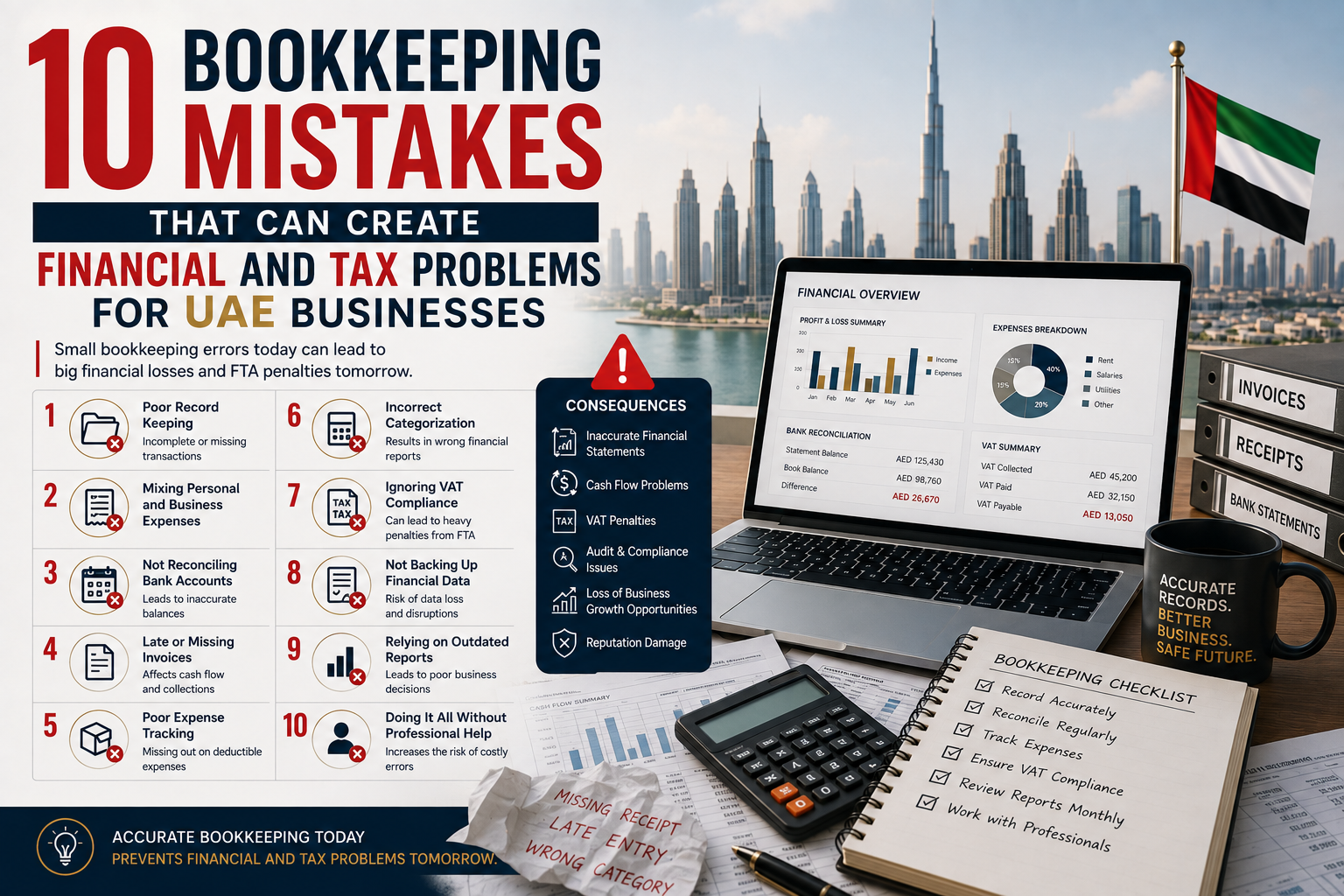
Accurate financial records are essential for businesses operating in the UAE. Every sale, expense, payment, purchase, and financial transaction needs to be recorded and organised properly to maintain a clear picture of the company's financial position.
When bookkeeping is inconsistent or poorly managed, errors can accumulate over time. What may initially appear to be a minor accounting issue can eventually affect financial reporting, cash flow management, budgeting, and tax-related recordkeeping.
Understanding common bookkeeping mistakes can help UAE business owners identify weaknesses in their financial processes and take steps to improve the accuracy and reliability of their records.
Whether a business manages its books internally or works with an external provider, establishing consistent bookkeeping procedures is important for effective financial management.
Why Do Bookkeeping Mistakes Matter?
Bookkeeping provides the financial foundation for many business activities.
Accurate records help businesses monitor:
- Revenue
- Expenses
- Cash flow
- Accounts receivable
- Accounts payable
- Assets and liabilities
- Financial performance
Errors in these records can affect the reports and decisions based on them.
For UAE businesses, maintaining organised financial records is also important when preparing information relevant to applicable tax and compliance obligations.
1. Mixing Business and Personal Expenses
One common mistake among small businesses is combining personal and business transactions.
When personal expenses are recorded alongside business transactions, it can become difficult to determine the company's actual operating costs.
This can create problems with:
- Expense tracking
- Financial reporting
- Bank reconciliation
- Cash flow analysis
- Tax-related recordkeeping
Business owners should maintain separate accounts and clearly identify business-related transactions.
2. Recording Transactions Late
Another common bookkeeping problem is delaying transaction recording.
When businesses wait weeks or months to update their records, they may not have an accurate picture of their current financial position.
Delayed bookkeeping can make it difficult to determine:
- Current cash balances
- Outstanding invoices
- Recent expenses
- Supplier obligations
- Actual revenue
Regular transaction recording helps keep financial information current.
3. Failing to Reconcile Bank Accounts
Bank reconciliation involves comparing accounting records with bank statements.
Failing to perform regular reconciliation can allow errors to remain undetected.
Potential issues include:
- Missing transactions
- Duplicate entries
- Incorrect amounts
- Unrecorded bank charges
- Unidentified payments
Regular reconciliation is an important part of maintaining reliable financial records.
4. Losing or Mismanaging Supporting Documents
Invoices, receipts, contracts, bank statements, and payment confirmations provide evidence of financial transactions.
If these documents are lost or poorly organised, businesses may struggle to verify transactions later.
A structured digital recordkeeping system can make it easier to locate supporting documents when preparing reports or reviewing transactions.
Businesses should also maintain records in accordance with applicable UAE requirements.
5. Incorrectly Categorising Expenses
Expenses should be recorded under appropriate accounting categories.
Incorrect categorisation can distort financial reports and make it harder to understand where business funds are being spent.
For example, marketing expenses, professional fees, office costs, and operating expenses should be recorded consistently according to the company's accounting structure.
A clear chart of accounts can help reduce categorisation errors.
6. Ignoring Accounts Receivable
Recording sales is only one part of managing customer payments.
Businesses should also monitor whether customers have actually paid their invoices.
Ignoring accounts receivable can result in:
- Increasing overdue invoices
- Poor cash flow visibility
- Delayed collections
- Unclear customer balances
Businesses should regularly review outstanding invoices and follow up on overdue amounts.
7. Failing to Track Accounts Payable
Businesses must also keep accurate records of amounts owed to suppliers and other parties.
Poor accounts payable management can result in:
- Missed payment deadlines
- Duplicate payments
- Supplier disputes
- Unexpected cash outflows
- Inaccurate financial reports
Maintaining an updated accounts payable record helps businesses understand upcoming financial obligations.
8. Relying Too Heavily on Manual Processes
Manual bookkeeping can become difficult as transaction volumes increase.
Entering data manually into spreadsheets or accounting systems can increase the risk of:
- Data-entry errors
- Duplicate records
- Missing transactions
- Incorrect calculations
Accounting software and automation can reduce repetitive tasks and improve efficiency.
However, technology should be supported by appropriate review and reconciliation procedures.
9. Not Reviewing Financial Reports Regularly
Bookkeeping information becomes more valuable when business owners regularly review it.
Some businesses record transactions but rarely examine the resulting financial reports.
Regular reviews can help identify:
- Unexpected expenses
- Changes in revenue
- Cash flow pressure
- Increasing customer balances
- Rising operating costs
Monthly financial reviews can provide management with a clearer understanding of business performance.
10. Ignoring Tax and Compliance Recordkeeping
One of the most significant bookkeeping mistakes is failing to maintain organised records that support applicable tax and compliance requirements.
Businesses should maintain relevant information relating to:
- Sales
- Purchases
- Expenses
- Financial transactions
- Invoices
- VAT-related records
- Other supporting documentation
Accurate bookkeeping can make it easier to organise information needed for applicable UAE tax processes.
Businesses should ensure that their recordkeeping procedures meet current requirements and seek professional tax advice where appropriate.
How Bookkeeping Mistakes Affect Cash Flow
Bookkeeping errors can have a direct impact on cash flow visibility.
For example, if a business fails to record outstanding customer invoices accurately, management may overestimate the amount of cash available.
Similarly, if supplier obligations are not properly recorded, the business may underestimate upcoming cash outflows.
Accurate bookkeeping helps businesses understand both expected inflows and financial commitments.
How Bookkeeping Errors Affect Financial Reporting
Financial reports rely on the accuracy of underlying accounting records.
Incorrect entries can affect:
- Revenue figures
- Expense totals
- Profit calculations
- Asset balances
- Liability balances
- Cash flow information
If financial reports contain inaccurate information, management may make decisions based on an incomplete or incorrect understanding of the business.
How to Prevent Bookkeeping Mistakes
Businesses can reduce bookkeeping errors by establishing consistent procedures.
Useful practices include:
Record Transactions Promptly
Avoid allowing transactions to accumulate without being entered.
Reconcile Accounts Regularly
Compare accounting records with bank and other financial statements.
Maintain Supporting Documentation
Keep invoices, receipts, and other financial records organised.
Use Accounting Software
Digital accounting systems can reduce repetitive manual tasks.
Review Financial Reports
Regular reviews can help identify unusual transactions and financial trends.
Separate Business and Personal Transactions
Maintain dedicated business accounts and expense records.
Establish Clear Responsibilities
Employees should understand who is responsible for recording, reviewing, and approving financial transactions.
Should UAE Businesses Use Accounting Software?
Accounting software can help businesses manage financial records more efficiently.
Depending on the platform, businesses may be able to:
- Record transactions
- Generate invoices
- Track expenses
- Reconcile bank accounts
- Monitor accounts receivable
- Track accounts payable
- Generate financial reports
Cloud-based accounting platforms can also provide authorised users with convenient access to financial information.
However, businesses should select software based on their transaction volume, reporting requirements, business structure, and operational needs.
When Should a Business Consider Professional Bookkeeping Support?
Professional bookkeeping support may be worth considering when:
- Financial records are consistently delayed
- Transaction volumes are increasing
- Bank reconciliation is difficult
- Customer invoices are not being tracked properly
- Supplier balances are unclear
- Financial reports are unreliable
- Tax-related records are difficult to organise
- Business owners spend too much time on bookkeeping
Outsourcing can give businesses access to professional bookkeeping expertise while reducing the administrative burden on internal teams.
Bookkeeping Mistakes to Watch for as Your Business Grows
Bookkeeping requirements often become more complex as businesses expand.
Growth may bring:
- More customers
- More suppliers
- More employees
- Higher transaction volumes
- Additional bank accounts
- Increased expenses
- More complex reporting requirements
A bookkeeping system that worked for a small startup may not remain suitable as transaction volumes increase.
Businesses should periodically review their processes and make improvements where necessary.
Conclusion
Avoiding common bookkeeping mistakes can help UAE businesses maintain more accurate financial records, improve cash flow visibility, and support better financial decision-making.
Businesses should focus on recording transactions promptly, reconciling accounts, maintaining supporting documentation, tracking receivables and payables, using suitable accounting technology, and regularly reviewing financial information.
Accurate bookkeeping can also help businesses organise the financial records needed for applicable tax and compliance processes.
For UAE businesses that need professional support, Dubai Business and Tax Advisors (DBTA) can assist with bookkeeping, bank reconciliation, financial reporting, catch-up bookkeeping, and related accounting requirements.
By establishing reliable bookkeeping processes and addressing errors early, businesses can build a stronger financial foundation and reduce the risks associated with inaccurate or incomplete records.
 Russian
 English
 Arabic
 French
 Spanish
 Portuguese
 Deutsch
 Turkish
 Dutch
 Italiano
 Romaian
 Portuguese (Brazil)
 Greek
