


LLB vs LLM in the UK: Which Legal Study Route Fits Your Career Plans?
It’s a question that echoes through the corridors of every prospective law student’s mind. You’ve decided the UK is the destination for your legal education. The prestige, the common law heritage, the global recognition—it’s a logical choice. But the path splits the moment you start looking at courses.
Do you commit to the foundational undergraduate degree, or do you build upon an existing qualification with a specialised master’s? This isn't just a choice between a bachelor’s and a master’s; it’s a fundamental fork in the road that dictates how you enter, or re-enter, the legal profession.
Understanding the Core Difference: The Foundation vs The Specialisation
The simplest way to look at this is to see the LLB as the cornerstone and the LLM as the custom architecture built on top of it.
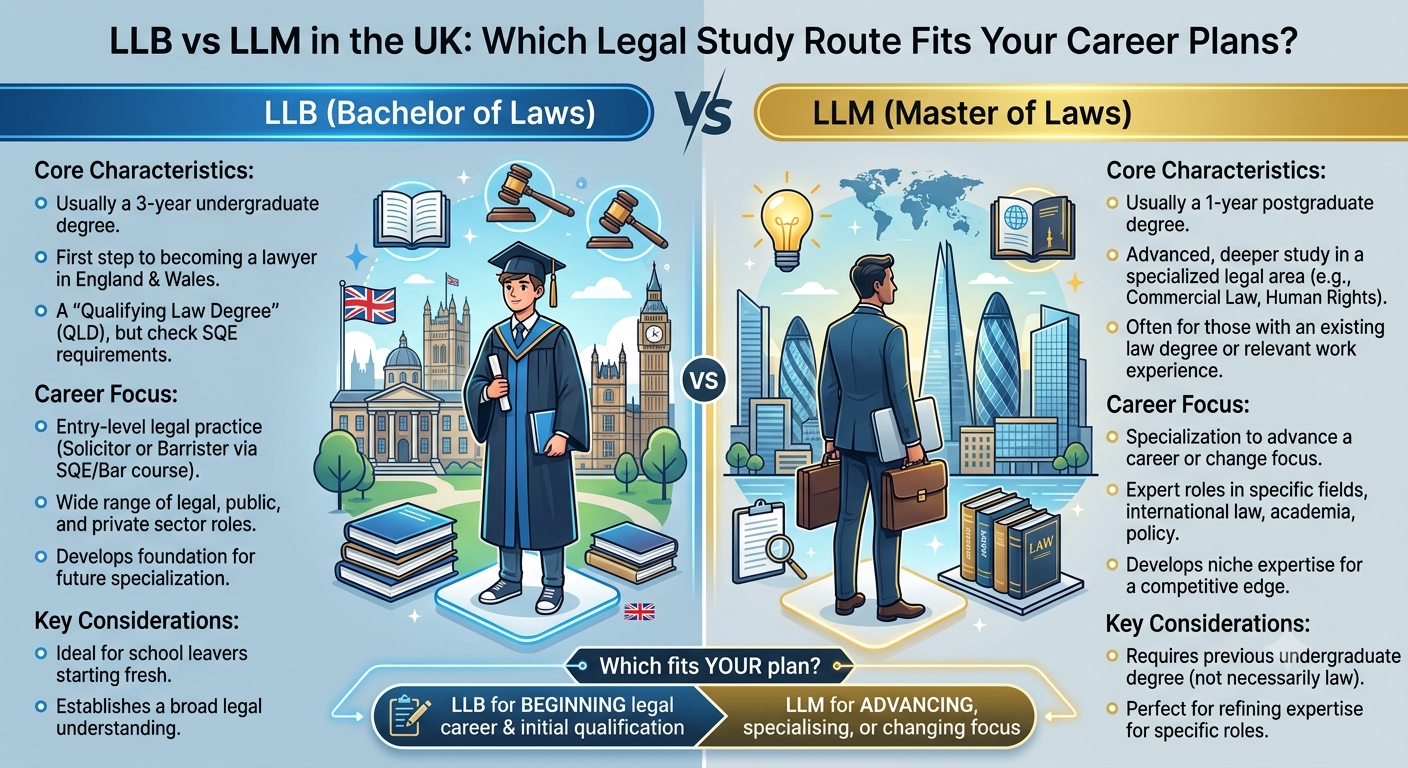
If you study LLB in the UK, you are engaging in a qualifying law degree. This is the primary academic stage of legal education. It’s designed to give you a comprehensive, panoramic view of the English legal system. You will cover the foundational 'black-letter' law subjects: Contract, Tort, Public Law, Criminal Law, Land Law, and Equity and Trusts, among others. It is a generalist, broad-spectrum course that teaches you to 'think like a lawyer' from the ground up.
Conversely, if you choose to study LLM in the UK, you are entering a world of high-level specialisation. The Master of Laws is a postgraduate degree that assumes you already possess a solid foundation in legal principles. It allows you to delve deep into a specific niche—be it International Human Rights Law, Corporate Governance, Intellectual Property, or Maritime Law. You are not starting from scratch; you are building a skyscraper on a pre-existing legal foundation.
The Academic vs. Professional Divide
For many international students, there is a crucial misunderstanding here. The LLB is a heavily academic degree, yes, but in the UK it serves a direct, functional purpose. It is the first necessary step towards qualifying as a solicitor or barrister in England and Wales.
If you are an international student with an existing degree in law from your home country, the LLM is not a route to UK qualification on its own. It does not replace the need to complete the Solicitors Qualifying Examination (SQE) or the Bar Practice Course (BPC). The LLM will give you a world-class academic credential that can significantly enhance your employability or deepen your expertise in a specific area, but it will not give you a license to practise.
The LLB, however, is the approved gateway. It is the academic component that allows you to proceed to the vocational stages of legal training. Without it, or without a recognised conversion course like the Graduate Diploma in Law (GDL), you cannot progress to becoming a practising lawyer in the UK.
A Question of Timing and Career Stage
The decision hinges almost entirely on your current career stage. Are you a school leaver stepping into the world of higher education, or are you a graduate looking to pivot or specialise?
For the school leaver or the transfer student who wants to practise law in the UK, the decision is largely predetermined. You will study LLB in the UK. This is your starting line. You choose this route to build your career from its most foundational point.
The LLM is a later-stage degree. It is for the graduate who wants to sharpen their focus. Perhaps you are a practising lawyer from another jurisdiction looking to gain a foothold in the UK legal market and need a credential that showcases specialised knowledge. Perhaps you are a law graduate who discovered a passion for environmental law during your undergraduate studies and wants to become an authority in that niche before entering the job market. The LLM is a tool for advancement, not a tool for entry.
What You Should Consider for International Students
If you are an international student, the considerations become more pointed. The "LLB vs LLM" question is heavily influenced by your long-term residency and career intentions.
If your goal is to qualify and practise as a solicitor or barrister in the UK, the path is narrow. You must complete a qualifying law degree (LLB or GDL) and then pass the SQE assessments. An LLM, while beneficial for your CV, will not satisfy these core regulatory requirements.
If your goal is to return to your home country and practise, or to work in an international organisation or an in-house counsel role for a multinational corporation, the LLM can be an incredibly powerful tool. It gives you an edge. It tells an employer in Dubai, Singapore, or New York that you have not only been trained in the UK’s rigorous legal tradition but that you possess advanced, specialised knowledge that is immediately applicable to their complex cross-border issues.
The Trajectory of Your Career
Ultimately, one is not 'better' than the other. They are designed for different purposes at different times.
Choosing the LLB means you are committing to a longer journey. You are going broad, learning the entire landscape of the law, and then you will specialise later through your training contracts or elective modules in your final year.
Choosing the LLM means you have already finished the broad journey. You are going deep. You are aiming to be the go-to person in your specific field. It assumes you are ready for the intensity of postgraduate study where the workload is heavy, the reading is dense, and the expectation is that you already know the fundamental principles.
So, as you look at your options, ask yourself not which is more prestigious, but which is more practical. Where are you on your journey? Do you need to build the house, or are you ready to furnish the penthouse? The answer to that question will tell you exactly which route to take.

 Arabic
 French
 Spanish
 Portuguese
 Deutsch
 Turkish
 Dutch
 Italiano
 Russian
 Romaian
 Portuguese (Brazil)
 Greek
