


How to Write an Abstract for a Research Paper - Format, Examples & Expert Tips
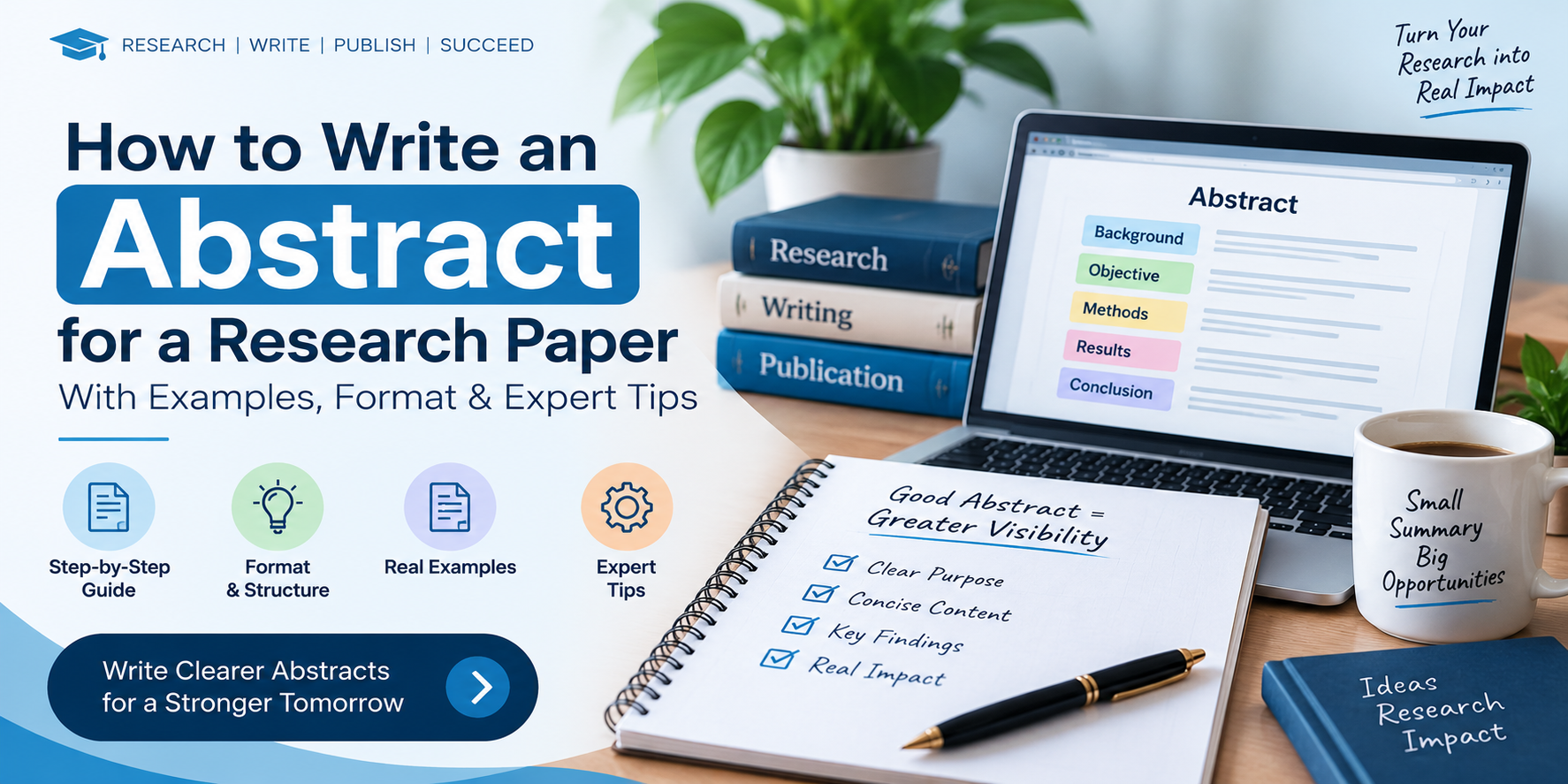
If you're wondering how to write an abstract for a research paper, start by thinking of it as a self-contained miniature version of your study. A strong abstract tells readers what problem you investigated, what you did, what you found, and why the findings matter—without requiring them to read the full paper first.
For many empirical research papers, a practical structure is:
Background/problem → Objective → Methods → Results → Conclusion
However, there's no universal abstract format or word limit for every journal and discipline. Some journals require a single unstructured paragraph, while others require labeled sections such as Background, Methods, Results, and Conclusions. Your target journal's Instructions for Authors should always take priority.
The safest time to write your research paper abstract is after the main manuscript is complete. This allows you to summarize the research you actually conducted rather than what you initially planned to do.
In this guide, you'll learn the essential abstract format for research paper writing, how to structure each section, what to leave out, how structured and unstructured abstracts differ, and how to improve your abstract using practical examples and a final submission checklist.
What Is an Abstract in a Research Paper?
A research paper abstract is a brief, self-contained summary of the essential content of an academic paper.
It allows someone to understand the study's basic purpose, approach, major findings, and conclusion without first reading the complete manuscript.
Depending on the type of paper, an abstract may communicate:
-
the research problem or context;
-
the objective or research question;
-
the methodology or analytical approach;
-
the most important findings;
-
the main conclusion; and
-
the significance or implications of the findings.
Not every discipline uses exactly the same structure.
An empirical scientific paper may devote substantial space to methods and results. A theoretical or humanities paper may instead emphasize the central question, argument, approach, and conclusion.
That's why the abstract structure should reflect both your paper type and the requirements of your target journal.
Why Is the Abstract Important?
The abstract performs several jobs simultaneously.
First, it helps readers decide whether the full paper is relevant to their research question.
Second, abstracts are commonly displayed and indexed by scholarly databases and discovery systems, making them an important source of searchable information about the article.
Third, editors and reviewers can use the abstract to quickly understand what the manuscript claims to contribute.
But avoid thinking of an abstract as an advertisement.
Its purpose isn't to "sell" weak research through persuasive language. Its job is to represent the study accurately, concisely, and clearly.
A useful abstract therefore prioritizes information over hype.
Instead of:
"Our groundbreaking research provides revolutionary new insights..."
Write:
"The intervention reduced [outcome] from X to Y during the 12-week study period."
Specific evidence is more informative than promotional adjectives.
What Should a Research Paper Abstract Include?
For many empirical papers, five elements provide a useful starting framework.
| Component | Question it answers | Typical content |
|---|---|---|
| Background | Why was the research needed? | Context or research problem |
| Objective | What did you investigate? | Aim, question or hypothesis |
| Methods | What did you do? | Design, participants/data, main methods |
| Results | What did you find? | Principal findings |
| Conclusion | What do the findings mean? | Interpretation or implications |
The amount of space devoted to each component depends on the study and journal.
1. Background or Research Problem
Give readers only enough context to understand why the study was conducted.
For example:
"Urban heat exposure is increasing in rapidly developing cities, but neighborhood-level differences in heat vulnerability remain poorly characterized."
This sentence establishes both the topic and the gap.
You don't need a miniature literature review.
2. Research Objective
State exactly what the research aimed to determine.
For example:
"This study examined whether neighborhood vegetation coverage was associated with daytime surface temperature across high-density urban districts."
The reader now knows what question the study addressed.
3. Methods
Mention the methodological details necessary to interpret the findings.
Depending on the study, these may include:
-
research design;
-
study population;
-
sample;
-
dataset;
-
intervention or exposure;
-
primary measurements; and
-
main analytical approach.
Don't reproduce your complete methodology section.
Include only information needed to understand how the results were obtained.
4. Results
This is where many abstracts become too vague.
Avoid:
"Significant differences were found between the groups."
When the journal's format and study design allow it, provide the most informative results, including appropriate quantitative information.
For example:
"Mean response time was 18% lower in the intervention group than in the comparison group."
Any number you include must come from the actual study.
Never invent a more impressive result for the abstract.
5. Conclusion and Implications
Finish by answering the reader's "so what?" question.
What does the result reasonably mean?
Keep the conclusion proportional to your evidence.
If your observational study identifies an association, don't rewrite it as proof of causation.
Similarly, don't generalize results from a narrow sample to an entire population without justification.
How to Write an Abstract for a Research Paper Step by Step
Once the manuscript is complete, you can build the abstract systematically rather than trying to summarize thousands of words from memory.
Step 1: Check the Journal Requirements First
Before writing, verify:
-
maximum word count;
-
structured or unstructured format;
-
required headings;
-
keywords requirements;
-
abbreviation rules;
-
trial or review reporting requirements; and
-
any study-type-specific instructions.
This can save substantial rewriting later.
Step 2: Extract One Key Point From Each Main Section
Open your completed manuscript and identify:
Introduction: What exact problem or gap motivated the study?
Methods: What did you actually do?
Results: What are the findings readers most need to know?
Discussion/Conclusion: What is the justified interpretation?
Put those points into a rough draft before worrying about elegance.
Step 3: Establish the Problem Quickly
Don't spend half the abstract explaining general background.
Your reader needs enough context to understand the problem, but the research itself should remain central.
Compare:
Weak:
"Technology has changed dramatically over the last several decades and continues to influence many areas of modern society."
Better:
"Although automated feedback is increasingly used in postgraduate writing instruction, its relationship with students' revision behavior remains unclear."
The second version gets to the research problem much faster.
Step 4: State the Objective Clearly
Use a direct sentence.
"This study examined..."
"We evaluated..."
"This systematic review assessed..."
"This analysis investigated..."
There's nothing inherently wrong with starting an objective sentence with "This study." Clarity matters more than following arbitrary rules that ban particular openings.
Step 5: Condense the Methods
Include enough methodological information for readers to understand the evidence.
For an empirical study, you might identify:
design + population/sample + primary measurement/intervention + analysis
For example:
"We conducted a cross-sectional survey of 412 postgraduate students and used multivariable regression to examine associations between feedback frequency and reported revision behavior."
Notice what's missing: recruitment logistics, every survey item, software settings, secondary variables, and procedural details.
Those belong in the Methods section.
Step 6: Report the Main Results
Don't make readers guess what happened.
Prioritize findings that directly answer the stated objective.
Where appropriate, report meaningful quantitative estimates rather than filling the results section with phrases such as:
-
"interesting results were observed";
-
"there was an improvement";
-
"several relationships were found"; or
-
"the hypothesis was supported."
Precision improves information value.
Step 7: End With a Defensible Conclusion
Your final sentence should follow logically from the results.
Avoid turning:
"X was associated with Y"
into:
"X causes Y."
Avoid turning:
"Participants at one university..."
into:
"All university students..."
Good abstract writing involves restraint as well as clarity.
Step 8: Remove Everything Nonessential
Now edit aggressively.
Look for:
-
repeated background;
-
introductory filler;
-
methodological details readers don't need;
-
duplicated results;
-
undefined abbreviations;
-
unnecessary adjectives;
-
vague claims;
-
information absent from the main paper; and
-
conclusions stronger than your evidence supports.
Every sentence should earn its place.
Structured vs. Unstructured Abstract Format for Research Paper
One of the first formatting decisions is whether your journal requires a structured or unstructured abstract.
Structured Abstract
A structured abstract divides information under labeled headings.
For example:
Background: [Research context]
Objective: [Study aim]
Methods: [Design and analysis]
Results: [Principal findings]
Conclusion: [Interpretation]
The actual headings vary by journal.
Some may use Objective, Design, Setting, Participants, Main Outcome Measures, Results, and Conclusions. Others use a simpler Background–Methods–Results–Conclusions structure.
Never invent your own headings when the journal provides specific ones.
Unstructured Abstract
An unstructured abstract communicates similar information in one continuous paragraph without visible section headings.
For example:
"Automated feedback tools are increasingly used in postgraduate education, yet their relationship with revision behavior remains unclear. This study examined... [methods]. Results showed... [findings]. These findings suggest... [conclusion]."
Unstructured doesn't mean unorganized.
The underlying logic should still be easy to follow.
How Long Should an Abstract Be?
There is no universal word count that applies to every research paper.
Many academic writing guides describe abstracts in roughly the 150–250-word range, but actual journal limits vary. The journal's own author instructions are the authoritative source for your submission.
Don't assume:
"Medical abstract = X words"
or:
"Scopus journal = Y words."
Scopus is an indexing and abstracting database; being indexed in Scopus doesn't impose one universal abstract format or word count across journals.
The same principle applies to publisher-wide assumptions.
Requirements can differ among journals belonging to the same publisher.
If the journal says 200 words, write no more than 200.
If it provides required headings, use those headings.
Abstract Example for Research Paper: Empirical Study
The following is a fictional example created only to demonstrate structure. The data aren't presented as findings from a real study.
Example
Background: Feedback timing may influence how postgraduate students revise academic writing, but evidence concerning rapid digital feedback remains limited.
Objective: This hypothetical study examined whether receiving digital feedback within 24 hours was associated with greater revision activity among postgraduate students.
Methods: A fictional cohort of 180 students was divided according to whether feedback was received within 24 hours or after 72 hours. Revision activity was measured using document-version histories across three assignments.
Results: In this illustrative dataset, students in the faster-feedback group completed a median of 6 substantive revisions per assignment compared with 4 in the delayed-feedback group. No meaningful difference was observed in total assignment completion rates.
Conclusion: These fictional results illustrate how an abstract can report the principal outcome precisely without reproducing the entire Results section.
Why This Example Works
It identifies:
problem → objective → design → principal result → interpretation
More importantly, it clearly labels the scenario as hypothetical instead of inventing research findings and presenting them as real evidence.
Abstract Example for Research Paper: Systematic Review
A systematic-review abstract needs somewhat different information.
Fictional Example
Background: Digital interventions are increasingly used to support academic writing, but evidence concerning their effectiveness is dispersed across multiple study designs.
Objective: This hypothetical systematic review evaluated reported effects of digital feedback interventions on university students' academic writing outcomes.
Methods: For illustration, assume researchers searched four bibliographic databases using predefined eligibility criteria and synthesized 28 eligible studies narratively.
Results: In this fictional example, 19 studies reported improvement in at least one writing-related outcome, while substantial differences in interventions and outcome measures limited direct comparison across studies.
Conclusion: The example illustrates how a systematic-review abstract should report the evidence base and limitations rather than simply claiming that an intervention "works."
For an actual systematic review, authors should follow the target journal's requirements and any applicable reporting guidance.
Do Different Study Designs Need Different Abstracts?
Yes.
This is an important point that generic abstract writing tips often miss.
Randomized Trials
Randomized controlled trials may be subject to specialized reporting requirements.
CONSORT for Abstracts provides reporting guidance specifically for randomized trials in journal and conference abstracts.
Depending on applicable requirements, authors may need to report information such as trial design, participants, interventions, primary outcomes, numbers randomized and analyzed, harms, trial registration, and funding.
Systematic Reviews and Meta-Analyses
PRISMA 2020 includes an extension/checklist for abstracts of systematic reviews.
A systematic-review abstract therefore shouldn't simply follow a generic five-sentence template if applicable reporting guidance or the journal requires additional information.
Qualitative Research
A qualitative abstract may need to emphasize:
-
research question;
-
context;
-
participants or data sources;
-
qualitative methodology;
-
analytical approach;
-
principal themes or interpretations; and
-
contribution.
Trying to force qualitative research into a clinical-trial abstract template can make the summary less informative.
Theoretical or Conceptual Papers
These may have no participant sample or empirical Results section.
Instead, the abstract can communicate:
problem → purpose → conceptual/theoretical approach → central argument → contribution
The abstract should reflect the paper that actually exists.
Abstract vs. Introduction: What's the Difference?
An abstract isn't a shortened introduction.
| Research paper abstract | Introduction |
|---|---|
| Summarizes the whole paper | Introduces the research problem |
| Can state final results | Builds toward the research question |
| Includes brief methodology where relevant | Provides deeper background/context |
| Includes conclusion | Usually doesn't reveal the entire discussion |
| Designed to stand alone | Leads into the rest of the manuscript |
If someone reads only your abstract, they should still understand the study's basic question, approach, principal result, and conclusion.
The introduction doesn't need to accomplish that independently.
Should an Abstract Include Keywords?
Separate article keywords are often placed near or below the abstract, depending on the journal's format.
However, don't assume every journal requires the same number.
Check the Instructions for Authors.
When selecting research paper keywords, prioritize terms that accurately describe your:
-
core topic;
-
population;
-
phenomenon;
-
methodology, where useful;
-
intervention or exposure; and
-
specialized subject area.
Avoid choosing generic words simply because they occur frequently.
For example, "research," "analysis," and "results" tell a database or reader almost nothing about your actual subject.
The abstract itself should also naturally contain terminology researchers use to describe your topic. Don't repeat keywords artificially just to increase frequency.
Should You Include Citations in an Abstract?
Usually, avoid them unless the journal or document type specifically allows or requires them.
An abstract should generally make sense without forcing the reader to retrieve another source.
Instead of:
"Previous research [12] demonstrates..."
state the relevant context concisely if it is necessary.
There can be discipline- or journal-specific exceptions, which is another reason the journal's instructions take priority over blanket rules.
Similarly, avoid:
-
footnotes;
-
tables;
-
figures;
-
lengthy equations;
-
unnecessary abbreviations; and
-
references to sections such as "see Figure 2 below."
The abstract should function independently.
What Tense Should You Use in a Research Paper Abstract?
There's no single tense that must be applied to every sentence.
Tense depends partly on what the sentence communicates and on disciplinary conventions.
A practical pattern for completed empirical research is:
| Purpose | Common choice | Example |
|---|---|---|
| Established context | Present | "Remote work remains common..." |
| Study purpose | Past or present, depending on convention | "This study examined..." |
| Methods | Past | "Data were collected..." |
| Results | Past | "The analysis showed..." |
| Interpretation | Present/cautious present | "These findings suggest..." |
Don't change a clear sentence merely to obey a mechanical tense formula.
Consistency and disciplinary convention matter more.
10 Common Abstract Writing Mistakes
A strong academic abstract is often improved more by removing problems than adding sophisticated vocabulary.
-
Writing too much background.
Get to the research problem quickly. -
Failing to report the actual result.
"Results are discussed" tells readers nothing. -
Copying entire sentences from different manuscript sections.
This can create a disjointed paragraph rather than a coherent summary. -
Adding findings that aren't in the paper.
Every claim must accurately represent the manuscript. -
Overclaiming causality or generalizability.
Match the conclusion to the design and evidence. -
Ignoring the journal's word limit.
Journal-specific requirements override generic advice. -
Using undefined abbreviations and excessive jargon.
Remember that the abstract must stand alone. -
Making unsupported claims of novelty.
Words such as "first," "groundbreaking," and "unprecedented" require evidence. -
Using vague results.
Give the reader the most informative finding the format permits. -
Forcing one template onto every study design.
Systematic reviews, randomized trials, qualitative studies, and theoretical papers may require different information.
A Practical Research Abstract Template
For a completed empirical study, use this framework as a drafting aid:
Background:
[One sentence explaining the specific problem or gap.]
Objective:
[One sentence stating exactly what you investigated.]
Methods:
[One or two sentences identifying design, population/data and essential analytical method.]
Results:
[One to three sentences reporting the findings that directly answer your objective.]
Conclusion:
[One sentence explaining the justified meaning or implication.]
Then remove the labels if your journal requires an unstructured paragraph.
For a non-empirical paper, modify the framework rather than inventing methods or results that don't exist.
Research Abstract Checklist Before Submission
Before uploading your manuscript, ask:
-
Does the abstract match the final manuscript?
-
Does it follow the target journal's required format?
-
Is it within the exact word limit?
-
Is the research problem clear?
-
Is the objective explicit?
-
Are the essential methods included?
-
Are the principal findings actually reported?
-
Does the conclusion follow from the results?
-
Have I avoided unsupported causal claims?
-
Are all numbers consistent with the Results section?
-
Have I removed information absent from the manuscript?
-
Are abbreviations minimized and defined where necessary?
-
Have I avoided unnecessary citations?
-
Are study-specific reporting guidelines addressed where applicable?
-
Are separate keywords formatted according to journal instructions?
-
Can the abstract make sense without the rest of the paper?
If you answer "no" to any essential question, revise before submission.
Can AI Help You Write a Research Abstract?
AI tools can assist with compression, grammar, restructuring, and identifying unclear sentences, but they shouldn't be trusted to determine your scientific findings.
The biggest risk isn't awkward prose.
It's factual distortion.
An AI system can accidentally:
-
change a sample size;
-
alter an effect estimate;
-
invent a statistical result;
-
strengthen an association into causation;
-
add a conclusion unsupported by the paper; or
-
describe a method you didn't use.
If you use AI-assisted writing, verify every sentence against the completed manuscript and follow the target journal's current policies regarding AI use and disclosure.
Your abstract must describe your actual research.
Final Takeaway
Learning how to write an abstract for a research paper is mainly an exercise in accurate compression.
Start with the journal requirements. Then summarize the problem, objective, essential methods, principal findings, and justified conclusion. For empirical research, that five-part framework works well as a starting point, but it shouldn't override discipline-specific or study-specific reporting standards.
Write the abstract after completing the manuscript whenever possible, report results rather than promising them, avoid unsupported claims, and make sure every number agrees with your paper.
Most importantly, don't treat "150–250 words" or one particular structure as a universal rule. The correct abstract format for research paper submission is the format required by your target journal.
If you're preparing your manuscript for publication, Scopus Journal Publications can support the next stages through its [journal publication services]. Researchers who need guidance earlier in the research process can also explore [research consultancy services].
Frequently Asked Questions
1. How do you write an abstract for a research paper?
For most completed empirical papers, summarize the research problem, objective, essential methods, principal results, and conclusion. Write concisely and follow the exact word count and structure specified by your target journal.
2. How long should a research paper abstract be?
Many academic writing resources use approximately 150–250 words as a general benchmark, but there is no universal limit. Your target journal's Instructions for Authors should determine the final length.
3. What are the five main parts of an abstract?
A useful framework for empirical research is background, objective, methods, results, and conclusion. Other paper types may require a different structure.
4. Should I write the abstract before or after the research paper?
For a completed journal manuscript, writing it after the main paper is usually most effective because you already know the final methods, results, and conclusion. Conference proposals can be different because an abstract may be requested before the complete paper exists.
5. Can an abstract have citations?
Usually, references should be avoided so the abstract remains self-contained. However, requirements can vary, so follow the journal's instructions rather than treating this as an absolute prohibition.
6. What is the difference between structured and unstructured abstracts?
A structured abstract separates information under headings such as Background, Methods, Results, and Conclusions. An unstructured abstract presents the information as a continuous paragraph.
7. Do I need to include statistical results in my abstract?
Include the most informative quantitative findings when they are relevant to your research question, study design, and journal requirements. Don't overload the abstract with every statistical test.
8. Can I use abbreviations in an abstract?
Use them sparingly. If an abbreviation is necessary, define it unless the journal permits a universally recognized abbreviation without definition.
9. Should a systematic review abstract use the same format as a normal research paper?
Not necessarily. Systematic reviews may need to follow PRISMA 2020 for Abstracts or other applicable journal/reporting requirements. The abstract may need information about eligibility criteria, information sources, synthesis, included studies, results, limitations, and registration.
10. What makes a good research abstract?
A good abstract is accurate, concise, self-contained, specific, and faithful to the manuscript. It tells readers what was investigated, how it was studied, what was found, and what the evidence reasonably means.

 Arabic
 French
 Spanish
 Portuguese
 Deutsch
 Turkish
 Dutch
 Italiano
 Russian
 Romaian
 Portuguese (Brazil)
 Greek
