


How to Choose the Right Stock Market Data API for Your Project
Building a financial website, mobile application, dashboard, or market research tool often requires access to reliable financial information. Stock prices, historical data, trading volume, market trends, and other financial details can help an application provide useful information to its users. However, collecting all this information manually can be difficult and time-consuming.
This is where a stock market data API can help. An API allows an application to connect with an external financial data provider and request the information it needs. Instead of building a complete market data system from the beginning, developers can use an existing API to bring financial information into their projects.
There are many financial APIs available, and they do not all offer the same features. Some provide free access, while others focus on advanced or professional data services. Choosing the right option depends on the type of project, required data, expected traffic, and development needs.
A Free Stock Data API can be a good starting point for beginners and small projects. However, it is important to understand what you are getting before selecting an API. This guide explains the main factors to consider when choosing a stock market data API.
Understand Your Project Requirements
Define the Purpose of Your Application
The first step is to understand why you need financial data. Different projects require different types of information.
For example, a simple stock tracking website may only need current stock prices and percentage changes. A market research application may need historical prices, trading volume, and additional financial information. A larger financial platform may require broader market coverage and more frequent updates.
Clearly defining the purpose of your application can help you choose an API that matches your needs.
Identify the Data You Need
Before selecting a stock market data API, make a list of the information your project requires.
You may need stock prices, historical data, trading volume, company information, market statistics, or other financial indicators. Some APIs offer many types of data, while others focus on specific categories.
Choosing an API based on actual requirements can help you avoid paying for features you do not need.
Check the API's Market Coverage
Stock Exchanges and Regions
Not every API covers the same stock exchanges. Some services may focus on specific countries or markets, while others provide international coverage.
If your application is designed for users interested in global markets, check whether the API supports the exchanges and regions you need.
Market coverage is especially important when developing applications that track stocks from multiple countries.
Other Financial Markets
Some projects may eventually need information beyond stocks. For example, a financial dashboard might include cryptocurrencies, forex, commodities, ETFs, and indices.
Choosing a provider with broader financial market coverage can be useful if you plan to expand your project later.
Compare Free and Paid API Options
When a Free Stock Data API Makes Sense
A Free Stock Data API can be useful for beginners, students, developers, and small projects. It allows developers to experiment with financial data without making a large initial investment.
For example, a developer can use a free API to build a prototype, test API requests, create a simple stock dashboard, or learn how financial data integration works.
Free access can be an effective starting point when the project has limited data requirements.
Understand Free Plan Limitations
Free does not always mean unlimited. Many free APIs have restrictions on the number of requests, available endpoints, historical data, or supported markets.
Before choosing a free service, carefully review its limitations. A project that starts small may eventually need more API requests as its number of users increases.
Understanding these restrictions early can help you avoid technical problems later.
Evaluate Data Quality and Reliability
Check Data Accuracy
Financial applications depend on accurate information. If prices or other market information are incorrect, users may lose trust in the application.
When choosing a stock market data API, developers should research the provider and understand the quality of its data.
It is also useful to test the API before building the entire application around it.
Understand Data Updates
Stock prices can change quickly, so developers should understand how frequently the API updates its information.
Some APIs offer real-time data, while others provide delayed or periodically updated information. The right option depends on the purpose of your application.
For a basic educational website, delayed data may be sufficient. A platform focused on active market monitoring may require faster updates.
Look at API Documentation
Clear Documentation Saves Time
Good documentation is one of the most important features of an API. Developers need to understand how to connect to the service and request the required information.
Documentation should explain available endpoints, request parameters, authentication methods, response formats, error messages, and usage limits.
Clear examples can be especially helpful for beginners.
Developer-Friendly Integration
A good stock market data API should not make integration unnecessarily complicated. Developers should be able to understand how requests work and how the returned information can be used.
Simple integration can reduce development time and make it easier to maintain the application in the future.
Consider API Request Limits
Understand Request Volume
APIs usually have limits on how many requests an application can make. Free plans generally have lower limits than paid plans.
For example, a small development project may make only a few requests, while a popular financial dashboard could generate thousands of requests.
Developers should estimate expected usage before choosing an API.
Plan for Future Growth
It is also important to think about future traffic. Your application may start with a small number of users and grow over time.
If the API has a clear upgrade path, it may be easier to continue using the same provider as your project becomes larger.
Check Historical Data Availability
Why Historical Data Matters
Historical data is useful for many financial applications. It allows users to examine previous price movements and study market behavior.
Developers can use historical data to create charts, comparisons, reports, and research tools.
Not every stock market data API provides the same amount of historical information, so this should be checked before making a decision.
Consider the Required Time Period
Some projects may only need a few months of historical data, while others may require several years.
Think about how far back your application needs to go and check whether the API provides the required information.
Consider Data Formats and Technical Compatibility
Common Data Formats
APIs generally return data in structured formats that applications can process. Developers should make sure the API's response format works well with their programming language and technology stack.
A compatible data format can make integration simpler.
Compatibility With Your Technology
Before choosing an API, consider what your project is built with. Whether you are using JavaScript, Python, PHP, mobile development tools, or another technology, the API should be easy to connect with your application.
Many providers offer code examples that demonstrate how their APIs can be used with popular programming languages.
Think About Security
Protect API Credentials
Many APIs require an API key for authentication. Developers should avoid exposing private API credentials directly in public code or client-side applications when the provider's security model requires the key to remain private.
Using secure server-side methods can help protect API credentials.
Follow Provider Requirements
Developers should also follow the API provider's security and usage guidelines. This can help protect the application and reduce the risk of unauthorized API usage.
Security should be considered from the beginning rather than added only after a project is launched.
Consider Pricing and Scalability
Compare Pricing Plans
Even when starting with a Free Stock Data API, it is useful to look at the provider's paid plans.
You may eventually need higher request limits, more historical data, broader market coverage, or additional features. Understanding pricing in advance can help with future planning.
Choose an API That Can Grow With Your Project
A good API should match your current requirements while also providing options for future development.
If your project grows, switching to a completely different data provider can require additional development work. A scalable provider can make this transition easier.
How FCS API Can Support Your Project
Broad Financial Market Coverage
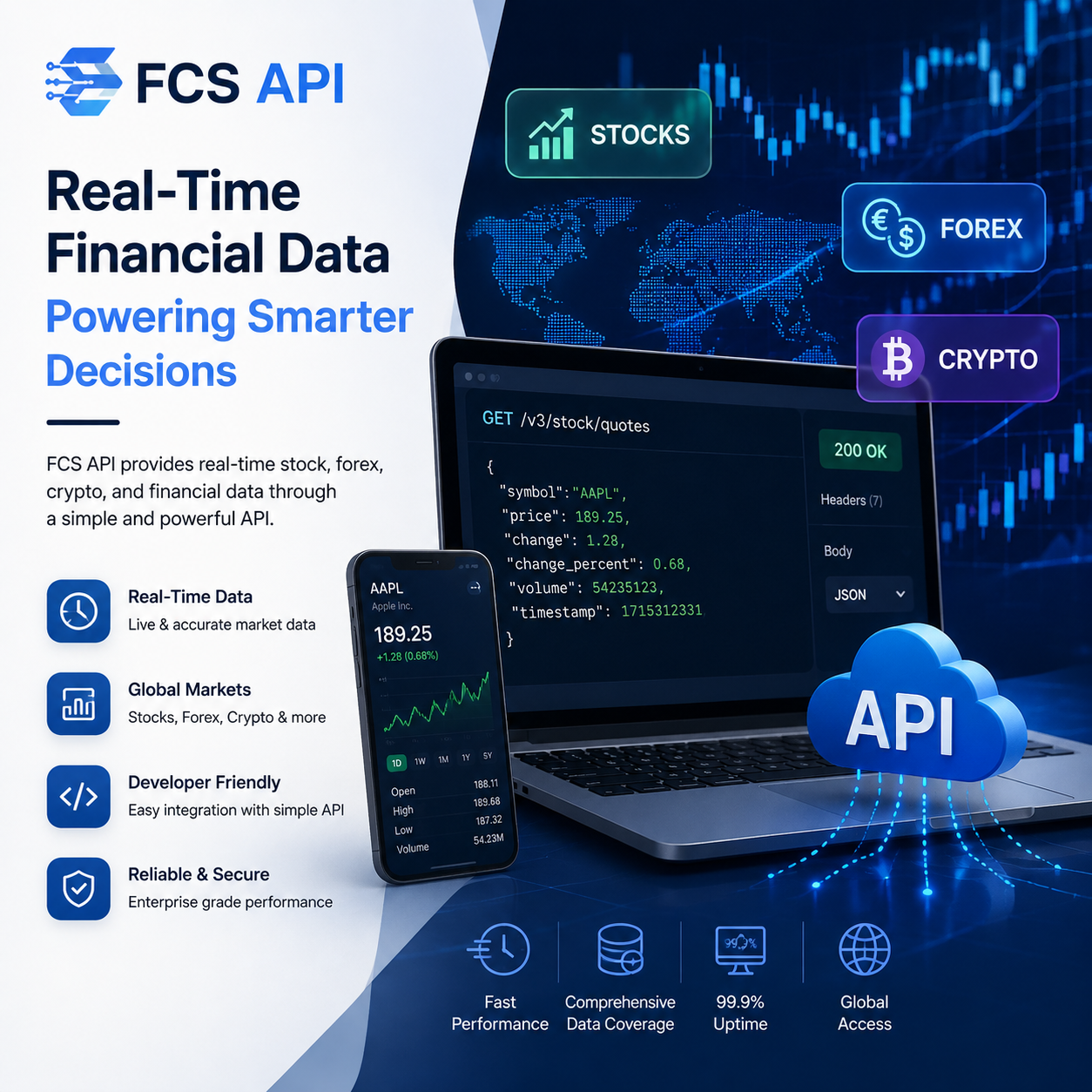
FCS API is a financial information platform that provides financial API data for global financial markets. It covers cryptocurrencies, stocks, forex, commodities, ETFs, and indices.
This broad coverage can be useful for developers who want to build applications that track more than just stocks.
Market Data and Charts
FCS API provides financial market information that can support different types of applications. Developers can use available data to create tools for tracking prices, studying trends, and displaying financial information.
The platform also offers charts that can help users understand market movements visually.
News, Economic Updates, and Educational Content
Market research often requires more than price information. Financial news and economic developments can provide additional context when users are studying markets.
FCS API also offers economic updates, news, and educational content to support users who want to learn more about financial markets and market trends.
Common Mistakes When Choosing an API
Choosing Only Based on Price
Price is important, but it should not be the only factor. An inexpensive or free API may not provide the data coverage, update frequency, or request limits required by your project.
Always compare features with your actual requirements.
Ignoring Documentation
Poor documentation can make an otherwise useful API difficult to integrate. Developers should review the documentation before making a final decision.
Not Testing the API
It is a good idea to test an API before building a major application around it. A test can help you understand response times, available data, request limits, and integration requirements.
Forgetting Future Requirements
Your application may grow or change over time. Consider future needs when selecting a stock market data API instead of focusing only on today's requirements.
A Simple Checklist for Choosing a Stock Market Data API
Check These Points Before You Start
Before choosing an API, ask yourself a few simple questions. Does it provide the financial data your project needs? Does it cover the markets and regions you want? Is the data real-time, delayed, or historical? How many requests are available? Is the documentation clear? Can the service scale as your application grows?
Answering these questions can make the selection process much easier.
Conclusion
Choosing the right stock market data API is an important decision when building a financial application. The right API can make it easier to access market information, create useful features, and reduce development effort.
A Free Stock Data API can be a practical option for beginners, students, developers, and small projects that want to test an idea without a large initial cost. However, free services can have limitations, so developers should carefully check data coverage, accuracy, update frequency, historical information, API limits, documentation, security, and pricing.
FCS API provides financial market information across stocks, cryptocurrencies, forex, commodities, ETFs, and indices. Its platform also includes charts, news, economic updates, and educational resources.
By clearly understanding your project's requirements and comparing the available options, you can choose a financial API that supports your current needs while giving your application room to grow.

 English
 Arabic
 French
 Portuguese
 Deutsch
 Turkish
 Dutch
 Italiano
 Russian
 Romaian
 Portuguese (Brazil)
 Greek
