


Data Protection Trends in Healthcare Cybersecurity
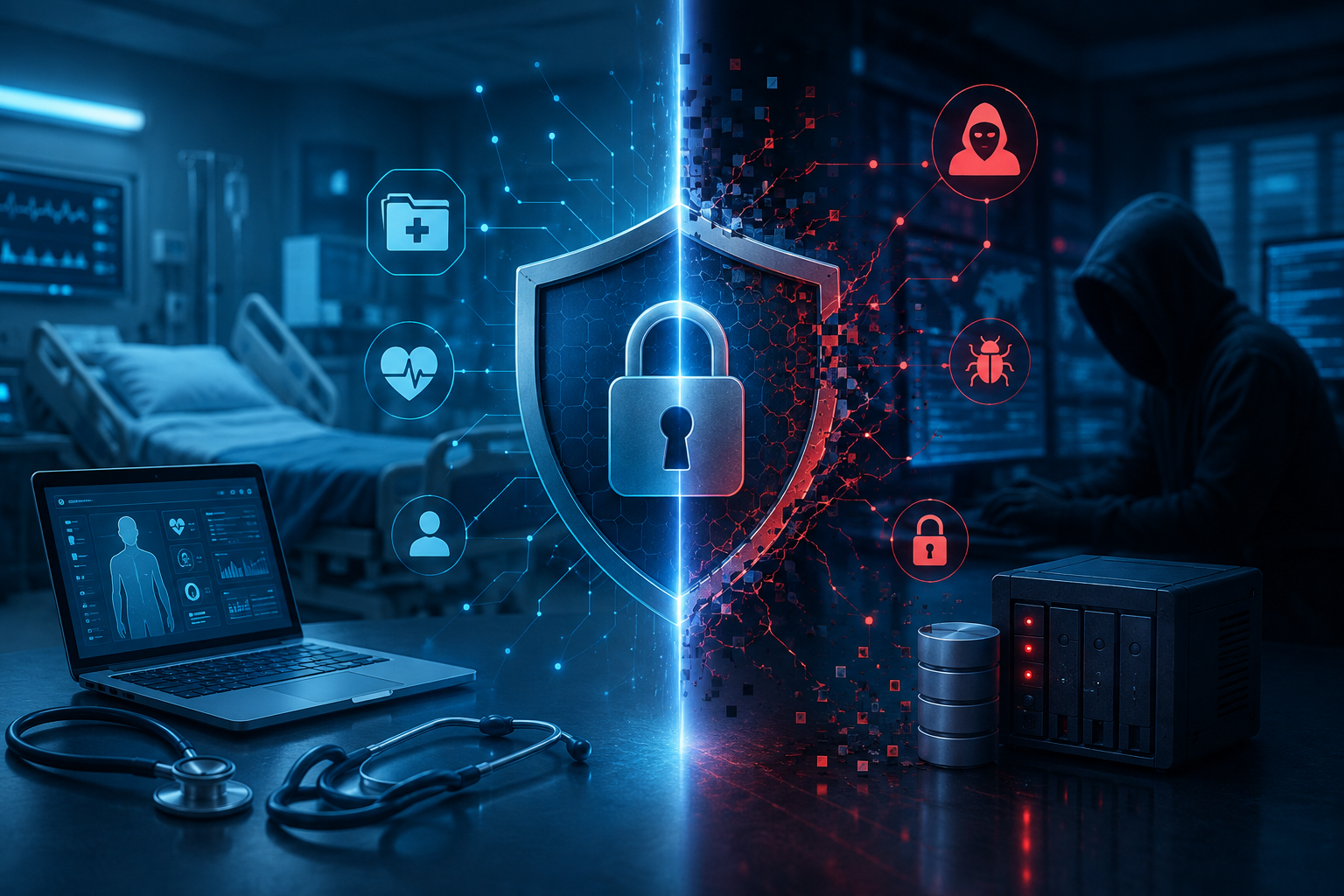
In the quiet after work hours, a healthcare organization can be at its most vulnerable. As a cardiology or pediatrics practice, you are always worried about your sensitive patient data getting leaked. Your concerns are not baseless when you know that the market is full of data predators, waiting for the right chance to leap and destroy your reputation. You are scared for their trust contained in a digital record.
Patients come to your hospital and share their deepest health secrets, genetic information, struggles, and histories. All they expect from you is great care of their health and confidence in your organization. However, in recent times, providing great healthcare has taken on a whole new meaning. As the trends in healthcare cybersecurity continue to change, the industry is learning that a data breach is more than just an external threat. It is not merely a nuisance for the IT department; it transforms into a medical data emergency. A surgeon unable to access a digital record cannot proceed with the surgery. A pharmacy unable to access a record cannot administer a life-saving dose of medication. This is why patient data protection services have now become a core part of healthcare organizations, helping safeguard sensitive information while supporting secure and reliable patient care. .
Cloud Data Protection Reshaping the Healthcare Industry
The healthcare industry was previously known to maintain an infrastructure that was held responsible for the optimum human health. But the advanced technology in the last decade has evolved this into an intricate system that requires continuous attention. Healthcare IT security trends now serve as a vital point in strategizing the operational planning for a practice.
1. Patient Data Security at the Operational Core
The mainstream healthcare industry used to operate without much focus on patient data security. But now, that’s all changed. The trends in healthcare IT security indicate that cyber safety is now the vial that holds patient security within.
The digitalized patient data security is no longer a secret ideology. It is now a concern at the board level. The reason is that one ransomware attack can bring an entire health system to a standstill for weeks. Administrators now understand that security is a matter of business continuity and the practice liability. They are now spending budgets on improved cybersecurity protocols, officers, and infrastructures. It is not just to safeguard patient data sets, but to keep the hospital doors open and the healthcare services rolling, uninterrupted.
2. The Zero Trust Digital Architecture
We used to secure hospitals like castles of old times: a high wall, a deep moat, and just like that, you were trusted. But this module has not been fruitful in a world of remote work and interconnected devices. There is no digital gap, which increases the chances of your practice’s cloud and on-site network being besieged with ease. This has made medical record security trends seem incompatible with increased safety for you.
To combat this situation of utter helplessness, the new gold standard is “Zero Trust”. It is based on one simple, human principle: Trust nothing, verify everything.
-
The ID Verification Every Time: Every time a doctor tries to access a patient's file, the computer asks for identification.
-
Micro-segmentation: This works in dividing the database into small segments, keeping the rest of the patient data safe in case of a data breach. It keeps the rest of the datasets from getting affected by the phishing or ransomware attempt.
-
Limited Accessibility: Give access controls based on the staff roles. Refrain from sharing data access and security credentials without necessity.
3. The Cloud Healthcare Database: A Fortress in the Sky
The healthcare system, a few decades ago, was scared of transferring its database to the cloud system. The data invisibility was the same as their practice records being stolen. Although with the digital advancements, cloud data protection for healthcare is now often more robust than what a single hospital can maintain on its own. Modern cloud environments are built specifically for the unique burdens of the healthcare industry.
-
Confidential Computing: This is a game-changer. It enables data to be "crunched" while it is still encrypted. Before, the computer had to read a certain file after opening it. With confidential computing, the system reads and concludes the file without actually opening it.
-
Automated Guardrails: Cloud technology now uses "Agentic AI" to scan for errors. If an employee has left a folder open in plain sight, the system identifies the security risk and closes it in an instant.
The transfer of the cloud-based datasets has played a key role in making it accessible at all the right points. It has also increased the security model of your practice’s information structure while ensuring improved healthcare service delivery.
4. Backups & Ransomware Defense for Optimum Patient Data Security
Ransomware is the “Apex Predator” of the cyber world. Hackers understand that hospitals are always under extreme pressure to remain connected. This makes them the perfect victims for extortion. But ransomware protection in the healthcare industry has evolved significantly beyond just the backup strategy. Now, the healthcare organizations focus on resilience.
The Immutable Rule: Modern hospitals use "Immutable Backups." These are copies of data that literally cannot be changed, deleted, or encrypted by anyone for a set period, not even the lead IT admin. If a hacker locks the main system, the hospital simply "rewinds" to the unchangeable backup and keeps working.
5. A Secured Network of Internet of Medical Things (IoMT)
From smart IV pumps to wearable heart monitors, the "Internet of Medical Things" (IoMT) is saving lives every day. But every connected device is a potential "open window" for a hacker. It creates backdoors for cyber attackers, compromising the integrity of your healthcare organization.
Medical record security trends are now tackling this head-on. With the help of Software Bill of Materials (SBOMs), the medical endpoints have become more secure than ever. It tells the security team exactly what code is inside every device. If a vulnerability is found in a specific piece of code, the hospital knows exactly which devices are at risk before an attack even begins. It helps in securing the rest of the network by isolating the affected devices from the rest.
6. Artificial Intelligence as Our New Guardian
We are in an AI arms race. While hackers use AI to write better phishing emails, healthcare systems are using AI to defend their data sets. Patient data security now relies on AI to spot the insecurities within the network. It can study the event history and identify if an action pattern does not feel familiar or even concerning.
-
Behavioral Detection: AI can detect the behavior patterns of a system or a device. If a physician attempts access at the normal routine time, but has sudden activity that seems out of the ordinary, then AIR triggers an alert.
-
Phishing Shields: AI scanners can now "read" incoming emails and spot the tiny, subtle cues that suggest a message is a fake, stopping the human error before it happens. It plays a vital role in keeping the network safe and the staff on alert.
7. The Compliance Value for Patient Data Security
Compliance is perceived as a paper mountain, but its actual importance is in establishing a secure ground for the patient data and its relevant processing. HIPAA, for instance, is not only about staying away from the legal penalties that result from non-compliance. It is also about having a universal roadmap that guarantees that all practice ranges have a high level of security for their medical records. Some data protection trends are set by the regulatory authorities to ensure patient data safety at all times.
Currently, the healthcare industry is witnessing a paradigm shift from "check-the-box" compliance audits to continuous cybersecurity compliance trends in healthcare. Rather than an annual nightmare, hospitals are now using automated systems to check their systems in real-time. This is a good way to ensure that patient data security is actively practiced among all healthcare organizations. When a hospital is in complete compliance, it means that its encryption is up to date, its access logs are being checked, and its staff is trained. In essence, compliance is the hospital's way of saying, "We value your privacy as much as your health."
8. Third-Party Trust: Checking the Neighbors
A hospital might have a billion-dollar firewall, but if its third-party billing company is insecure, the back door is wide open. Cybersecurity trends in healthcare now involve intense "Third-Party Risk Management."
Before a vendor is allowed to touch patient data, they go through a digital physical. Hospitals are now demanding constant proof of security health from their partners, ensuring that every link in the chain is as strong as the center.
|
Trend |
The Human Impact |
The Technology |
|---|---|---|
|
Zero Trust |
Privacy is guaranteed at every step |
MFA & Micro-segmentation |
|
Cloud Security |
Records are available anywhere, safely |
Confidential Computing |
|
Ransomware Defense |
No "downtime" for surgeries |
Immutable Backups |
|
IoMT Security |
Smart devices remain life-savers |
SBOMs & Isolated Networks |
|
AI Defense |
Threats are caught before they strike |
Behavioral Analytics |
9. A Security Aware Practice Culture
Technology has given power to the healthcare industry, but a hospital’s strongest defense is its staff. We know that training is an essential part of compliance assurance, but that is not all. Practices are now moving toward a security-first culture.
In 2026, the best security is frictionless. If a security measure makes a nurse’s job harder, they will find a solution that serves the purpose and keeps the work easy. Modern healthcare IT security trends focus on making the right choice that delivers ease and efficiency.
To add to it, ransomware prevention in healthcare can be practiced with a standardized culture that adheres to all security protocols, including:
-
Biometrics: Using fingerprints or facial recognition rather than 16-character passwords that people ultimately write on a sticky note.
-
Credential Sharing: The login credentials for whichever purpose must not be shared. Instead, a system should be installed to help with the authenticated one-time accessibility without sharing the credentials.
-
Data Minimization: If someone doesn’t need a certain file or document, they must not keep it. By deleting old and unnecessary data, hospitals reduce what hackers can steal.
Conclusion
At the end of the day, data protection trends aren't about bits and bytes. They are about ensuring that when a patient is at their most vulnerable, the systems meant to help them are standing strong.
The healthcare IT security trends have seen a massive shift in the foundational mindset. While previously it was an act of compliance, today it is an act of righteousness on a practice’s part. This indicates that the patient data security measures are now an integral part of a practice’s internal operational roadmap. It also saves the hassle of getting practices to comply with the HIPAA regulations at gunpoint. Because we all know that this is not only about the business but also about the safety of your patients.
 Portuguese (Brazil)
 English
 Arabic
 French
 Spanish
 Portuguese
 Deutsch
 Turkish
 Dutch
 Italiano
 Russian
 Romaian
 Greek
