


Why Bad Cost Estimates Sink More Contractors Than Bad Weather
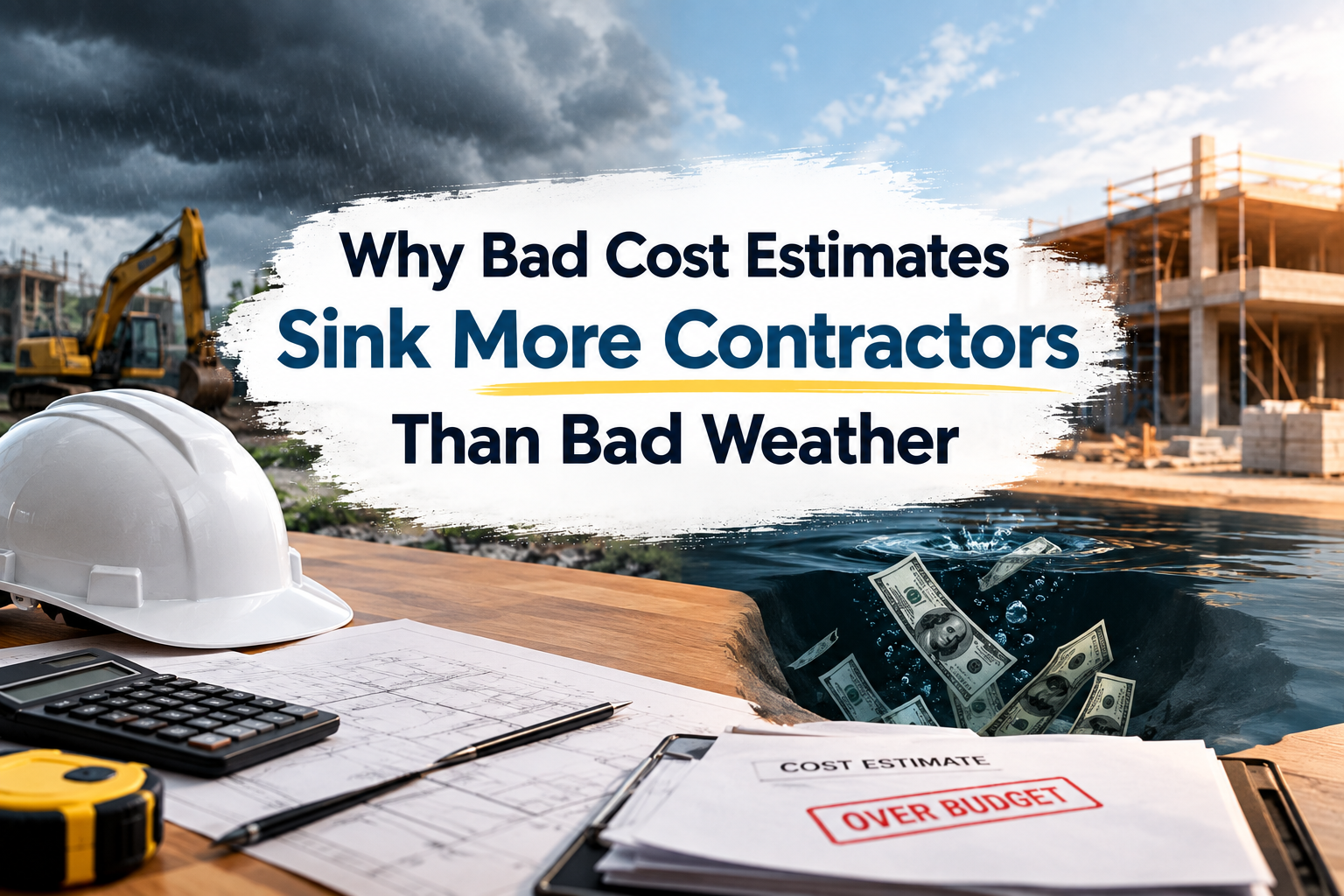
Ask any general contractor how a project actually goes sideways, and weather delays or supply chain hiccups usually aren't the real answer. The real answer, more often than not, traces back to a number that was wrong from day one: the estimate. A bid built on soft numbers doesn't just cost money later, it costs the trust of clients, subcontractors, and lenders who were told one figure and handed another.
The Hidden Cost of Guessing on a Bid
Contractors under deadline pressure sometimes build estimates from memory, past projects, or rough rules of thumb. It works until it doesn't. Material prices shift, labor rates vary by region and season, and a single missed line item in a 16-division scope can quietly erase a project's entire profit margin.
Why Experience Alone Isn't Enough Anymore
A contractor who's been in the business for twenty years still can't out-guess volatile lumber pricing or a sudden spike in steel costs. Experience helps with judgment calls, but it doesn't replace a disciplined, line-by-line takeoff process. The estimators who consistently win profitable bids are the ones treating cost estimating as its own specialized discipline, not an afterthought squeezed in between site visits.
What Gets Missed Most Often
-
Waste factors on materials that aren't accounted for in rough calculations
-
Local code requirements that change permitting costs mid-project
-
Labor cost differences between regions on multi-state projects
-
Change orders that weren't priced into contingency planning
-
Specialty trade work bundled into a general allowance instead of priced separately
How Accurate Estimating Protects the Whole Project Timeline
A solid estimate does more than win the bid. It sets the tone for everything that follows scheduling, subcontractor negotiations, and how much room there is to absorb the inevitable surprise that shows up mid-build. Projects that start with a realistic number tend to finish closer to budget, because there's less scrambling to patch gaps that were baked in from the beginning.
Bid Accuracy Affects More Than the Contractor
Lenders and investors read a cost estimate as a signal of how buttoned-up the entire project team is. A number that's clearly padded, or one that comes back wildly different from a second opinion, raises questions that can stall financing before ground is ever broken. Clean, itemized estimates move faster through underwriting because there's less for a reviewer to second-guess.
Code Compliance Is Part of the Cost, Not an Afterthought
Building codes vary by state and even by municipality, and a cost estimate that ignores local amendments to the IBC, IECC, or fire and life safety codes is often wrong before construction even starts. Estimators who factor these into the takeoff from the beginning save clients from expensive change orders once a plan check flags something that was never priced in.
What a Modern Estimating Process Actually Looks Like
The days of a single estimator working off a printed blueprint with a highlighter are mostly gone. Digital takeoff tools, BIM-integrated workflows, and predictive cost software have changed what "accurate" even means in this industry.
-
Plan review comes first. Every serious estimate starts with a detailed read of the drawings, not a shortcut based on similar past projects.
-
Takeoffs are itemized by trade. Concrete, MEP, framing, and finishes each get their own line rather than being folded into a vague allowance.
-
Current market pricing replaces static price books. Material and labor costs shift constantly, and estimates built on outdated pricing are wrong the moment they're delivered.
-
A second review catches what the first pass missed. Quality checks before delivery are what separate a reliable estimate from a rushed one.
Contractors who outsource this process instead of handling it in-house often see faster turnaround and fewer missed line items, simply because it becomes someone's full-time focus instead of a task squeezed between site visits and client calls. For a closer look at how a dedicated team approaches this across every CSI division, this breakdown of construction cost estimating services covers the process from initial takeoff through final bid-ready numbers.
Final Thought
The contractors who consistently win profitable work aren't the ones with the lowest bids, they're the ones with the most accurate ones. A number that holds up under scrutiny, matches real code requirements, and leaves room for the unexpected is worth far more than a fast guess that looks good on paper and falls apart on-site.

 English
 Arabic
 French
 Spanish
 Portuguese
 Deutsch
 Dutch
 Italiano
 Russian
 Romaian
 Portuguese (Brazil)
 Greek
