


What Makes a Data Science Research Topic Worth Investigating
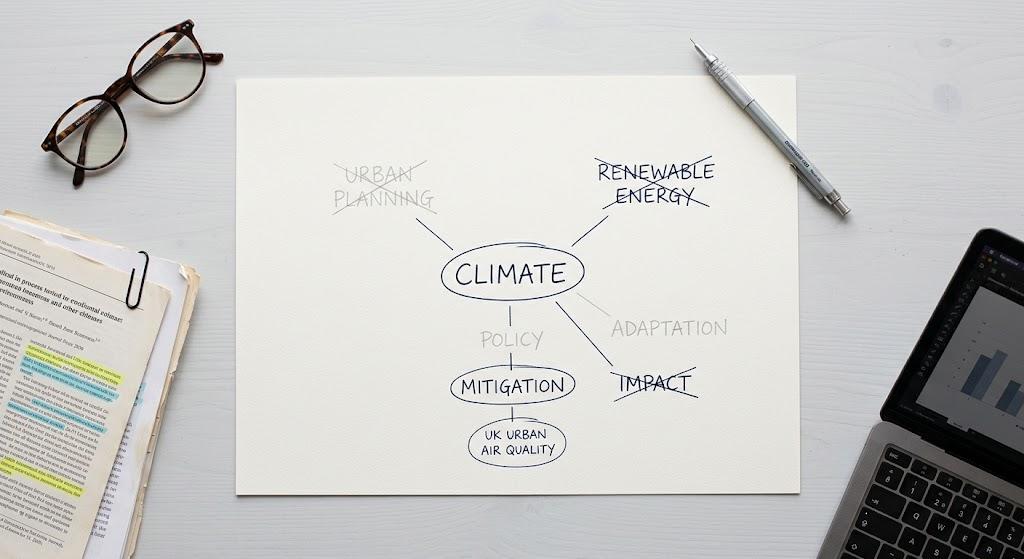
Ask most supervisors what goes wrong at the proposal stage, and you'll hear a version of the same complaint: a student is clearly interested in something, but can't say what they're actually asking about it. Machine learning in healthcare, fraud detection, climate modelling these come up constantly, said with real enthusiasm, and yet none of them is a question. They're just places where a question might eventually live.
That gap is worth taking seriously, because most struggles with topic selection aren't really about creativity. They're about not knowing how to tell the difference between something that sounds impressive and something that can actually be investigated, argued and defended within the time and data available.
The Difference Between an Interest and a Question
Naming a field tells your supervisor almost nothing about what you intend to do with it. A field gives you a direction to read in; it doesn't give you anything to test, measure or argue.
The shift that separates strong proposals from weak ones is moving from naming a subject to naming a tension within it. Where do existing methods disagree? Where does an approach that works well in one context quietly fail in another? Where has a dataset been used repeatedly, but always with the same assumption left unexamined? Research questions tend to live in exactly these gaps, not in the subject headings themselves.
A topic framed as a subject invites a survey. A topic framed as a tension invites a finding. Markers notice the difference immediately, and so, later, do employers reading a dissertation summary on a CV.
Why Broad Topics Feel Safe but Cause the Most Trouble
Broad topics are seductive because they feel low-risk. Studying "AI in education" in general seems hard to get wrong. In practice, the opposite happens. Broad topics collapse the moment you try to write a method section, because there's no longer a single, answerable question guiding your choices.
You end up deciding which dataset, which model, which evaluation metric to use without any principle to justify the choice, because the topic never told you what mattered. Readers can sense this. The work reads as competent but directionless, because it is.
A narrower question does the opposite. It tells you what data you need, what comparison is fair, and what result would count as meaningful. Narrowing isn't a limitation you accept reluctantly it's what makes the rest of the project possible at all.
Testing Whether an Idea Can Actually Be Investigated
Before committing to a direction, it helps to interrogate it the way a sceptical reviewer would. Can you name the specific data source you'd use, and do you actually know whether you can get access to it? Can you describe, in one sentence, what result would prove your idea wrong? If you can't picture a plausible negative outcome, you probably don't have a research question yet you have a conclusion you've already decided is true, which isn't research so much as confirmation dressed up as one.
It's also worth asking who would care about the answer, in an analytical rather than career-minded sense. Is there a practitioner, a policy debate, or a prior study whose conclusions your work would genuinely inform? If the honest answer is "no one, because this has been settled many times already," the direction needs sharpening rather than abandoning. Usually the underlying interest is fine it's the framing around it that's doing too little work.
One thing frequently overlooked here is the gap between data being available and data being suitable. A dataset being downloadable doesn't mean it fits your question. It might be too small, skewed toward one group, or missing the exact variable your argument depends on. Checking this before you commit saves months later.
Turning a General Interest Into a Focused Direction
Take recommendation systems as a working example not a real case study, just a way of showing the mechanics. Interest in the subject on its own isn't yet a question, but it's a reasonable place to start.
The next step is sitting with the subject long enough to notice where the standard explanations feel incomplete where a method assumed to work well seems to depend on conditions that don't hold in messier, real settings. In this case, you might notice that most recommendation research assumes user preferences are fairly stable, when in practice they shift after specific events or seasons. Pushed further, that observation becomes an actual question: how well do existing models cope when user behaviour changes abruptly, and what happens to recommendation quality during that transition?
Notice what happened there. The subject didn't change it's still recommendation systems. But the framing moved from a category to a claim that can be tested, with a method that follows from it. This is broadly how people working through data science research topics arrive at something they can defend, rather than a rebadged version of work that already exists.
Why the Obvious Approach Often Fails
Students often reach for the first framing that occurs to them, usually because it's the one most visible in whatever they've already read. That's a natural instinct, but it tends to produce work that replicates existing findings rather than extending them. If your proposed method and dataset closely resemble a well-cited paper from the last few years, you're not really asking a new question you're testing whether you can reproduce someone else's answer, which is a different and much narrower task unless replication is explicitly your goal.
There's a quieter reason the obvious approach fails, too: it rarely accounts for constraints specific to your own situation the size of dataset you can realistically obtain, the compute available to you, the length of the project. A method that's theoretically ideal but practically unreachable isn't a plan. It's a wish list with citations attached.
Recognising When an Idea Needs to Change
Some warning signs show up early, if you're willing to notice them. If you can't explain your question without listing three or four different things you're "also interested in," the question hasn't been found yet you're still describing an area. If your literature search keeps returning papers that already answer almost exactly what you proposed, using almost exactly your intended method, that's not confirmation you're on the right track. It's a sign the angle needs adjusting so your contribution is actually distinguishable from what's already there.
A less obvious sign is enthusiasm outpacing precision. Being excited about a topic isn't the same as being able to state, precisely, what you'll measure and what result would change your conclusion. When that gap appears, it's worth pausing before any data collection begins, because the direction usually needs one more round of narrowing rather than a full restart.
What Changes Once You Approach It This Way
Once a question is properly framed, the decisions downstream get easier, not harder. The literature review has a clear job situating your specific claim, not summarising an entire field. The methodology follows from the question instead of being assembled from whatever tools happen to be familiar. The results, whatever they turn out to be, mean something, because you defined in advance what would count as meaningful.
That's really the skill being tested by a research project, more than technical fluency on its own: the judgement to turn a broad curiosity into something specific enough to investigate honestly, including the possibility that the initial idea was wrong. It's a slower way of arriving at a topic than picking the first thing that sounds interesting, but it's the difference between a project that fills the required pages and one that says something worth reading.
 Greek
Greek
 English
 Arabic
 French
 Spanish
 Portuguese
 Deutsch
 Turkish
 Dutch
Dutch
 Italiano
 Russian
 Romaian
 Portuguese (Brazil)