


What Size Solar System Is Right for a Home in Noida?
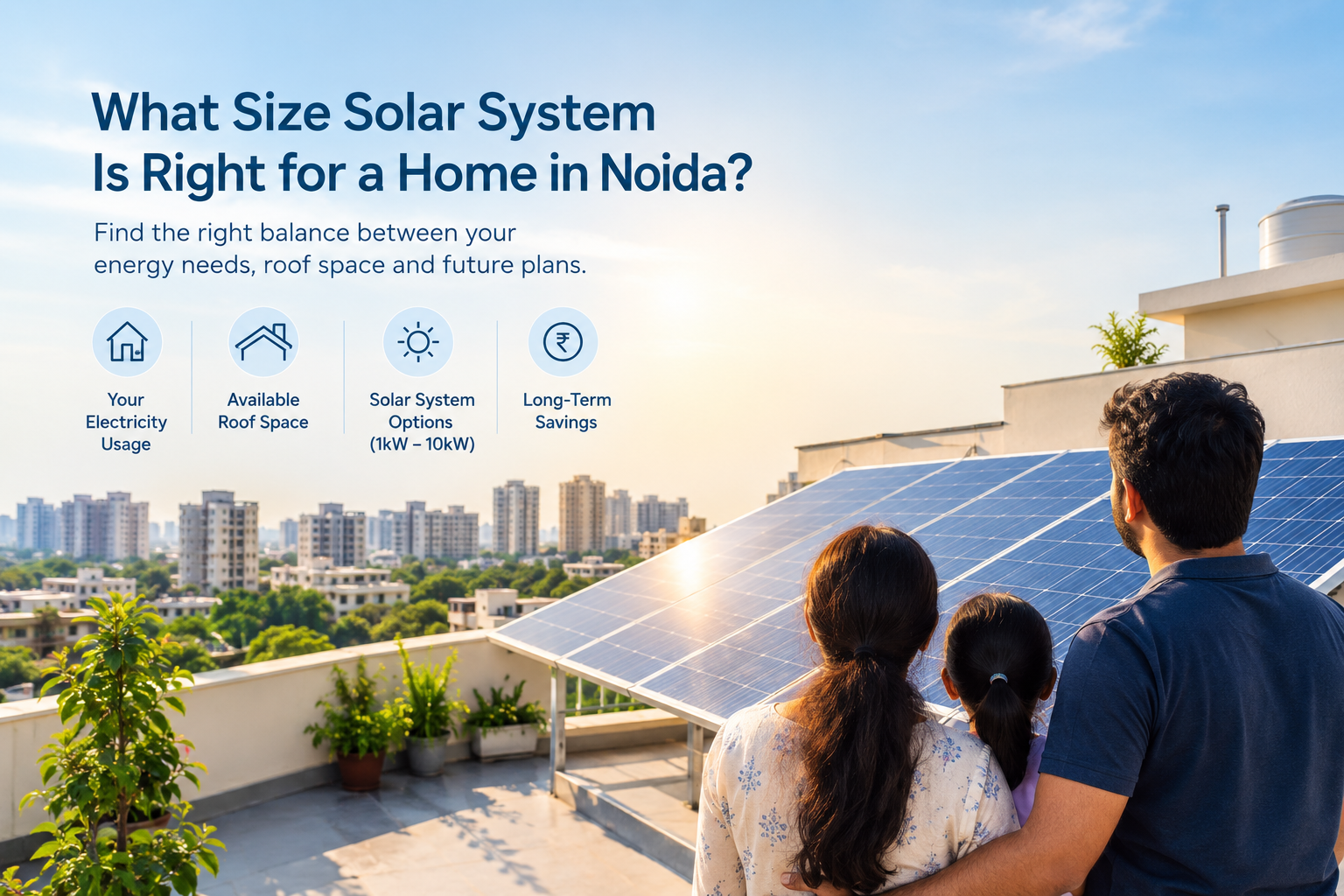
A 3kW system may be enough for one home, while another household may need 5kW or more. The right size is not decided simply by the number of bedrooms or the size of your rooftop. Your monthly electricity consumption, AC usage, appliances, available roof space, and future electricity needs all matter.
For homeowners considering rooftop solar installation in Noida, understanding these factors can help you avoid installing a system that is either too small for your needs or unnecessarily large.
How Do You Calculate the Right Solar System Size?
The easiest starting point is your electricity bill.
Look at your electricity consumption in units (kWh) over the last few months. Try to check at least six months of bills rather than relying on one month, because electricity usage can change significantly between summer and winter.
For example, a home using around 300–450 units per month may have very different requirements from a home consuming 600–800 units, particularly if several air conditioners are used during summer.
As a general starting point, a 1kW rooftop solar system can generate around 4–5 units of electricity per day in Noida, depending on sunlight, season, system design and other site conditions. A 3kW system can therefore generate roughly 12–15 units per day, while a 5kW system can produce around 20–25 units per day under suitable conditions.
These figures are estimates, not a guarantee of monthly generation.
Which Solar System Size Is Suitable for a Noida Home?
Here is a simple starting point:
|
Solar System |
Approx. Daily Generation |
Typical Home Use |
|
1kW |
4–5 units |
Small homes or low electricity consumption |
|
2kW |
8–10 units |
Smaller 2BHK homes |
|
3kW |
12–15 units |
2BHK–3BHK homes, moderate usage |
|
5kW |
20–25 units |
Larger homes with multiple appliances/ACs |
|
7kW |
28–35 units |
Large homes with higher consumption |
|
10kW |
40–50 units |
Large houses, villas or high electricity usage |
Solar Oorja currently lists residential systems from 1kW to 10kW and notes that 3kW and 5kW systems are among its commonly used residential sizes for homes in Noida and Greater Noida.
However, don't select a system just because your neighbour has the same size. Two houses in the same sector can have completely different electricity consumption.
Is a 3kW Solar System Enough for a Home in Noida?
For many 2BHK and 3BHK homes, 3kW solar panels for home can be a practical starting point.
A 3kW system can generate approximately 12–15 units per day under suitable conditions. It may work well for a household with moderate electricity consumption, especially if the home has efficient appliances and does not run several heavy loads simultaneously.
If you regularly use one or two ACs, refrigerators, washing machines, water pumps, televisions and other household appliances, check your actual electricity consumption before deciding.
A 3kW system should not automatically be considered sufficient simply because you live in a 2BHK or 3BHK.
When Should You Consider a 5kW Solar System?
A 5kW solar system for home may make more sense when your electricity consumption is considerably higher.
This can include larger 3BHK or 4BHK homes where multiple ACs, geysers, refrigerators, water pumps and other high-consumption appliances are used.
A 5kW system can generate approximately 20–25 units per day under suitable conditions.
If your electricity bill increases significantly during Noida's hot summer months because of air-conditioning, don't size your system based only on your winter bill.
It is better to look at your annual consumption and understand when your electricity usage is highest.
How Much Roof Space Do You Need?
Electricity consumption isn't the only factor.
You also need enough shadow-free rooftop space for solar panels.
As a broad estimate, Solar Oorja lists around 80–100 sq. ft. of roof space per kW for its residential installations. That means:
-
1kW → around 80–100 sq. ft.
-
3kW → around 240–300 sq. ft.
-
5kW → around 400–500 sq. ft.
-
7kW → around 560–700 sq. ft.
-
10kW → around 800–1,000 sq. ft.
Actual requirements can vary depending on panel dimensions, mounting arrangement, roof shape, access pathways and shading.
This is why a proper roof assessment is important before finalising your rooftop solar installation in Noida.
Don't Ignore Shade on Your Roof
A large rooftop does not necessarily mean you can install a large solar system.
Water tanks, nearby buildings, trees, boundary walls and other structures can create shadows over the panels. Even partial shading can affect system performance.
During a professional site assessment, the installer should check the roof orientation, available space and shadow patterns before designing the system.
For example, Solar Oorja's residential solar service includes a site survey and shadow analysis before recommending a system size.
You can explore their [residential solar installation service in Noida] to understand what is included in the installation process.
Should You Install a Bigger Solar System for Future Needs?
This depends on your expected electricity consumption.
Suppose you currently use around 350 units per month but are planning to add another AC, an electric vehicle or other high-power appliances. In that case, future consumption should be considered while designing the system.
At the same time, installing a much larger system simply because you have available roof space may not always be necessary.
The goal is to find a practical balance between your electricity consumption, roof capacity, system cost and expected generation.
What Type of Solar System Should You Choose?
System size and system type are two different decisions.
For many homes connected to the electricity grid, an on-grid solar system can be used to generate electricity during the day while remaining connected to the grid.
An on-grid system does not normally provide backup power during a grid outage because it shuts down when the grid goes off. If backup power is important to you, a hybrid system with battery storage may be more suitable.
Solar Oorja provides on-grid, off-grid and hybrid solar solutions for residential properties in Noida and Greater Noida.
You can also read this guide on [on-grid vs off-grid vs hybrid solar systems] before making a decision.
What About Solar Subsidy in Noida?
The cost of a residential solar installation can also be affected by applicable government subsidy schemes.
Under the PM Surya Ghar programme, Solar Oorja currently lists residential subsidy amounts of ₹30,000 for 1kW, ₹60,000 for 2kW and ₹78,000 for 3kW and above for the central component, with additional state support where applicable.
Because subsidy rules, eligibility and implementation can change, homeowners should confirm the applicable amount at the time of installation rather than relying on an old quotation or online calculator.
Solar Oorja also provides a [solar calculator for Noida] that estimates system size and savings based on electricity-bill information.
So, What Size Solar System Should You Install?
There is no single solar system size that is right for every home in Noida.
As a starting point:
1–2kW: Suitable for homes with relatively low electricity consumption.
3kW: A practical option for many 2BHK and 3BHK homes with moderate electricity usage.
5kW: Worth considering for larger homes or households using multiple ACs and other high-consumption appliances.
7–10kW: More appropriate for large homes, villas and properties with substantially higher electricity consumption and sufficient roof space.
But these are only starting points. Your electricity bills and roof conditions should have the final say.
Before choosing a system, review your recent electricity bills, estimate your future electricity needs, check available shadow-free roof space and understand whether you need battery backup.
If you're considering solar panel installation in Noida, a professional site assessment can give you a much more accurate system size than simply choosing a capacity based on your home size.
Solar Oorja offers residential solar systems from 1kW to 10kW and provides site assessment and system design based on electricity consumption and rooftop conditions.
Final Takeaway
Choosing the right rooftop solar system for your Noida home isn't about buying the biggest system available. It is about matching the system to your electricity consumption, roof space and future requirements.
For many homes, 3kW and 5kW systems are practical starting points, but your actual electricity bills should guide the final decision.
If you're planning a rooftop solar installation in Noida, getting the roof and electricity usage assessed before installation can help you choose the capacity with much more confidence.
Frequently Asked Questions
1. What size solar system is best for a 3BHK house in Noida?
A 3kW or 5kW system may be suitable for many 3BHK homes, but the correct capacity depends on actual electricity consumption, AC usage, roof space and future requirements.
2. How much electricity does a 3kW solar system generate in Noida?
A 3kW system can generate approximately 12–15 units per day under suitable conditions. Actual production changes with season, sunlight, shading, panel orientation and system performance.
3. How much roof space is required for a 5kW solar system?
A 5kW residential system generally requires around 400–500 sq. ft. of suitable shadow-free rooftop area, although the exact requirement depends on the equipment and installation layout.
4. Is 3kW solar enough to run two ACs?
It depends on the total electricity consumption of the home. ACs can consume a significant amount of electricity, so you should consider your complete household load rather than sizing the solar system only around the number of ACs.
5. Can I install solar panels if my roof has limited space?
Yes, but the available area may limit the maximum system capacity you can install. A site survey can determine how much usable, shadow-free space is actually available.
6. Should I choose on-grid or hybrid solar for my home?
If your main objective is reducing electricity bills and your grid supply is reliable, an on-grid system may be suitable. If you need electricity backup during power cuts, a hybrid system with batteries may be worth considering.
7. How do I know exactly how much solar capacity my home needs?
Start by checking your recent electricity bills and monthly unit consumption. Then have your roof assessed for usable space and shading. A professional solar installer can use this information to recommend an appropriate system size.
 Portuguese
 English
 Arabic
 French
 Spanish
 Deutsch
 Turkish
 Dutch
Dutch
 Italiano
 Russian
 Romaian
 Portuguese (Brazil)
 Greek
Greek