


Driving Licence Test Questions: A Beginner’s Guide to Signs, Rules and Hazards
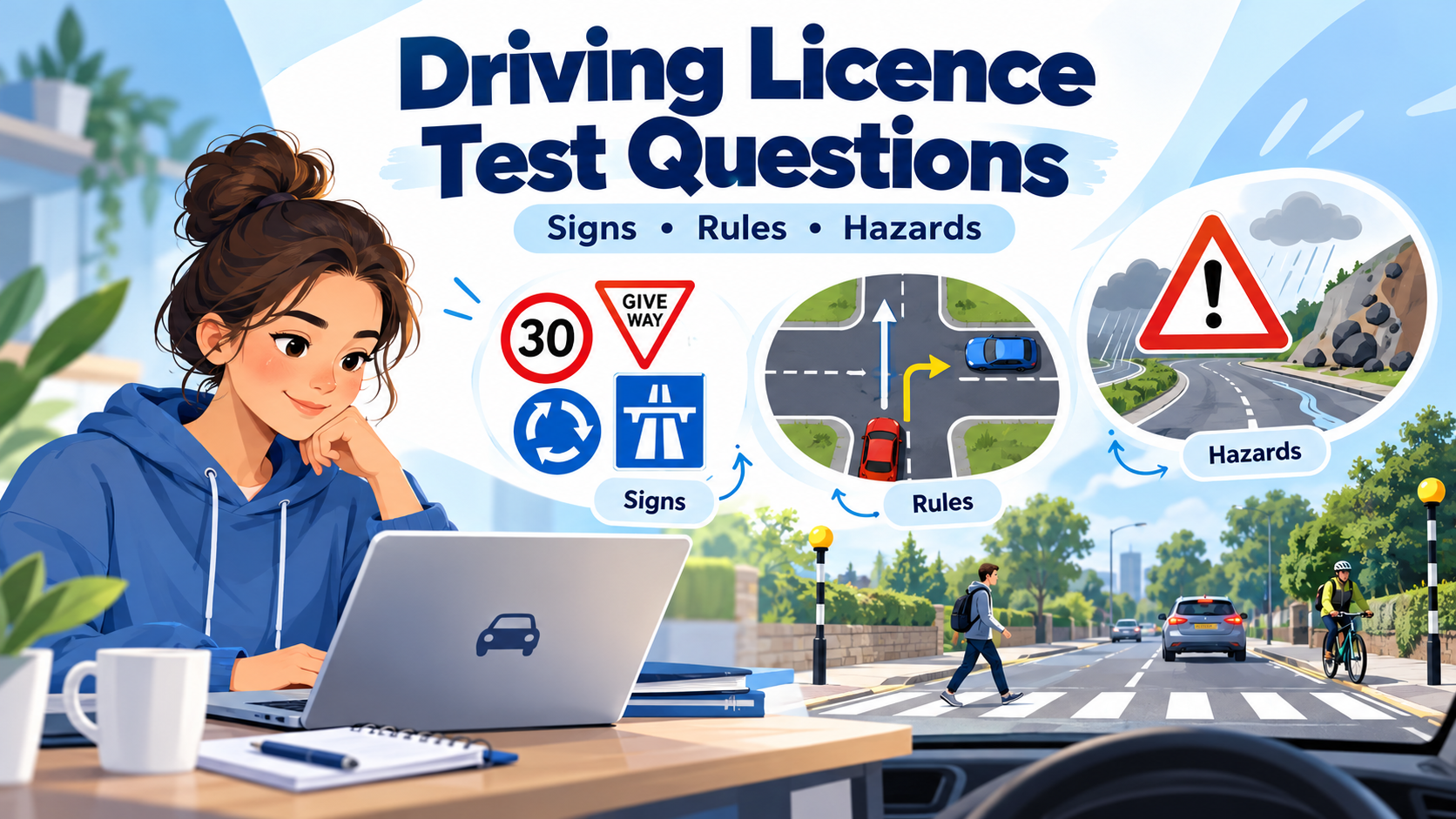
Preparing for a theory exam can feel overwhelming when you first see how many topics are involved. Road signs, junctions, stopping distances, pedestrians, lane rules, hazards, parking restrictions, and safe-driving decisions can all appear in one test. The easiest way to make sense of it is to stop treating every question as a separate fact.
Good preparation for driving licence test questions is really about learning how the road works. Once you understand the reason behind a rule, unfamiliar questions become much easier to solve.
Start by Learning What Road Signs Ask You to Do
Beginners often try to memorise traffic signs from pictures. That can help initially, but recognition alone is not enough.
When you see a sign, connect it with an action.
A Stop sign means you must stop completely before proceeding when it is safe. A Give Way sign deals with priority. A speed-limit sign controls maximum permitted speed, while a warning sign tells you to prepare for something ahead.
Useful sign groups to review include:
-
Warning signs
-
Prohibition signs
-
Mandatory signs
-
Priority signs
-
Speed restrictions
-
Parking and stopping signs
-
Direction and information signs
When answering driving licence test questions, look at the sign’s shape, colour, symbol, and any additional plate underneath it. A small extra panel can change when or where the main instruction applies.
Road Markings Can Change the Whole Situation
A question may look like it is testing road signs when the real clue is painted on the road.
Watch for solid and broken lines, stop lines, pedestrian crossings, direction arrows, lane dividers, and restricted areas.
A broken line may allow a manoeuvre when it is safe. A solid line can place stronger restrictions on crossing. Lane arrows can determine whether you must turn or continue straight.
This is why learners should read the entire road scene before choosing an answer.
Do not look at one object and stop thinking.
Priority Questions Need a Slow, Logical Approach
Junction questions are among the most common areas where beginners hesitate.
The best approach is to check the situation in an order:
-
First look for traffic lights.
-
Then check road signs.
-
Next inspect road markings.
-
After that, consider vehicle positions and local right-of-way rules.
This prevents you from assuming that the first vehicle to arrive automatically goes first.
Priority questions become much easier once you learn to identify which rule controls the junction.
Hazards Are Often Hidden Inside Ordinary Situations
Not every hazard is dramatic.
A child standing near the pavement, a cyclist approaching a junction, a van blocking your view, wet leaves on a bend, or a parked vehicle with someone inside may all require extra attention.
Hazard questions usually test whether you can recognise danger early.
Ask yourself:
-
What could happen next?
-
Who might move unexpectedly?
-
Is my view blocked?
-
Would I have enough time to stop?
This method is much more useful than trying to remember which answer appeared in a previous practice test.
Speed Questions Are About Judgement Too
Many beginners assume speed questions are simply about remembering numbers.
They are not.
The legal speed limit matters, but road conditions matter as well.
Rain, fog, snow, traffic, pedestrians, roadworks, darkness, and sharp bends can all require a lower speed.
So if a driving licence test questions scenario shows poor visibility alongside a posted speed limit, the safest response may involve slowing below that maximum.
A speed limit is not a target.
Following Distance Gives You Time to React
Safe following distance appears in many forms.
A question may show a vehicle travelling too close behind another car, ask about braking distance, or describe sudden traffic ahead.
The important principle is time.
More space gives you more time to notice danger, react, and brake safely.
Following distance should increase when:
-
The road is wet or icy
-
Visibility is poor
-
Traffic is unpredictable
-
You are travelling faster
-
You are behind a large vehicle that blocks your view
Understanding this principle helps across many different types of theory questions.
Pedestrians and Cyclists Need Extra Attention
Theory tests often include vulnerable road users because drivers have a greater responsibility when interacting with them.
Pedestrians may step onto crossings unexpectedly. Cyclists can move around potholes, parked cars, or road debris. Children may not judge speed accurately.
When a question involves pedestrians or cyclists, pay close attention to visibility, road position, crossings, and available space.
The correct answer is usually the one that creates the safest margin rather than the fastest progress.
Parking and Stopping Questions Can Be Deceptive
A place may look physically large enough to park while still being unsafe or prohibited.
Check for signs, yellow lines, crossings, junctions, driveways, bus stops, bends, and restricted zones.
Stopping and parking are not always treated the same way, either.
This is another area where reading the whole scene matters more than recognising one rule in isolation.
Do Not Memorise Practice-Test Answer Positions
One of the easiest traps in theory preparation is remembering that “B was correct last time.”
That does not mean you learned the rule.
A better method is to explain the answer to yourself.
For example:
“I should slow down because the parked van blocks my view of the pedestrian crossing.”
If you can explain why an answer is correct, you are much more likely to handle a similar question with different wording.
Turn Wrong Answers Into Study Topics
Your mistakes are useful.
Instead of immediately starting another full test, group wrong answers by topic.
If you miss several junction questions, revise priority rules.
If road signs cause problems, compare similar signs together.
If hazard questions are difficult, practise identifying what could happen next.
This makes revision more focused and prevents you from repeating the same errors.
Build Understanding Before Test Day
The strongest preparation for driving licence test questions combines sign recognition, road rules, hazard awareness, and safe decision-making.
Do not aim to memorise every possible question. Learn how to read the road, identify the rule that applies, and choose the option that gives the safest and most lawful response.
For more practice, use the Driving Licence Practice Questions page to review signs, rules, hazards, junctions, speed, and common theory-test situations. The goal is not simply to score well in practice, but to understand why each answer makes sense.

 English
 Arabic
 French
 Portuguese
 Deutsch
 Turkish
 Dutch
Dutch
 Italiano
 Russian
 Romaian
 Portuguese (Brazil)
 Greek
Greek
