


Fidelity 401k Hardship Withdrawal: Rules and Requirements
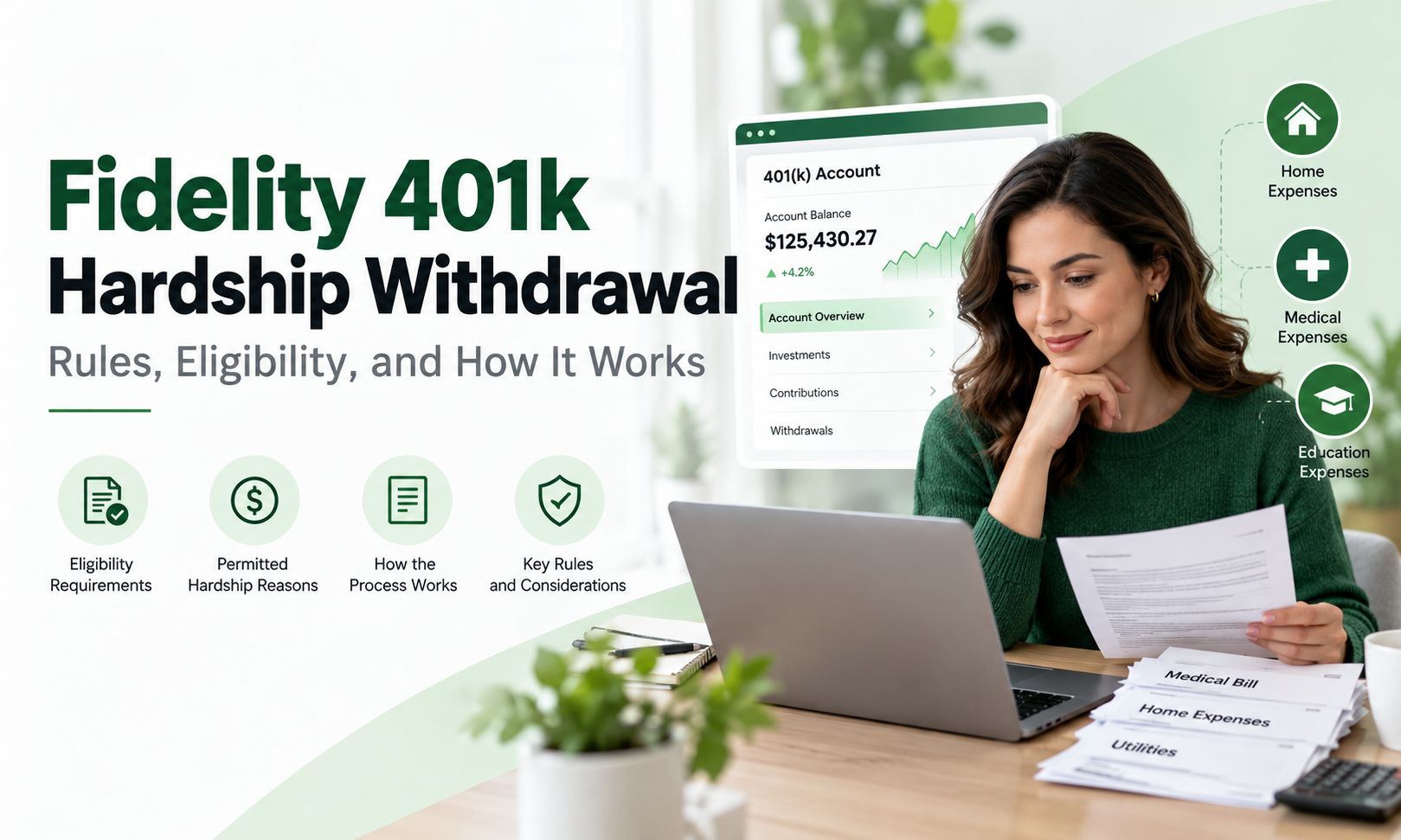
Financial emergencies can create unexpected challenges, especially when you need money for medical expenses, housing payments, or other essential costs. If you have retirement savings through Fidelity Investments, a Fidelity 401k Hardship Withdrawal may provide access to some of your funds during a qualifying financial emergency.
However, withdrawing money from your 401k is not always simple. The Internal Revenue Service (IRS) establishes specific hardship withdrawal rules, and your employer's retirement plan determines which withdrawal options are available.
Understanding the eligibility requirements, qualifying expenses, documentation, taxes, and withdrawal process can help you make an informed financial decision.
This guide explains everything you need to know about Fidelity Investments hardship withdrawals, including how to qualify, apply, and avoid common mistakes.
What Is a Fidelity 401k Hardship Withdrawal?
A Fidelity 401k Hardship Withdrawal allows eligible employees to withdraw money from their employer-sponsored retirement savings to cover certain immediate and heavy financial needs.
Unlike a 401k loan, a hardship distribution does not require repayment. However, the withdrawal permanently reduces your retirement savings and may create income tax obligations.
Fidelity administers retirement plans for many employers, but hardship withdrawal availability depends on your employer's specific plan.
Important features include:
-
Available for qualifying financial emergencies.
-
Subject to IRS hardship withdrawal requirements.
-
Limited to the amount needed for the qualifying expense.
-
May require documentation or financial certification.
-
Generally subject to income tax on pretax distributions.
-
May involve an additional 10% early withdrawal tax.
The IRS states that hardship distributions must address an immediate and heavy financial need and must not exceed the amount necessary to satisfy that need.
Fidelity 401k Hardship Withdrawal Rules
Before applying for a hardship withdrawal from Fidelity 401k, you should understand the main rules.
1. Immediate and Heavy Financial Need
You must have a qualifying financial need recognized under applicable IRS rules and your employer's retirement plan.
Routine purchases, vacations, and nonessential personal expenses generally do not qualify.
2. Your Employer Must Allow Hardship Withdrawals
Not every employer-sponsored 401k plan permits hardship distributions.
Even when Fidelity manages your retirement savings, your employer's plan determines which hardship provisions apply.
3. Withdrawal Amount Must Be Limited
You generally cannot withdraw more than the amount necessary to meet your qualifying financial need.
Reasonably anticipated taxes and penalties resulting from the withdrawal may be included in the amount requested.
4. Available Financial Resources Must Be Considered
You generally must certify that you do not have enough cash or other reasonably available liquid assets to satisfy the financial need.
You must also obtain other currently available distributions under applicable employer plans, subject to the IRS rules.
Federal rules do not require participants to take a 401k loan before receiving a hardship distribution, although plan-specific requirements should be checked.
5. Hardship Withdrawals Cannot Be Repaid
Unlike a retirement plan loan, a hardship withdrawal cannot be repaid to your 401k or rolled over into an IRA.
Fidelity 401k Hardship Withdrawal Eligibility Requirements
To qualify for a Fidelity Investments 401k Hardship Withdrawal, you generally must satisfy several conditions.
You may qualify if:
-
You participate in an employer-sponsored 401k plan that allows hardship distributions.
-
You have an eligible financial emergency.
-
Your request does not exceed the permitted hardship amount.
-
You satisfy the plan's financial certification requirements.
-
You provide supporting information when requested.
Eligibility is determined by the applicable plan provisions and IRS regulations.
If you are unsure whether your retirement plan allows hardship distributions, review your Summary Plan Description or contact your plan administrator.
What Expenses Qualify for a Fidelity Hardship Withdrawal?
The IRS recognizes several categories of expenses that can qualify as immediate and heavy financial needs.
Medical Expenses
Qualifying medical expenses may include:
-
Eligible hospital bills.
-
Necessary medical treatments.
-
Certain surgical expenses.
-
Unreimbursed healthcare costs.
The expenses must satisfy the applicable IRS requirements.
Preventing Eviction or Foreclosure
You may qualify if you need funds to prevent eviction from your primary residence or foreclosure on its mortgage.
Supporting documents may include an eviction notice, foreclosure notice, or qualifying overdue payment statement.
Purchasing a Primary Residence
Certain costs directly related to purchasing your principal residence may qualify.
However, regular mortgage payments generally do not qualify under this category.
Educational Expenses
Eligible postsecondary education expenses may include:
-
Tuition payments.
-
Related educational fees.
-
Qualifying room and board costs.
These expenses may cover up to the next 12 months of education for eligible individuals.
Funeral and Burial Expenses
Certain funeral or burial expenses for qualifying family members or plan beneficiaries may be eligible.
Home Repairs and Disaster Expenses
Eligible repairs to a primary residence and certain financial losses related to federally declared disasters may qualify under specific conditions.
Your employer's plan must permit the applicable hardship category.
How to Apply for a Fidelity 401k Hardship Withdrawal Online
If your employer's retirement plan allows hardship distributions, you may be able to submit a request through Fidelity NetBenefits.
Step 1: Sign In to Fidelity NetBenefits
Visit the official Fidelity NetBenefits website and sign in.
Select your workplace retirement plan.
Step 2: Find the Withdrawal Options
Locate the loans and withdrawals section associated with your 401k plan.
Review the available distribution options.
Step 3: Select Hardship Withdrawal
If the hardship distribution option is available, select it and review the eligibility requirements.
Step 4: Enter Your Financial Details
Choose the appropriate hardship reason and enter the amount you need.
Make sure your requested withdrawal corresponds to the qualifying financial expense.
Step 5: Submit Required Documents
Depending on your plan, you may need to submit:
-
Medical invoices.
-
Tuition statements.
-
Eviction or foreclosure notices.
-
Funeral expense records.
-
Eligible home repair documents.
-
Other supporting information.
Some plans permit electronic certifications instead of requiring every supporting document during the initial submission.
Step 6: Review and Submit Your Request
Review the withdrawal amount, tax withholding options, and payment details.
Submit your application and save the confirmation information.
Step 7: Track Your Withdrawal
Check NetBenefits for available status updates or contact your retirement plan administrator for information about your request.
The exact online process may vary by employer.
Fidelity 401k Hardship Withdrawal Taxes and Penalties
A Fidelity 401k Withdrawal Hardship request may provide immediate financial assistance, but it can create tax consequences.
Federal Income Tax
Traditional pretax 401k hardship withdrawals are generally included in your taxable income.
For example, if you withdraw $10,000 and your applicable federal marginal tax rate is 22%, the estimated additional federal income tax could be $2,200.
Your actual taxes depend on your overall financial situation.
Early Withdrawal Tax
If you withdraw taxable retirement funds before age 59½, an additional 10% federal tax generally applies unless you qualify for an IRS exception.
A hardship withdrawal does not automatically eliminate this additional tax.
State Income Taxes
Depending on where you live, state income taxes may also apply.
The IRS confirms that hardship distributions of previously untaxed money generally create income tax liability and may trigger an additional early distribution tax.
How Much Can You Withdraw From Fidelity 401k for Hardship?
There is no universal fixed dollar amount available to every Fidelity participant.
Your maximum hardship distribution depends on:
-
Your qualifying financial expense.
-
Your eligible retirement savings balance.
-
The contributions your employer's plan permits you to withdraw.
-
Reasonably anticipated taxes and penalties.
-
Your specific retirement plan rules.
For example, if your qualifying financial need is $6,000, your withdrawal generally must be limited to that amount, plus any permitted additional amount for resulting taxes and penalties.
Your entire retirement balance may not be eligible for hardship distribution.
How Long Does a Fidelity Hardship Withdrawal Take?
The processing time for a Fidelity Investments Hardship Withdrawal varies depending on your employer's retirement plan and the completeness of your application.
Several factors may affect processing:
-
Employer or administrator approval requirements.
-
Supporting document verification.
-
Accuracy of the submitted information.
-
Payment method.
-
Bank processing schedules.
Check your request details through NetBenefits for available estimates rather than assuming a guaranteed processing period.
Fidelity 401k Hardship Withdrawal vs. Fidelity 401k Cash Out
A Fidelity 401k Cash Out generally refers to withdrawing a distributable retirement balance, often after leaving an employer.
A hardship withdrawal is different because it is specifically intended to cover qualifying financial needs.
The main differences include:
-
Purpose: Hardship distributions address specific financial emergencies.
-
Eligibility: Cash-out eligibility depends on distributable events and plan rules, while hardship withdrawals have additional requirements.
-
Withdrawal amount: Hardship distributions are limited by qualifying financial needs and eligible funds.
-
Taxes: Both may result in income taxes and early withdrawal taxes.
-
Repayment: Hardship withdrawals cannot be repaid to the plan.
Consider your long-term retirement goals before selecting either option.
Common Reasons for Fidelity Hardship Withdrawal Denial
A hardship withdrawal may be denied when the application does not satisfy plan requirements.
Common reasons include:
-
The expense does not qualify.
-
Required information is missing.
-
The requested amount exceeds the permitted limit.
-
Insufficient eligible funds are available.
-
The retirement plan does not offer hardship distributions.
Reviewing the eligibility requirements before submitting your application can help prevent avoidable problems.
FAQs
1. What qualifies for a Fidelity 401k Hardship Withdrawal?
Qualifying expenses may include eligible medical costs, educational expenses, preventing eviction or foreclosure, certain primary residence expenses, funeral costs, and eligible disaster-related expenses. Your employer's plan determines which categories are available.
2. Can I withdraw from Fidelity 401k for financial hardship while employed?
Yes. If your employer's retirement plan permits hardship distributions and you satisfy the eligibility requirements, you may request a withdrawal while still employed.
3. How much can I take out through a Fidelity hardship withdrawal?
You generally may withdraw no more than the amount necessary to cover your qualifying financial need, including reasonably anticipated taxes and penalties, subject to your plan's available eligible funds.
4. Does Fidelity 401k hardship withdrawal require proof?
Your plan may require supporting documents, financial certifications, or both. Requirements depend on the plan's procedures and the reason for your withdrawal.
5. Do I have to pay taxes on a Fidelity Investments hardship withdrawal?
Traditional pretax 401k hardship distributions generally count as taxable income. An additional 10% federal tax may apply if you are younger than 59½ and do not qualify for an exception.
6. Can I repay a Fidelity 401k hardship withdrawal?
No. A hardship withdrawal cannot be repaid to your retirement plan. You may generally continue making eligible retirement contributions, but those contributions do not reverse the original distribution.
Conclusion
A Fidelity 401k Hardship Withdrawal may provide financial assistance when you face an immediate and heavy financial need. However, understanding the withdrawal rules, eligibility requirements, taxes, and documentation process is essential before requesting money.
Start by reviewing your employer's retirement plan through Fidelity NetBenefits. Confirm that your financial emergency qualifies, determine how much you can withdraw, and prepare any required documents.
Because hardship withdrawals permanently reduce retirement savings and may create additional tax obligations, consider other financial options before proceeding.

 English
 Arabic
 French
 Spanish
 Portuguese
 Turkish
 Dutch
 Italiano
 Russian
 Romaian
 Portuguese (Brazil)
 Greek
