


Citizen Developer: Turn Business Ideas Into Useful Apps
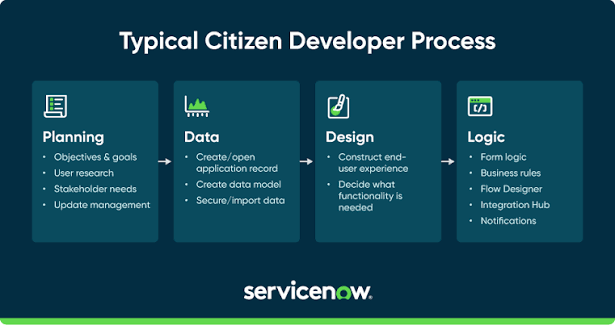
Technology has become an essential part of how businesses operate, communicate, and serve customers. Companies need applications that simplify everyday tasks, organize information, and improve productivity. However, traditional software development can require specialized skills, significant resources, and close coordination with technical teams. This is where a citizen developer can make a meaningful difference.
A citizen developer is a business professional who creates applications, automates workflows, or develops digital solutions without necessarily having formal software development training. Instead of relying entirely on traditional programming, citizen developers often use low-code and no-code platforms to turn business ideas into practical applications.
The growing availability of visual development tools and artificial intelligence has made application creation more accessible. Employees in departments such as marketing, sales, finance, human resources, and operations can participate in solving technical problems within their areas of expertise.
Citizen development does not replace professional software developers. Instead, it creates opportunities for business users and technical specialists to collaborate, improve internal processes, and deliver useful digital solutions more efficiently.
Understanding how citizen development works can help organizations identify new opportunities for innovation while maintaining the security, reliability, and quality of their applications.
What Is a Citizen Developer?
A citizen developer is someone who builds or customizes business applications using accessible development tools, even without extensive coding knowledge. These individuals usually work in business departments rather than traditional information technology teams.
Their main advantage is their understanding of everyday business challenges. Because they work directly with existing processes, they can recognize inefficiencies and identify opportunities for improvement.
For example, a human resources employee might create an application that organizes leave requests and approval workflows. A sales representative could build a simple tool for tracking potential customers, while an operations manager might automate maintenance requests.
Citizen developers use their business knowledge to determine what an application should accomplish. They then use suitable development platforms to create a solution, test its functionality, and improve it based on feedback.
Although coding may not be necessary for every project, citizen developers still benefit from logical thinking, problem-solving abilities, and an understanding of data management. They must also follow organizational policies when creating applications that handle business information.
What Does a Citizen Developer Do?
The responsibilities of a citizen developer vary according to the organization, department, and development platform. Some concentrate on application building, while others focus on automation, reporting, or improving existing business systems.
Common responsibilities include:
-
Identifying repetitive activities that could be automated.
-
Understanding business requirements and user expectations.
-
Creating internal applications with visual development tools.
-
Designing digital forms for collecting and organizing information.
-
Building workflows for requests, approvals, and notifications.
-
Connecting approved applications and data sources.
-
Testing applications to identify errors and usability problems.
-
Gathering feedback from employees and improving functionality.
-
Documenting applications and explaining how they operate.
-
Following company security, privacy, and governance policies.
Citizen developers may also collaborate with IT professionals when a project involves complex integrations, sensitive information, or advanced technical requirements.
Their purpose is not simply to build software. It is to create practical solutions that address genuine business problems and improve the way people work.
How Citizen Development Works
Citizen development usually begins with identifying a problem that affects an employee, department, or business process.
The employee then defines the desired outcome and selects a suitable development platform. Many platforms provide visual interfaces, reusable components, templates, and configurable workflows that make application creation easier.
For example, a company might manage customer inquiries through spreadsheets and email conversations. This process could lead to missed requests, duplicated information, and delayed responses.
A citizen developer could create an internal application that collects inquiries, assigns responsibility, tracks progress, and sends automatic notifications. Employees could access relevant information through a shared interface rather than searching through multiple conversations.
After building an initial version, the citizen developer tests it with a small group of users. Feedback helps identify missing features, confusing instructions, and unexpected behavior.
Before the application is introduced more widely, the organization should review its permissions, data handling, reliability, and maintenance requirements. This process helps ensure that an application is useful as well as responsible to operate.
The Role of Low-Code and No-Code Platforms
Low-code and no-code platforms are central to citizen development because they reduce the technical barriers associated with traditional programming.
Low-Code Development Platforms
Low-code platforms provide visual development environments that simplify application creation. Users can configure prebuilt components, design interfaces, connect data sources, and establish workflow logic.
Some coding may still be necessary for advanced functionality or specialized integrations. However, these platforms can reduce the amount of custom programming required for many business applications.
Low-code development is particularly useful when a company needs flexibility beyond basic templates but wants to avoid building every component from scratch.
No-Code Development Platforms
No-code platforms allow users to create applications through visual editors, configurable settings, and drag-and-drop functionality.
These tools are suitable for straightforward solutions such as internal forms, request management systems, task trackers, and simple dashboards.
Because users can focus on the application's purpose instead of writing code, no-code platforms can make experimentation and prototyping more accessible.
AI-Powered Development Tools
Artificial intelligence is expanding the possibilities of citizen development. Some platforms allow users to describe an application in natural language and receive suggestions for interfaces, workflows, formulas, or application components.
AI assistance can help users understand technical concepts and develop initial solutions more quickly. However, AI-generated applications are not automatically secure or reliable.
Citizen developers should review generated logic, test application behavior, and seek qualified technical guidance whenever necessary.
Benefits of Citizen Development for Businesses
Citizen development offers several advantages when businesses provide appropriate tools, training, and oversight.
Faster Application Development
Business employees can often create simple applications without waiting for every request to move through a traditional development queue. This can help departments address straightforward problems more quickly.
Improved Productivity
Automating repetitive activities allows employees to spend more time on meaningful work. Digital forms, automated notifications, and centralized records can also reduce administrative effort.
Better Understanding of Business Needs
Citizen developers usually have direct experience with the processes they want to improve. This knowledge helps them identify practical requirements and create applications that reflect how employees actually work.
Reduced Pressure on IT Teams
Professional developers often manage complex projects, system maintenance, integrations, and technical infrastructure. Citizen development can help address suitable low-complexity requests, allowing IT teams to focus on more demanding responsibilities.
Greater Employee Participation
When employees can contribute to application development, they become active participants in digital transformation. Their ideas can lead to useful improvements that might otherwise remain unaddressed.
More Flexible Business Processes
Business requirements change as companies grow and adapt to customer expectations. Well-managed citizen development makes it easier to adjust internal workflows and develop solutions that support changing needs.
These benefits depend on choosing appropriate projects and ensuring that applications deliver measurable improvements rather than adding unnecessary complexity.
Citizen Developer vs. Professional Developer
Citizen developers and professional developers contribute to application development in different ways.
Citizen developers generally focus on solving business problems using low-code, no-code, and AI-assisted tools. Their strengths include practical business knowledge, familiarity with departmental workflows, and the ability to identify everyday operational challenges.
Professional developers bring deeper expertise in programming, software architecture, database design, testing, system integrations, and application security. They are better equipped to manage complex software requirements and build highly customized systems.
For example, a citizen developer might create an internal request tracker, while a professional developer builds a sophisticated customer management platform that integrates with several business systems.
The roles can work together effectively. Citizen developers contribute business knowledge and initial solutions, while professional developers provide technical guidance, review risks, and help scale applications when necessary.
Citizen development should therefore be viewed as a complementary approach to software development rather than a replacement for technical expertise.
Challenges and Risks of Citizen Development
Despite its advantages, citizen development requires careful management. Giving employees access to application-building tools without appropriate guidance can create technical and organizational problems.
Data Security and Privacy
Applications may collect customer details, employee records, or confidential business information. Incorrect permissions or insecure configurations can expose sensitive data.
Organizations should establish approved data sources, access controls, and security requirements before applications are deployed.
Lack of Documentation
Applications created without clear documentation can become difficult to maintain. If the original creator leaves the organization, colleagues may struggle to understand how the application works.
Businesses should document application ownership, important workflows, data connections, and maintenance responsibilities.
Application Duplication
Different departments may create similar applications to solve the same problem. This can lead to duplicated effort, inconsistent information, and unnecessary maintenance.
A shared inventory of internal applications can help teams discover existing solutions before creating new ones.
Integration Problems
Some applications need to exchange information with existing business systems. A development platform may not support every integration, particularly when specialized software or legacy infrastructure is involved.
Technical teams should evaluate important integration requirements before an application becomes essential to business operations.
Reliability and Maintenance
An application that works during initial testing may encounter problems when business requirements change or more users begin relying on it.
Regular testing, clear ownership, monitoring, and maintenance planning help keep applications dependable.
Best Practices for Successful Citizen Development
Organizations can establish a successful citizen development program by encouraging experimentation while maintaining clear standards.
Start by identifying suitable projects. Simple internal forms, departmental dashboards, routine notifications, and approval workflows are often useful starting points.
Provide employees with training on their chosen platforms, application testing, data handling, and basic security principles. Training should also explain the situations that require professional technical assistance.
Establish governance policies that identify approved development tools, permitted data access, and the types of applications that require additional review. These policies should protect the organization without making simple projects unnecessarily difficult.
Encourage collaboration between business users and IT professionals. Citizen developers should know where to seek help when they encounter technical limitations, security questions, or integration challenges.
Before releasing an application, test it with representative users and realistic scenarios. Check that permissions work correctly, information is handled appropriately, and workflows produce the expected results.
Finally, evaluate the application's performance after deployment. Feedback, usage patterns, and measurable improvements can help organizations decide whether to expand, update, or retire a solution.
How to Become a Citizen Developer
Becoming a citizen developer starts with curiosity, practical problem-solving, and a willingness to learn accessible development tools.
Begin by examining your everyday work. Identify tasks that involve repetitive data entry, unnecessary email exchanges, manual approvals, or difficulty finding information.
Next, explore an approved low-code or no-code platform. Learn how to create forms, configure workflows, organize data, and connect application components.
Build a small application that addresses a clear problem. For example, you could create a task tracker, a digital request form, or an automated notification process.
Test the solution with colleagues and collect feedback. Improve the application based on actual user needs rather than assuming that the initial design is perfect.
You should also learn about data privacy, access permissions, documentation, and application testing. These skills help you create solutions that are useful and appropriate for business environments.
As your confidence grows, collaborate with technical teams and explore more advanced projects. You can gradually develop your understanding of integrations, workflow logic, and application governance.
The Future of Citizen Development
Citizen development is evolving as businesses adopt AI-assisted software creation, visual development environments, and more accessible automation tools.
AI can help employees translate business requirements into initial application designs, suggest workflow improvements, and explain technical concepts. These capabilities may allow more people to participate in creating digital solutions.
However, easier application creation also increases the importance of security, quality assurance, and responsible governance. A solution that is easy to create is not necessarily suitable for handling confidential data or supporting critical business operations.
Organizations will benefit most when citizen developers and professional developers work together. Business employees can identify opportunities and create suitable solutions, while technical specialists help ensure that applications remain secure, reliable, and maintainable.
The future of citizen development will depend on balancing accessibility with accountability. Businesses that provide the right tools, training, and technical support can encourage innovation without losing control over their technology environment.
Frequently Asked Questions
What is a citizen developer in simple terms?
A citizen developer is a person who creates business applications or automates tasks without needing extensive programming knowledge. They usually use visual development tools to solve problems within their workplace.
Does a citizen developer need coding experience?
No, many citizen developers begin without coding experience. Low-code and no-code platforms provide visual tools that simplify application creation, although technical knowledge can help with more advanced projects.
What tools do citizen developers use?
Citizen developers use low-code platforms, no-code application builders, workflow automation tools, reporting software, and AI-assisted development environments. The right choice depends on the application requirements and company policies.
Can citizen developers build applications for businesses?
Yes, citizen developers can build internal tools for managing requests, tracking tasks, collecting information, automating approvals, and organizing departmental workflows. Complex or sensitive applications may require professional technical review.
How does citizen development help a company?
Citizen development can improve productivity, reduce repetitive work, simplify business processes, and help employees respond to operational problems more quickly. It can also allow professional developers to focus on complex technical projects.
Is citizen development the same as shadow IT?
No. Citizen development takes place within an approved framework that defines acceptable tools, access permissions, and security requirements. Shadow IT involves technology used without appropriate organizational approval or oversight.
What skills are important for a citizen developer?
Useful skills include problem-solving, logical thinking, communication, process analysis, basic data management, application testing, and an understanding of security requirements.
What are the main risks of citizen development?
The main risks include insecure applications, unauthorized data access, duplicated tools, limited documentation, integration difficulties, and maintenance problems. Training and IT oversight can help reduce these risks.
Can small businesses benefit from citizen development?
Yes, small businesses can use citizen development to organize customer inquiries, simplify employee requests, automate routine tasks, and improve internal reporting without requiring custom software for every business need.
Will AI replace citizen developers?
AI is more likely to change how citizen developers work than eliminate their role. It can assist with application creation, but people still need to define business requirements, check results, protect data, and ensure that solutions meet organizational needs.
Conclusion
A citizen developer helps bridge the gap between business operations and technology by turning practical ideas into useful digital solutions. Through low-code platforms, no-code tools, workflow automation, and AI assistance, employees can create applications that improve productivity and simplify everyday work.
The approach can benefit organizations by encouraging innovation, reducing manual processes, and allowing technical teams to concentrate on more complex projects. However, successful citizen development requires clear governance, appropriate training, application testing, and responsible data management.
For businesses seeking to improve their digital capabilities, citizen development offers a practical way to involve employees in solving operational challenges. By combining business knowledge with suitable technology and professional IT support, organizations can create more efficient workflows and build a stronger foundation for digital innovation.

 English
 Arabic
 French
 Spanish
 Portuguese
 Deutsch
 Turkish
 Italiano
 Russian
 Romaian
 Portuguese (Brazil)
 Greek
