


What Are the Warning Signs Your Boiler Needs Repair?
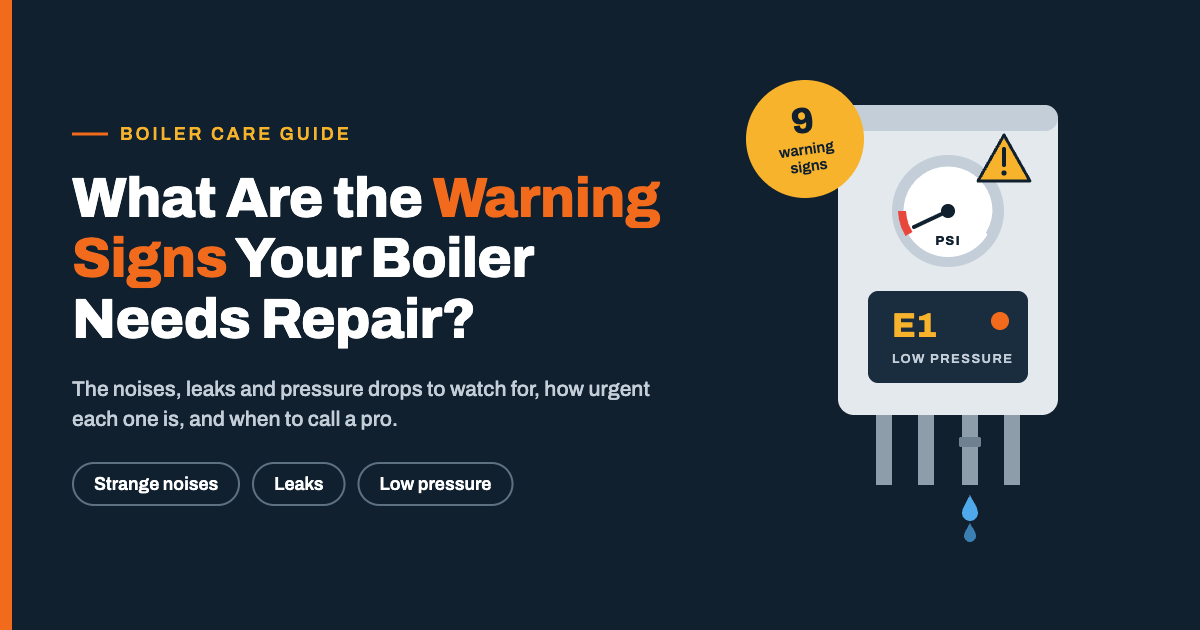
The clearest warning signs that your boiler needs repair are strange noises, water leaks, dropping pressure, a yellow or flickering flame, radiators that stay cold, and heating bills that keep rising. Any gas smell or carbon monoxide alarm is an emergency, not a warning sign: leave the home and call for help from outside.
Boilers rarely fail without notice. They usually give you weeks of small clues first. Learning to read those clues helps you book a fix while it is still small, affordable and on your schedule rather than on the coldest night of the year.
9 Warning Signs Your Boiler Needs Repair
- Banging, gurgling or whistling noises. A rumbling "kettle" sound usually means limescale or sludge on the heat exchanger. Gurgling often points to trapped air or low water pressure.
- Water leaks or drips. The U.S. Department of Energy lists water leaking from a boiler as one of the easiest problems to spot. Leaks often come from a failing pump seal, pressure-relief valve or corroded pipe. Left alone, they damage floors and electrical parts.
- Pressure keeps dropping. Most home hot-water boilers run at about 12–15 psi when cold. If you keep topping it up, there is a leak somewhere in the system.
- A yellow or orange flame. A healthy gas flame burns crisp blue. A lazy yellow flame suggests incomplete combustion, which can produce carbon monoxide.
- The pilot light keeps going out. This often points to a faulty thermocouple, a draft or a gas supply issue.
- Radiators heat unevenly. Cold spots at the top usually mean trapped air. Cold at the bottom usually means sludge buildup.
- No hot water or heat at all. Check the thermostat and power first. If both are fine, a diverter valve, pump or ignition part may have failed.
- Rising energy bills. If your usage has not changed but bills have, your boiler is burning more fuel for the same heat.
- Soot, odors or a CO alarm. Black marks around the boiler, a musty or gas smell, or a carbon monoxide alarm all need immediate attention.
How Urgent Is It? A Quick Guide
Not every sign means the same level of risk. Use this table to decide how fast to act.
|
Warning sign |
Likely cause |
How urgent |
|---|---|---|
|
Gas smell or CO alarm |
Gas leak or blocked flue |
Emergency: leave the home now |
|
Yellow or orange flame |
Incomplete combustion |
Same day |
|
Water leak |
Pump seal, relief valve or corrosion |
Within 24–48 hours |
|
Pressure keeps dropping |
Hidden leak in the system |
Within a few days |
|
No heat or hot water |
Pump, valve or ignition failure |
As soon as possible in cold weather |
|
Banging or kettling noise |
Limescale or sludge |
Book a service soon |
|
Cold spots on radiators |
Trapped air or sludge |
DIY first, then a pro |
|
Rising bills |
Falling efficiency |
At the next annual service |
What You Can Safely Check Yourself
A few simple checks can rule out minor issues before you book a visit. Stop at any step that involves opening the boiler casing or touching gas parts.
- Thermostat and timer. Confirm the heating is on, the set temperature is above room temperature, and the schedule is correct.
- Power and reset. Check the breaker and the boiler's power switch. Press the reset button once. If it locks out again, call a professional.
- Pressure gauge. If the pressure is low and your boiler has a fill valve, top it up to the manufacturer's level. If it drops again within days, there is a leak.
- Bleed radiators. With the heating off and cool, use a radiator key to release trapped air until water appears.
- Condensate pipe. On condensing boilers, a frozen or blocked outdoor drain pipe can shut the boiler down in winter.
When to Call a Boiler Repair Service
If a DIY check does not fix the problem, or the same issue returns, it is time for a professional. Boilers combine gas, high water pressure and electricity, so most repairs are not safe to attempt yourself.
Call a qualified boiler repair service aurora when you notice leaks, a yellow flame, repeated lockouts, pressure that will not hold or any unusual smell. A trained technician can test combustion, inspect the heat exchanger and flue, and check safety controls such as the pressure-relief valve.
If your home also has central air or a heat pump, working with an HVAC repair company that services both heating and cooling equipment means one team knows your whole system. That makes seasonal maintenance simpler and problems easier to trace.
Before the visit, note the boiler's make, model and age, any error code on its display, and when the problem started.
Repair or Replace? What Age and Efficiency Tell You
Repair usually makes sense for a newer boiler with a one-off fault. Replacement starts to make sense when the boiler is old, needs repairs every winter, or burns far more fuel than a modern unit.
According to the U.S. Department of Energy, older low-efficiency heating systems run at just 56–70% AFUE, while today's high-efficiency condensing models reach 90–98.5%. In practice, an old boiler can waste 30 to 44 cents of every fuel dollar. The DOE also flags units with a standing pilot light as strong candidates for replacement.
A good rule of thumb: if your boiler is over 15 years old and a single repair would cost a large share of a new one, get a replacement quote before you approve the repair.
How to Prevent Boiler Breakdowns
Most boiler failures trace back to skipped maintenance. A short routine keeps yours safe and efficient.
- Book a professional service every year, ideally in early autumn before the heating season.
- Check the pressure gauge once a month during winter.
- Bleed radiators at the start of each heating season.
- Keep the area around the boiler clear of storage, laundry and dust.
- Ask your technician about a magnetic filter or system flush if radiators show cold spots.
- Install carbon monoxide detectors near every sleeping area and test them when the clocks change, as the CDC recommends.
Frequently Asked Questions
Why is my boiler making a banging noise?
Banging or "kettling" is usually caused by limescale or sludge on the heat exchanger, which makes water overheat in spots. A power flush or descaling by a technician typically fixes it.
Is it dangerous if my boiler is leaking?
A small leak is not usually an immediate danger, but it can damage your home and electrical components. Turn off the boiler if water is near any wiring, and book a repair within a day or two.
Why does my boiler keep losing pressure?
Repeated pressure loss almost always means a leak, either from the pressure-relief valve, a radiator or a hidden pipe. Topping it up only treats the symptom.
What are the signs of carbon monoxide from a boiler?
Watch for soot, a yellow flame and a pilot light that keeps going out. In people, the CDC lists headache, dizziness, weakness, nausea and confusion as common symptoms. If you suspect CO, get everyone outside and call for help.
How often should a boiler be serviced?
Once a year. The CDC advises having heating systems inspected by a qualified technician annually.

 English
 Arabic
 French
 Spanish
 Portuguese
 Deutsch
 Turkish
 Italiano
 Russian
 Romaian
 Portuguese (Brazil)
 Greek
