


Boat Cover Poles: How to Choose the Right Support System
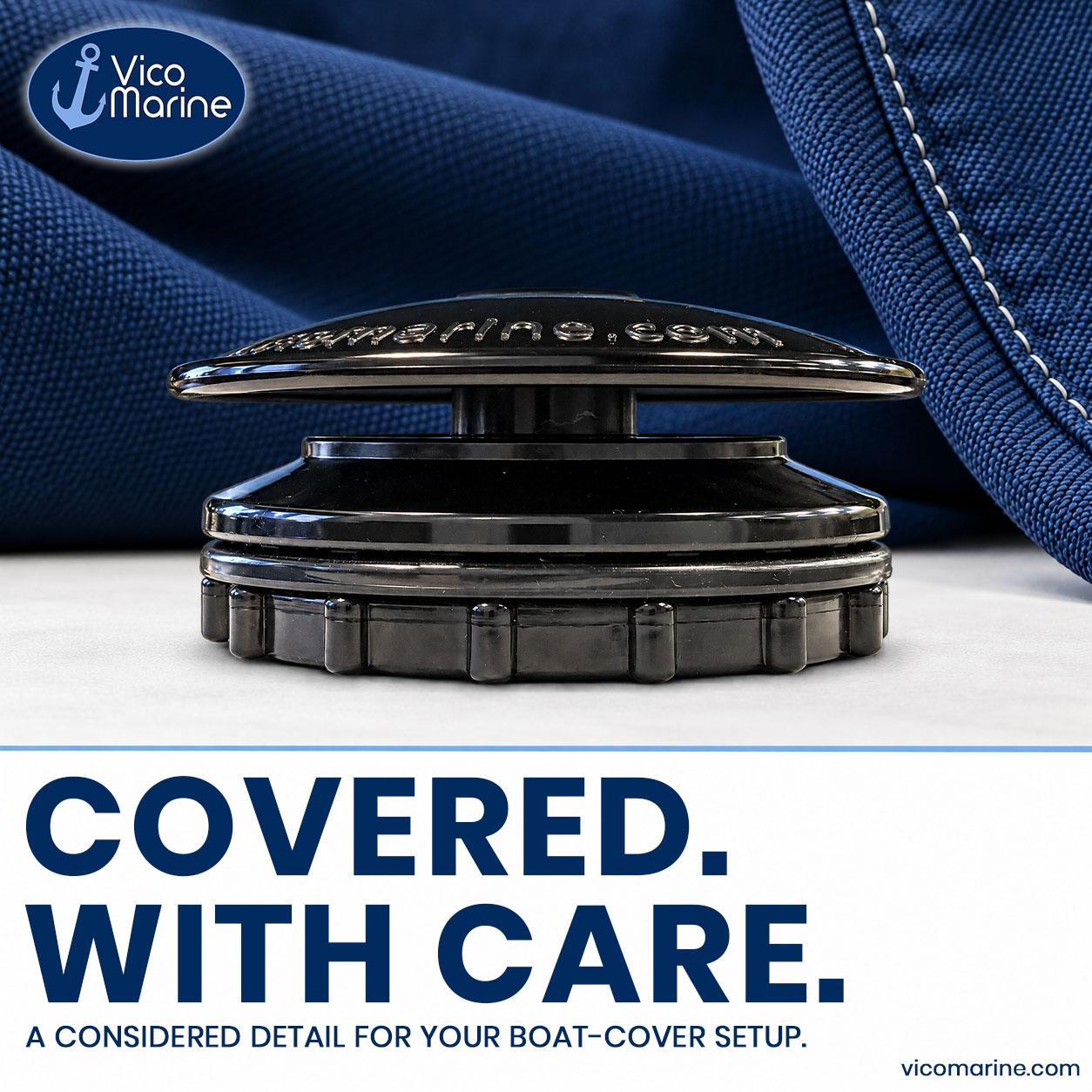
A well-fitted boat cover can still collect water if the fabric has nowhere to shed it. A shallow dip between seats or behind a windshield may become a pocket during rain, pulling the cover farther downward as water accumulates.
Boat cover poles help create raised support points beneath the fabric. Choosing them well means looking beyond maximum height: the upper fitting, base, adjustment mechanism, and cover layout all matter.
For boat owners replacing worn equipment, and canvas professionals planning a new cover, the best starting point is the same: understand how the complete setup will hold its shape.
Why Boat Cover Support Poles Matter
A support pole helps lift a designated area of the cover so the surrounding fabric can slope toward the edges. That slope gives rainwater a route off the boat instead of a place to collect.
Pooling can place extra strain on fabric, stitching, and attachment points. BoatUS Foundation’s storage-cover testing found that inadequate support and accumulated water could stretch fabric, pull stitching, and damage poles. BoatUS Foundation
The practical lesson is to assess the whole cover. One tall support does not necessarily eliminate a low section several feet away. A boat cover support system may need multiple supports or other components specified by the cover maker.
Support also differs from ventilation. Raising the fabric helps with shape and drainage; moving air beneath the cover requires a suitable ventilation arrangement. Both deserve attention during storage planning.
Adjustable and Telescoping Boat Cover Poles Explained
“Adjustable” describes the ability to change a pole’s height. “Telescoping” describes a construction in which nested tube sections slide to change that height. Telescoping boat cover poles are therefore one type of adjustable support.
The adjustment range lets you fit the pole to the actual distance between its base and the intended cover attachment. It also helps when small height changes are needed during setup.
Vico Marine’s Classic Series uses two telescoping sections and a flip-lock collar. Its Pro Series uses three sections and two flip-lock collars. Both published series specifications list anodized aluminum construction. cdn.shopify.com
Choose between configurations by checking the required working height, collapsed size, and attachment options. More sections do not automatically make a pole more suitable for your particular cover.
Five Details to Check Before Buying
1. Working Height
Measure where the pole will actually stand. A measurement from the cockpit floor may differ considerably from one taken above a raised platform.
Choose adjustable boat cover poles whose specified range includes the intended setup height. Follow the manufacturer’s extension limits rather than pulling the sections farther apart to gain extra reach.
2. Upper Attachment
The top fitting must match the cover’s connection. A snap fitting, grommet connection, and vent attachment serve different arrangements.
Vico lists plug, snap, swedge, and spline tip options. Its spline tip is intended for Boat Vent 2, Boat Vent 3, Boat Vent 4, and Flex Support. Confirm the exact combination when ordering replacement parts. Vico Marine
3. Base and Contact Surface
The base needs a suitable resting surface. Consider whether it will contact fiberglass, flooring, or another approved location, and check for anything that could let it shift.
Marine cover support poles should be selected with the base as carefully as the top fitting. A pole that reaches the cover but cannot remain stable has not solved the support problem.
4. Cover Condition
Look around existing attachment points for worn fabric, stretched areas, or failing stitching. New hardware should not be expected to compensate for damage that needs repair.
Provide a canvas professional with photographs of the full cover and close-ups of questionable areas. That helps separate a hardware replacement from a cover-repair job.
5. Intended Application
Storage covers, canopies, and freestanding shelters use different support arrangements. Boat canopy support poles and boat shelter support poles must suit their intended structures.
Do not assume that a pole designed to tent a fitted storage cover is interchangeable with a canopy-frame component or shelter post.
Comparing a Complete Pole and Cover Setup
A useful way to compare solutions is to follow each connection: cover to top fitting, fitting to pole, and pole to base. Check the compatibility of every component rather than choosing individual boat cover accessories independently.
Vico Marine’s Boat Cover Poles offer telescoping adjustment and several tip styles for different cover arrangements. The company also offers an optional swivel base with a thermoplastic rubber pad, intended to improve stability and distribute contact pressure. Vico Marine
When comparing a boat cover pole system, ask what is included and what must be ordered separately. Record the pole model, tip, base, and compatible cover hardware so future replacements are easier to identify.
Positioning the Poles Correctly
Begin with the cover positioned as its manufacturer directs. Identify designated support attachments and areas that would otherwise form low pockets.
Place each pole on an appropriate surface and adjust it gradually. The aim is a supported slope, not excessive tension concentrated at one small point.
Vico’s guidance calls for its poles to stand straight up and down under the cover; uneven side loading can damage the pole, boat, or fabric. vicomarine.com
After securing the cover, inspect it from outside. Check that the poles remain upright and that a raised section has not left another area sagging. Follow the cover maker’s instructions for any additional straps or supports.
Maintaining Boat Cover Support Over Time
Recheck the setup after the cover has settled and after significant weather. A support arrangement that looked correct initially may need attention if fabric shifts or hardware loosens.
Vico recommends monthly inspection of the flip-lock collar, aluminum tubing, and crutch tip. Follow its adjustment instructions for the specific hardware rather than tightening parts by guesswork. vicomarine.com
Keep the cover clean according to its fabric-care instructions. Inspect contact points, clear debris, and address recurring pooling promptly. Before trailering or using the cover in different conditions, confirm that both the cover and support arrangement are approved for that use.
Frequently Asked Questions
How many boat cover poles do I need?
There is no universal number. Cover shape, unsupported spans, designated attachment points, and storage conditions determine the arrangement. Ask the cover manufacturer or canvas installer to assess the full layout.
Are adjustable and telescoping poles the same?
Not exactly. Adjustable means the height can change; telescoping means sliding tube sections provide that adjustment. Check the actual height range and locking method for the product you are considering.
Can support poles prevent every water pocket?
No. Effective drainage depends on cover fit, tension, support locations, and overall shape. If water still collects, review the complete arrangement rather than simply extending one pole higher.
Should I buy the tallest pole available?
Choose the range that fits the intended position. Maximum height alone says little about tip compatibility, base stability, or whether the pole will work with your cover.

 English
 Arabic
 French
 Spanish
 Portuguese
 Deutsch
 Turkish
 Dutch
 Russian
 Romaian
 Portuguese (Brazil)
 Greek
