


Blended Learning at Scale: How a Learning Management System Connects Live Classes, Online Courses, and Mobile Learning
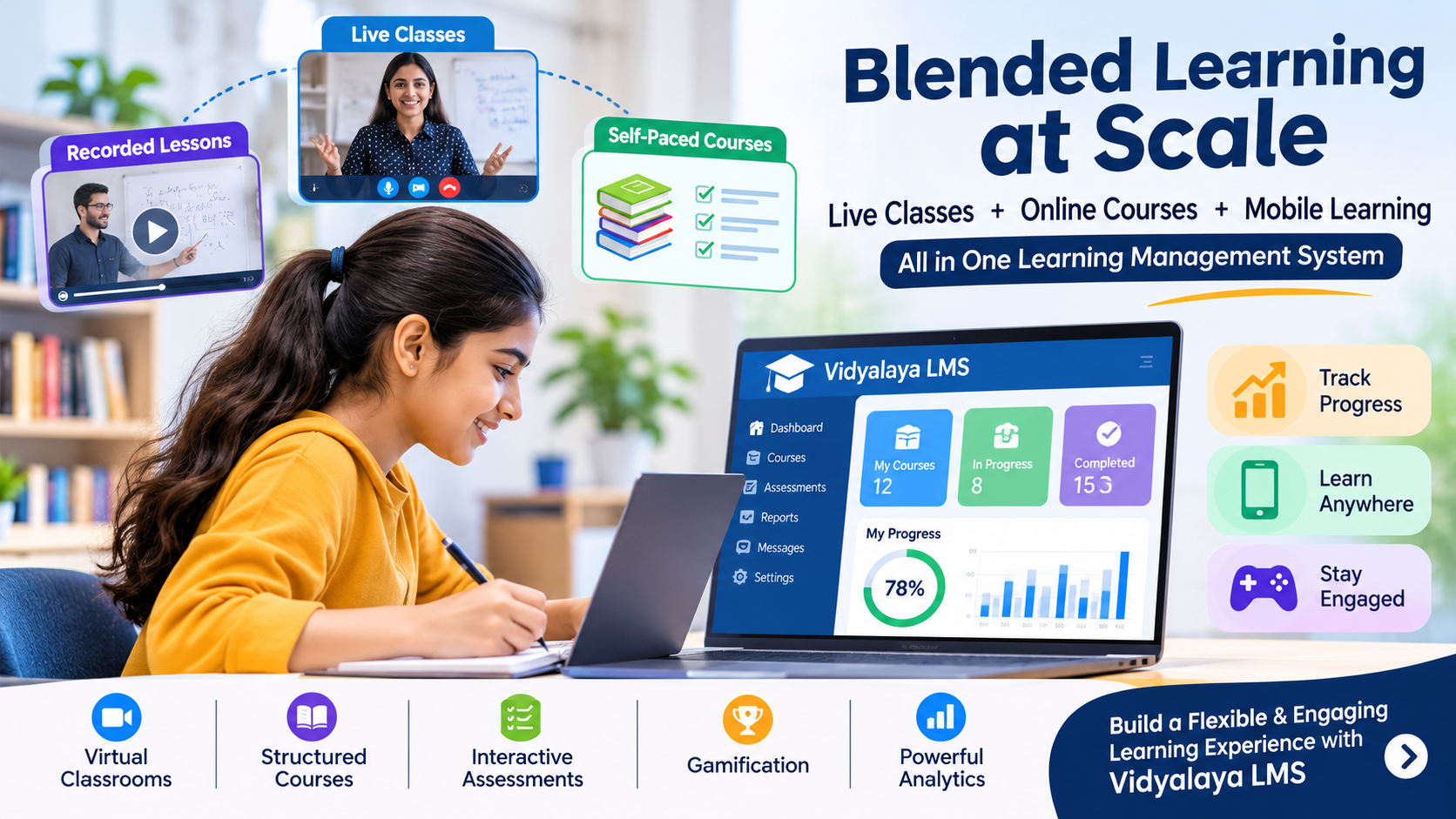
Learning no longer happens only inside a classroom or a scheduled training session. Students attend virtual classes, employees complete professional training online, and instructors share recorded lessons for flexible learning. Organizations are combining different learning methods to make education more accessible, engaging, and convenient.
However, managing these activities across separate platforms can create challenges. Course materials may be scattered, attendance records may be disconnected, and instructors may struggle to monitor learner participation.
A modern Learning Management System (LMS) brings these activities together. It provides a centralized environment where administrators can organize courses, deliver live sessions, share learning resources, conduct assessments, and track learner progress.
Why Is Blended Learning Becoming Important?
Blended learning combines instructor-led teaching with digital and self-paced learning activities. It gives learners the flexibility to study independently while retaining opportunities to interact with instructors and classmates.
For educational institutions, this approach can support classroom teaching, virtual lessons, recorded lectures, and online assignments. Businesses can use it to combine instructor-led workshops, employee onboarding, product demonstrations, and self-paced professional training.
A well-structured blended learning program offers several advantages:
-
Learners can access resources beyond scheduled sessions.
-
Instructors can combine live teaching with independent study.
-
Organizations can deliver consistent training across locations.
-
Recorded content can be reused for future learning programs.
-
Assessments help evaluate understanding and course progress.
The challenge is coordinating all these activities effectively. This is where an integrated LMS becomes valuable.
1. Bring Live and Virtual Classrooms Together
Live learning provides direct interaction between instructors and learners. Participants can ask questions, discuss concepts, and receive explanations in real time.
An LMS that supports virtual classroom integration can help instructors organize online sessions alongside regular course activities.
For example, a school can schedule a live mathematics class, share supporting materials, and provide related assignments through the same learning environment. Similarly, a business can conduct product training sessions for employees working across different locations.
Integration with video conferencing tools such as Zoom and Google Meet can help connect virtual sessions with the wider learning process.
2. Make Recorded Lessons Available for Flexible Learning
Not every learner can attend a live session. Work schedules, time differences, personal commitments, and internet availability can affect participation.
Recorded lessons provide an alternative by allowing learners to revisit explanations and study at a convenient time.
A centralized learning platform can organize recorded sessions with relevant courses and learning materials. Learners can review important topics, revise difficult concepts, and prepare for assessments without depending entirely on live instruction.
For organizations, recorded training content can also support employee onboarding and recurring training programs.
3. Organize Self-Paced Courses and Learning Resources
Self-paced learning allows individuals to progress through course material according to their availability and learning requirements.
However, flexibility should not mean a lack of structure. Learners need a clear sequence of topics, resources, activities, and assessments.
A Learning Management System helps instructors organize courses into modules and learning paths. Depending on platform capabilities, resources can include:
-
Video lessons and recorded sessions
-
PDFs, documents, and presentations
-
Audio and interactive learning materials
-
Online quizzes and assignments
-
External learning resources and links
-
SCORM-compatible course content
This structure helps learners understand what they need to complete and gives instructors a consistent way to organize digital education programs.
4. Keep Learners Engaged with Interactive Activities
One of the challenges of online learning is maintaining participation over time. Simply uploading course materials does not guarantee that learners will remain interested or complete their programs.
Interactive activities can make learning more participatory. Quizzes, discussion forums, messaging, assignments, and collaborative sessions give learners opportunities to engage with the content.
Gamification can add another layer of motivation. Points, badges, leaderboards, and rewards can encourage participation when they are connected to meaningful learning activities.
For example, a corporate training program can award points for completing modules and passing assessments. An educational institution can use quizzes and learning challenges to encourage students to revise their lessons.
5. Monitor Learner Progress Across Different Formats
When learning happens through live classes, recorded lessons, and self-paced courses, administrators need a clear view of learner activity.
A centralized LMS can provide reports and dashboards that help instructors review course participation, assessment performance, completion status, and other available learning metrics.
These insights can help identify:
-
Learners who have not completed assigned modules.
-
Courses with lower participation.
-
Topics where learners frequently struggle.
-
Assessment results that require additional attention.
-
Training programs that may need content updates.
Learning analytics can support more informed decisions, but reports are most useful when instructors interpret them alongside learner feedback and actual performance.
6. Extend Learning Through Mobile Access
Mobile learning gives students and employees more flexibility to access digital resources beyond desktops and classrooms.
A mobile-friendly LMS application can provide access to courses, recorded lessons, assignments, notifications, and communication tools, depending on the platform's supported features.
For schools, this can help students and teachers stay connected with learning activities outside regular class hours. For businesses, mobile access can support employees who work remotely, travel frequently, or operate across multiple locations.
The result is a more accessible learning environment where participation is not restricted to a particular place or device.
7. Connect Assessments with Learning Activities
Assessments are essential for understanding whether learners have achieved the objectives of a course.
A blended learning program can combine different evaluation methods, such as online quizzes, assignments, timed tests, and instructor-led assessments.
An LMS helps organize these activities alongside course content. Instructors can review assessment results, identify knowledge gaps, and provide additional learning resources where required.
For corporate training, assessments can help evaluate product knowledge, process understanding, and employee readiness. In educational settings, they can support regular academic evaluation and revision.
How Vidyalaya LMS Supports Blended Learning
Vidyalaya LMS provides a centralized platform for managing digital learning activities across educational institutions and business training environments.
Its capabilities support different stages of the learning process, including course creation, content management, virtual classrooms, assessments, learner communication, and progress tracking.
Key capabilities include:
-
Live Classrooms: Support virtual learning sessions through integrations with tools such as Zoom and Google Meet.
-
Recorded Classes: Give learners access to recorded lessons for revision and flexible study.
-
Course Management: Organize users, courses, learning materials, and access permissions.
-
Learning Paths: Structure learning activities into planned sequences.
-
Assessments and Quizzes: Create online evaluations and monitor learner performance.
-
Gamification: Use points, badges, and leaderboards to encourage participation.
-
Mobile Learning: Support learning access through mobile applications.
-
Reports and Analytics: Review available course, user, and assessment information.
-
Integrations: Connect with relevant external tools and learning resources.
Organizations can explore the Learning Management System to understand how these capabilities can support their digital learning requirements.
What Should You Look for in a Blended Learning Platform?
Before selecting an LMS, evaluate whether it can support the complete learning process rather than only online course delivery.
Consider these factors:
-
Multiple learning formats: Does it support live sessions, recorded content, digital documents, and self-paced courses?
-
Course organization: Can administrators create structured courses and learning paths?
-
Learner engagement: Are quizzes, discussions, assignments, and gamification available?
-
Progress tracking: Can instructors review course completion and assessment performance?
-
Mobile accessibility: Can learners access relevant resources through supported mobile devices?
-
Integration capabilities: Can the LMS connect with video conferencing and other existing systems?
-
Security and access control: Can administrators manage user roles and permissions appropriately?
The right platform should align with the organization's teaching or training model and provide room for future growth.
Conclusion
Blended learning is creating new opportunities for educational institutions and businesses to deliver training through a combination of live instruction, recorded lessons, digital courses, and independent study.
Managing these formats effectively requires a connected platform that brings course content, communication, assessments, and learner progress together.
A well-equipped Learning Management System helps organizations coordinate these activities, support flexible learning, and maintain better visibility into training outcomes.
Vidyalaya LMS provides tools to manage digital courses, virtual classrooms, assessments, mobile learning, and learner progress through a centralized platform. Institutions and businesses can evaluate its capabilities to build a more connected and flexible learning environment.

 Russian
 English
 Arabic
 French
 Spanish
 Portuguese
 Deutsch
 Turkish
 Dutch
 Italiano
 Romaian
 Portuguese (Brazil)
 Greek
