


Connected Campus Management: How an Online School Portal and Campus ERP Simplify Educational Operations
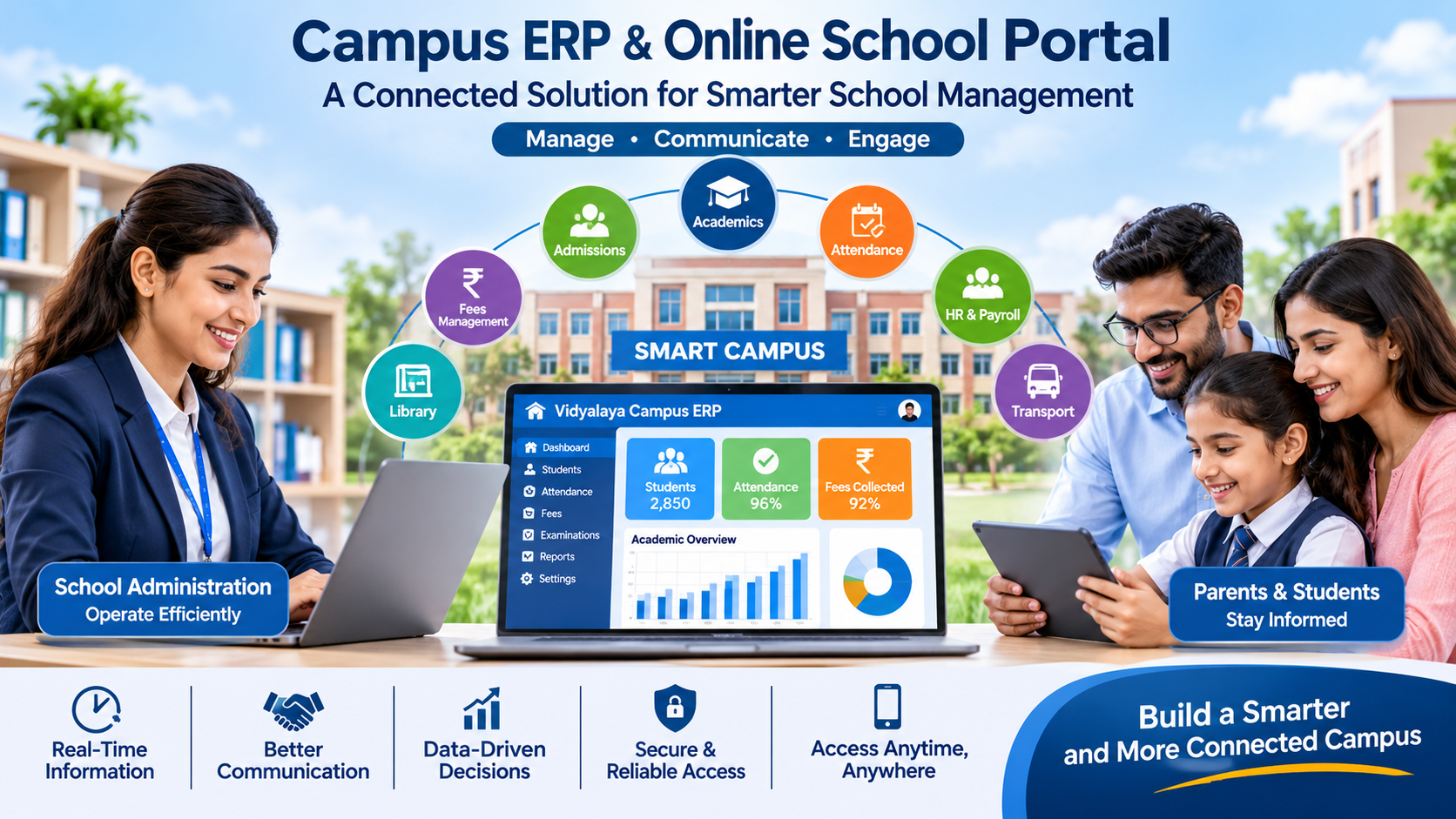
Educational institutions manage multiple activities every day, from student admissions and attendance to fee collection, examinations, employee administration, and parent communication. As schools and colleges grow, coordinating these responsibilities through separate systems can become increasingly complicated.
Parents want quick access to academic updates, teachers need organized student information, and administrators require a complete view of institutional operations. Managing these expectations requires more than individual digital tools. Educational institutions need a connected system that brings campus activities and stakeholder communication together.
An Online School Portal combined with Campus ERP Software provides a practical way to achieve this. While the portal gives parents, students, teachers, and management convenient access to relevant information, Campus ERP coordinates the academic, administrative, financial, and resource-related processes behind the institution.
Why Do Educational Institutions Need Connected Digital Systems?
Many institutions maintain separate records for student information, attendance, examinations, fees, library activities, and employee management. When these records are not properly connected, staff may need to enter the same information repeatedly or collect reports from different departments.
A connected digital environment helps reduce these gaps by bringing important institutional information into a centralized system.
For example, when a student's attendance is updated, authorized users can access the relevant information through their designated portal accounts. Similarly, parents can review available fee details, examination schedules, academic results, and other student-related updates without repeatedly contacting the school office.
This approach supports better coordination between departments and creates a more transparent communication process.
1. Give Parents and Students Anytime Access to Important Information
Parents regularly need information about their children's academic and administrative activities. Visiting the school or contacting teachers for every update can be inconvenient.
An online school portal provides a common digital access point where authorized parents and students can view relevant information through individual login credentials.
Depending on the enabled modules, the portal can provide access to:
-
Student personal and academic details.
-
Attendance records and presence reports.
-
Examination schedules and results.
-
Fee details and payment information.
-
Library information and issued books.
-
Student health and activity records.
-
Holiday lists and school announcements.
This makes routine information easier to access and helps parents remain connected with their children's educational progress.
2. Help Teachers Manage Academic Information Efficiently
Teachers work with multiple classes, subjects, student records, and academic schedules. A centralized system can help them access relevant information without depending on separate registers or manual reports.
Through their assigned portal access, teachers can review student details and other available academic information. When connected with the wider campus management system, they can also coordinate activities such as attendance, examination records, and academic updates.
This creates a more organized working environment and allows teachers to focus more attention on instruction and student development.
3. Centralize Institutional Operations with Campus ERP
An online portal mainly focuses on providing information access to different stakeholders. Campus ERP goes further by coordinating the operational processes that generate and maintain that information.
A comprehensive campus management system can connect several departments through dedicated modules.
Important capabilities may include:
-
Admission Management: Handle enquiries, applications, admission records, and enrollment activities.
-
Student Management: Maintain student profiles, guardian details, documents, and academic information.
-
Attendance Management: Record and monitor student and employee attendance.
-
Fees Management: Manage fee structures, collections, concessions, and financial reports.
-
Timetable Management: Coordinate class schedules, subjects, and teacher availability.
-
Examination Management: Organize assessments, marks, results, and report cards.
-
HR and Payroll: Maintain employee records, leave details, and salary information.
-
Resource Management: Coordinate transport, library, hostel, inventory, accounting, and assets.
When these functions operate through an integrated platform, administrators can manage more institutional activities from a common environment.
4. Provide Separate Dashboards for Different Users
Not every stakeholder needs access to the same information. Parents generally require student-related updates, teachers need academic information, and management needs broader operational visibility.
A role-based dashboard helps organize access according to user responsibilities.
For example:
-
Parent Dashboard: Student attendance, fees, examination schedules, results, and other available updates.
-
Student Dashboard: Academic information, timetable, learning-related details, and examination records.
-
Teacher Dashboard: Student information and relevant academic and administrative activities.
-
Management Dashboard: Institutional reports, operational information, and administrative summaries.
Separate user dashboards make information easier to navigate while supporting controlled access to institutional records.
5. Improve Communication Between Institutions and Families
Communication is an essential part of effective campus administration. Schools regularly share circulars, announcements, examination schedules, fee reminders, event details, and important notices.
A connected portal and ERP environment can help institutions coordinate communication using supported channels such as SMS, email, mobile applications, and WhatsApp integration.
Parents can receive relevant updates, while teachers and administrators can share information through the communication facilities available to their user accounts.
This reduces dependence on repeated manual communication and helps maintain a more consistent information flow.
6. Use Centralized Reports for Better Administrative Decisions
Campus administrators need accurate information to understand institutional performance and plan future activities.
A connected ERP system can bring information from different departments into reports and dashboards. These may cover student strength, admission activity, attendance status, fee collection, employee records, and other operational indicators.
The online portal also allows authorized stakeholders to access relevant student information and reports.
When data is maintained consistently, management can review institutional activities more efficiently and identify areas requiring attention.
7. Support Campus Growth Through Integrated Technology
As institutions expand, their administrative requirements become more complex. New departments, additional student batches, multiple campuses, and changing academic requirements can increase the workload on management teams.
A scalable Campus ERP platform can help institutions coordinate these expanding operations through configurable modules and integrations.
Depending on institutional requirements, integrations may include:
-
Online payment gateways.
-
Biometric attendance systems.
-
Vehicle tracking systems.
-
Online examinations and virtual classrooms.
-
SMS and email communication.
-
Mobile applications.
-
Accounting software integration.
-
WhatsApp communication.
These integrations help connect different digital activities instead of managing every process independently.
How Vidyalaya Connects Online Portal and Campus ERP
Vidyalaya offers an integrated educational management platform that combines campus operations with stakeholder access.
Its Online School Portal provides a common gateway for parents, students, teachers, and other authorized users. It supports access to information such as student details, attendance, fees, examination schedules, results, library records, health details, and activities.
Its Campus ERP Software brings core administrative and academic processes together through modules covering admissions, student management, attendance, fees, timetables, assessments, HR, payroll, accounting, transport, library, hostel, inventory, and other campus resources.
The Campus ERP solution also offers separate dashboards for parents, students, teachers, and management, along with reporting and integration capabilities.
Together, these solutions help institutions coordinate internal operations while giving stakeholders convenient access to relevant information.
What Should You Consider Before Choosing a Campus Management Solution?
Selecting the right digital platform requires understanding the institution's operational needs and long-term plans.
Consider these factors before making a decision:
-
Portal accessibility: Can parents, students, and teachers access their relevant information through individual accounts?
-
Module coverage: Does the solution support admissions, attendance, fees, examinations, HR, and resource management?
-
Role-based access: Can administrators assign appropriate permissions to different users?
-
Integration capabilities: Can the platform connect with payment gateways, biometric devices, mobile applications, and communication tools?
-
Reporting facilities: Can management generate useful reports for institutional planning?
-
Customization: Can the system accommodate specific campus workflows and institutional requirements?
-
Security and support: Does the provider offer appropriate data protection, implementation assistance, and ongoing technical support?
A suitable solution should support daily institutional activities while remaining adaptable to future requirements.
Conclusion
Modern educational institutions need more than isolated software tools to manage their growing responsibilities. They need a connected digital environment that supports administrative coordination and keeps parents, students, teachers, and management informed.
An Online School Portal provides convenient access to student-related information, while Campus ERP coordinates the academic, administrative, financial, and resource management processes behind the institution.
Vidyalaya brings these capabilities together through its integrated solutions, helping schools and educational institutions manage campus operations and stakeholder communication through a centralized platform.


 English
 Arabic
 French
 Portuguese
 Deutsch
 Turkish
 Dutch
 Italiano
 Russian
 Romaian
 Portuguese (Brazil)
 Greek
