



IN BREME NOBODY TRULY LACKS A NEIGHBOUR — UNDERSTANDING THE SOCIAL SOUL OF THIS COMMUNITY
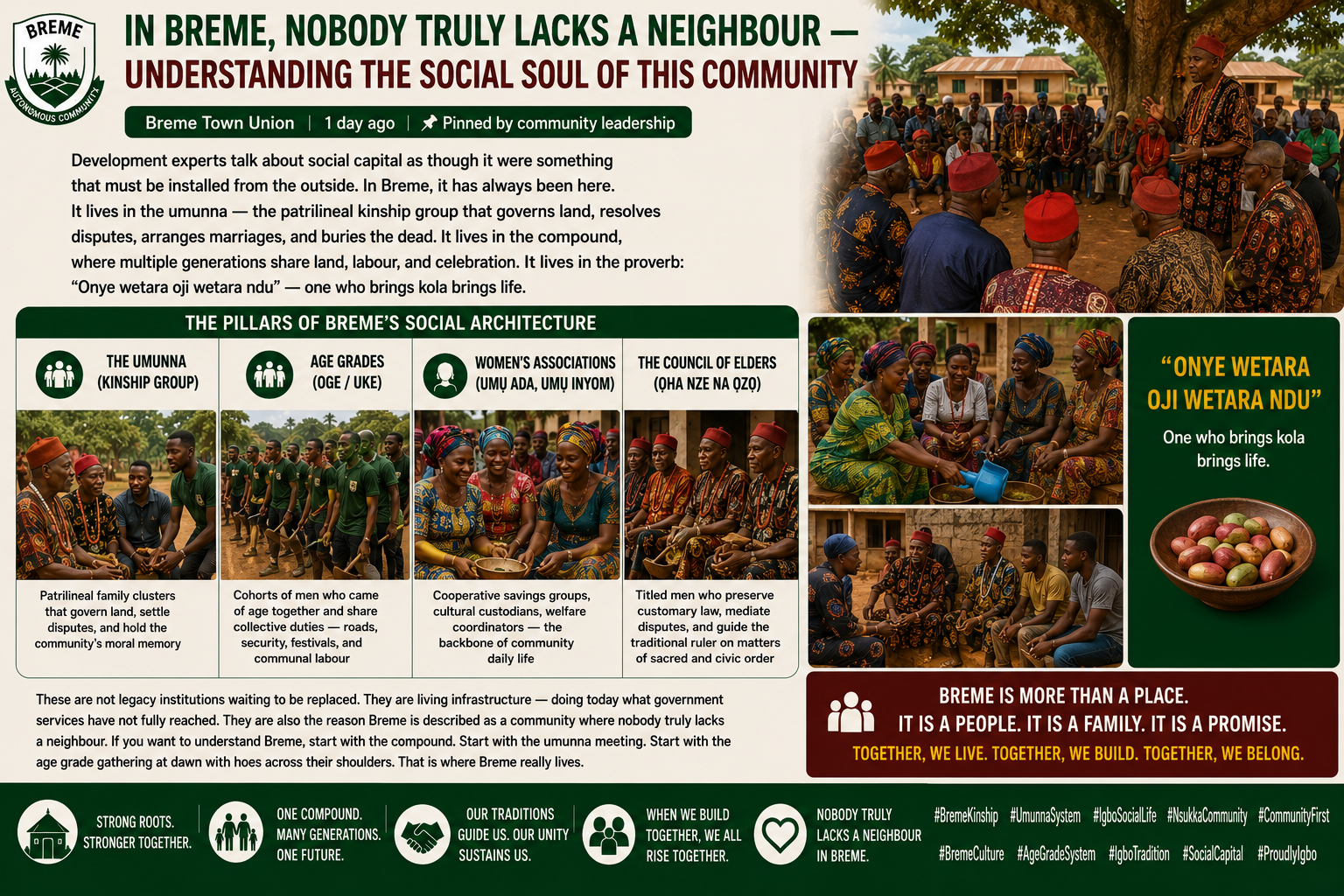
Development experts talk about social capital as though it were something that must be installed from the outside. In Breme, it has always been here. It lives in the umunna — the patrilineal kinship group that governs land, resolves disputes, arranges marriages, and buries the dead. It lives in the compound, where multiple generations share land, labour, and celebration. It lives in the proverb: "Onye wetara oji wetara ndu" — one who brings kola brings life.
The pillars of Breme's social architecture:
1. The Umunna (Kinship Group)
(Patrilineal family clusters that govern land, settle disputes, and hold the community's moral memory)
2. Age Grades (Oge / Uke)
(Cohorts of men who came of age together and share collective duties — roads, security, festivals, and communal labour)
3. Women's Associations (Ụmụ Ada, Ụmụ Inyom)
(Cooperative savings groups, cultural custodians, welfare coordinators — the backbone of community daily life)
4. The Council of Elders (Ọha Nze na Ọzọ)
(Titled men who preserve customary law, mediate disputes, and guide the traditional ruler on matters of sacred and civic order)
These are not legacy institutions waiting to be replaced. They are living infrastructure — doing today what government services have not fully reached. They are also the reason Breme is described as a community where nobody truly lacks a neighbour. If you want to understand Breme, start with the compound. Start with the umunna meeting. Start with the age grade gathering at dawn with hoes across their shoulders. That is where Breme really lives.
#BremeKinship #UmunnaSystem #IgboSocialLife #NsukkaCommunity #CommunityFirst #AutonomousCommunities
Development experts talk about social capital as though it were something that must be installed from the outside. In Breme, it has always been here. It lives in the umunna — the patrilineal kinship group that governs land, resolves disputes, arranges marriages, and buries the dead. It lives in the compound, where multiple generations share land, labour, and celebration. It lives in the proverb: "Onye wetara oji wetara ndu" — one who brings kola brings life.
The pillars of Breme's social architecture:
1. The Umunna (Kinship Group)
(Patrilineal family clusters that govern land, settle disputes, and hold the community's moral memory)
2. Age Grades (Oge / Uke)
(Cohorts of men who came of age together and share collective duties — roads, security, festivals, and communal labour)
3. Women's Associations (Ụmụ Ada, Ụmụ Inyom)
(Cooperative savings groups, cultural custodians, welfare coordinators — the backbone of community daily life)
4. The Council of Elders (Ọha Nze na Ọzọ)
(Titled men who preserve customary law, mediate disputes, and guide the traditional ruler on matters of sacred and civic order)
These are not legacy institutions waiting to be replaced. They are living infrastructure — doing today what government services have not fully reached. They are also the reason Breme is described as a community where nobody truly lacks a neighbour. If you want to understand Breme, start with the compound. Start with the umunna meeting. Start with the age grade gathering at dawn with hoes across their shoulders. That is where Breme really lives.
#BremeKinship #UmunnaSystem #IgboSocialLife #NsukkaCommunity #CommunityFirst #AutonomousCommunities
IN BREME NOBODY TRULY LACKS A NEIGHBOUR — UNDERSTANDING THE SOCIAL SOUL OF THIS COMMUNITY
Development experts talk about social capital as though it were something that must be installed from the outside. In Breme, it has always been here. It lives in the umunna — the patrilineal kinship group that governs land, resolves disputes, arranges marriages, and buries the dead. It lives in the compound, where multiple generations share land, labour, and celebration. It lives in the proverb: "Onye wetara oji wetara ndu" — one who brings kola brings life.
The pillars of Breme's social architecture:
1. The Umunna (Kinship Group)
(Patrilineal family clusters that govern land, settle disputes, and hold the community's moral memory)
2. Age Grades (Oge / Uke)
(Cohorts of men who came of age together and share collective duties — roads, security, festivals, and communal labour)
3. Women's Associations (Ụmụ Ada, Ụmụ Inyom)
(Cooperative savings groups, cultural custodians, welfare coordinators — the backbone of community daily life)
4. The Council of Elders (Ọha Nze na Ọzọ)
(Titled men who preserve customary law, mediate disputes, and guide the traditional ruler on matters of sacred and civic order)
These are not legacy institutions waiting to be replaced. They are living infrastructure — doing today what government services have not fully reached. They are also the reason Breme is described as a community where nobody truly lacks a neighbour. If you want to understand Breme, start with the compound. Start with the umunna meeting. Start with the age grade gathering at dawn with hoes across their shoulders. That is where Breme really lives.
#BremeKinship #UmunnaSystem #IgboSocialLife #NsukkaCommunity #CommunityFirst #AutonomousCommunities

 English
 Arabic
 French
 Spanish
 Portuguese
 Deutsch
 Turkish
 Dutch
Dutch
 Italiano
 Russian
 Romaian
 Greek
Greek
