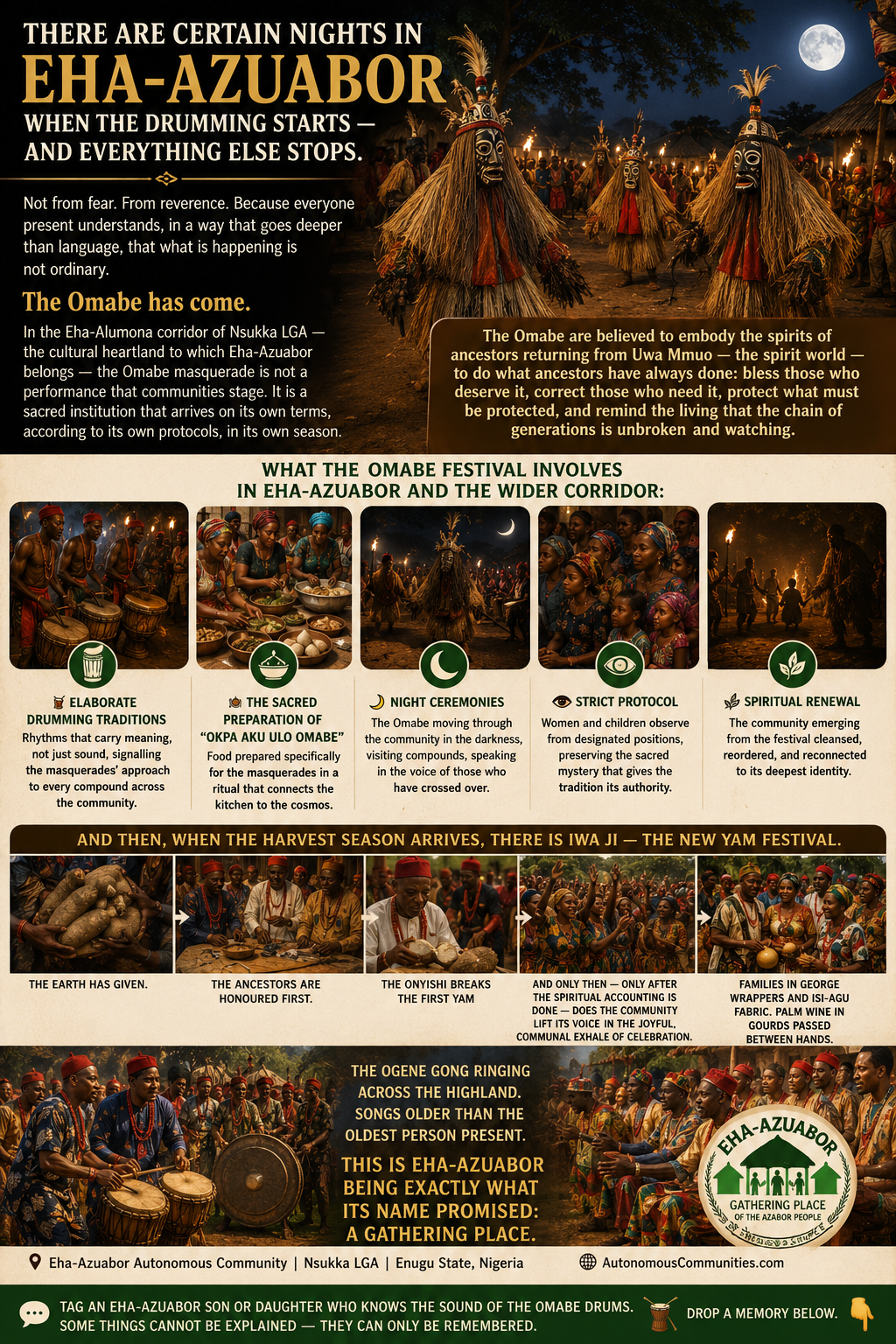
• πŸŒ™ THERE ARE CERTAIN NIGHTS IN EHA-AZUABOR WHEN THE DRUMMING STARTS — AND EVERYTHING ELSE STOPS.

    Not from fear. From reverence. Because everyone present understands, in a way that goes deeper than language, that what is happening is not ordinary.
    The Omabe has come.
    In the Eha-Alumona corridor of Nsukka LGA — the cultural heartland to which Eha-Azuabor belongs — the Omabe masquerade is not a performance that communities stage. It is a sacred institution that arrives on its own terms, according to its own protocols, in its own season. πŸ₯
    The Omabe are believed to embody the spirits of ancestors returning from Ềwa Mmα»₯ọ — the spirit world — to do what ancestors have always done: bless those who deserve it, correct those who need it, protect what must be protected, and remind the living that the chain of generations is unbroken and watching.

    What the Omabe Festival involves in Eha-Azuabor and the wider corridor:
    πŸ₯ Elaborate drumming traditions — rhythms that carry meaning, not just sound, signalling the masquerades' approach to every compound across the community
    🍽️ The sacred preparation of "ọkpa akα»₯ α»₯lọ Ọmabe" — food prepared specifically for the masquerades in a ritual that connects the kitchen to the cosmos
    πŸŒ™ Night ceremonies — the Omabe moving through the community in the darkness, visiting compounds, speaking in the voice of those who have crossed over
    πŸ‘οΈ Strict protocol — women and children observe from designated positions, preserving the sacred mystery that gives the tradition its authority
    🌿 Spiritual renewal — the community emerging from the festival cleansed, reordered, and reconnected to its deepest identity
    And then, when the harvest season arrives, there is Iwa Ji — the New Yam Festival. The earth has given. The ancestors are honoured first. 🍠 The Onyishi breaks the first yam in ritual thanksgiving. And only then — only after the spiritual accounting is done — does the community lift its voice in the joyful, communal exhale of celebration.
    Families in George wrappers and isi-agu fabric. Palm wine in gourds passed between hands. The ogene gong ringing across the highland. Songs older than the oldest person present.
    This is Eha-Azuabor being exactly what its name promised: a gathering place.

    πŸ“ Eha-Azuabor Autonomous Community | Nsukka LGA | Enugu State, Nigeria
    🌐 AutonomousCommunities.com

    ━━━━━━━━━━━━━━━━━━━━━━━━━━━━━━━━━━
    πŸ’¬ Tag an Eha-Azuabor son or daughter who knows the sound of the Omabe drums. Some things cannot be explained — they can only be remembered. πŸ₯ Drop a memory below. πŸ‘‡
    ━━━━━━━━━━━━━━━━━━━━━━━━━━━━━━━━━━

    #EhaAzuabor #OmabeFestival #IwaJi #NewYamFestival #NsukkaMasquerade #EhaAlumona #IgboMasquerade #MmanwuNigeria #NsukkaNigeria #EnuguState #AncestralTradition #NsukkaCulture #IgboFestival #AutonomousCommunities #SacredTradition
    πŸŒ™ THERE ARE CERTAIN NIGHTS IN EHA-AZUABOR WHEN THE DRUMMING STARTS — AND EVERYTHING ELSE STOPS. Not from fear. From reverence. Because everyone present understands, in a way that goes deeper than language, that what is happening is not ordinary. The Omabe has come. In the Eha-Alumona corridor of Nsukka LGA — the cultural heartland to which Eha-Azuabor belongs — the Omabe masquerade is not a performance that communities stage. It is a sacred institution that arrives on its own terms, according to its own protocols, in its own season. πŸ₯ The Omabe are believed to embody the spirits of ancestors returning from Ềwa Mmα»₯ọ — the spirit world — to do what ancestors have always done: bless those who deserve it, correct those who need it, protect what must be protected, and remind the living that the chain of generations is unbroken and watching. What the Omabe Festival involves in Eha-Azuabor and the wider corridor: πŸ₯ Elaborate drumming traditions — rhythms that carry meaning, not just sound, signalling the masquerades' approach to every compound across the community 🍽️ The sacred preparation of "ọkpa akα»₯ α»₯lọ Ọmabe" — food prepared specifically for the masquerades in a ritual that connects the kitchen to the cosmos πŸŒ™ Night ceremonies — the Omabe moving through the community in the darkness, visiting compounds, speaking in the voice of those who have crossed over πŸ‘οΈ Strict protocol — women and children observe from designated positions, preserving the sacred mystery that gives the tradition its authority 🌿 Spiritual renewal — the community emerging from the festival cleansed, reordered, and reconnected to its deepest identity And then, when the harvest season arrives, there is Iwa Ji — the New Yam Festival. The earth has given. The ancestors are honoured first. 🍠 The Onyishi breaks the first yam in ritual thanksgiving. And only then — only after the spiritual accounting is done — does the community lift its voice in the joyful, communal exhale of celebration. Families in George wrappers and isi-agu fabric. Palm wine in gourds passed between hands. The ogene gong ringing across the highland. Songs older than the oldest person present. This is Eha-Azuabor being exactly what its name promised: a gathering place. πŸ“ Eha-Azuabor Autonomous Community | Nsukka LGA | Enugu State, Nigeria 🌐 AutonomousCommunities.com ━━━━━━━━━━━━━━━━━━━━━━━━━━━━━━━━━━ πŸ’¬ Tag an Eha-Azuabor son or daughter who knows the sound of the Omabe drums. Some things cannot be explained — they can only be remembered. πŸ₯ Drop a memory below. πŸ‘‡ ━━━━━━━━━━━━━━━━━━━━━━━━━━━━━━━━━━ #EhaAzuabor #OmabeFestival #IwaJi #NewYamFestival #NsukkaMasquerade #EhaAlumona #IgboMasquerade #MmanwuNigeria #NsukkaNigeria #EnuguState #AncestralTradition #NsukkaCulture #IgboFestival #AutonomousCommunities #SacredTradition
    0 Reacties 0 aandelen 14K Views 0 voorbeeld
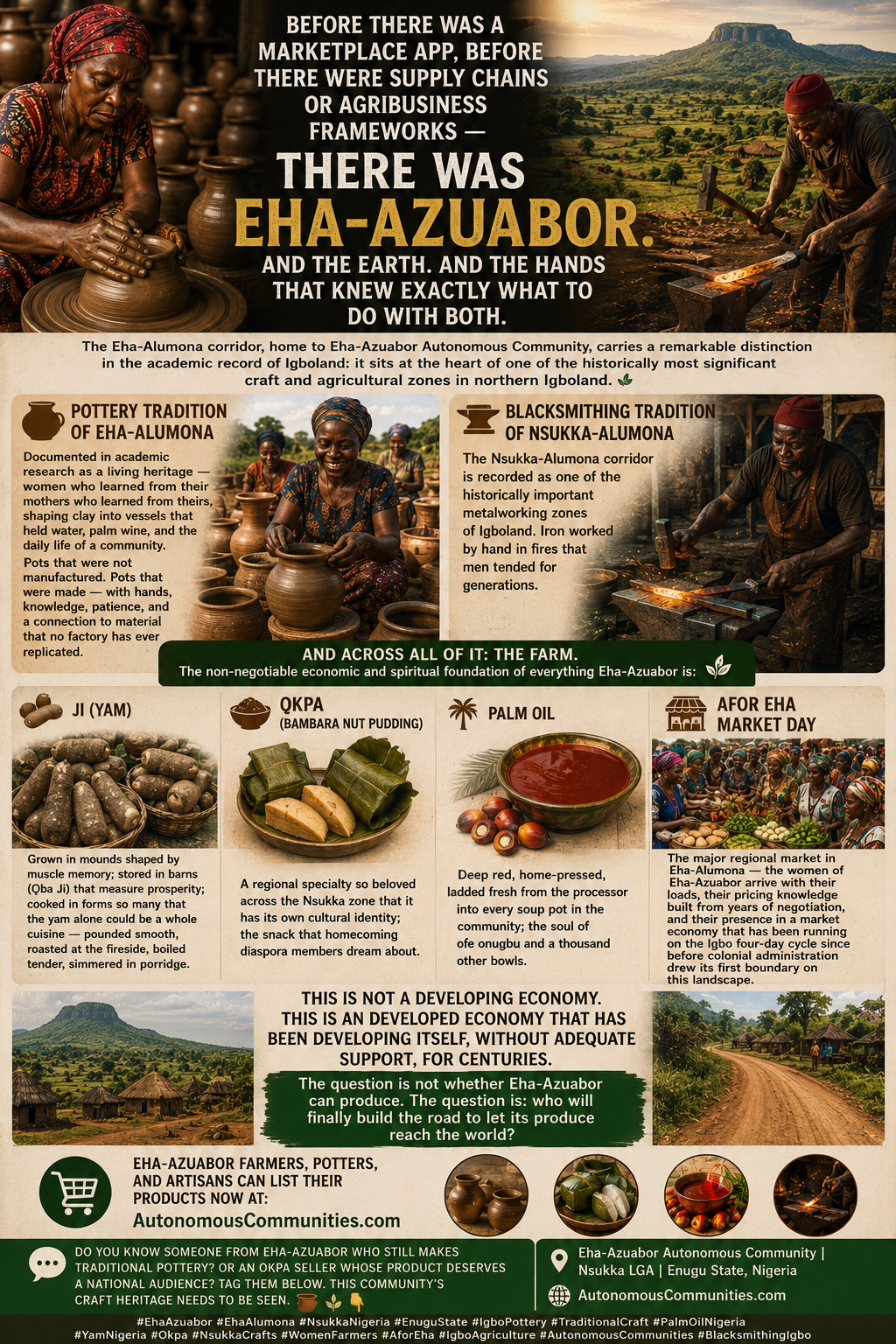
  • 🏺 BEFORE THERE WAS A MARKETPLACE APP, BEFORE THERE WERE SUPPLY CHAINS OR AGRIBUSINESS FRAMEWORKS — THERE WAS EHA-AZUABOR. AND THE EARTH. AND THE HANDS THAT KNEW EXACTLY WHAT TO DO WITH BOTH.

    The Eha-Alumona corridor, home to Eha-Azuabor Autonomous Community, carries a remarkable distinction in the academic record of Igboland: it sits at the heart of one of the historically most significant craft and agricultural zones in northern Igboland. 🌿
    The pottery tradition of Eha-Alumona is documented in academic research as a living heritage — women who learned from their mothers who learned from theirs, shaping clay into vessels that held water, palm wine, and the daily life of a community. Pots that were not manufactured. Pots that were made — with hands, knowledge, patience, and a connection to material that no factory has ever replicated. 🏺
    The blacksmithing tradition — the Nsukka-Alumona corridor is recorded as one of the historically important metalworking zones of Igboland. Iron worked by hand in fires that men tended for generations.
    And across all of it: the farm. The non-negotiable economic and spiritual foundation of everything Eha-Azuabor is:
    🍠 Ji (Yam) — grown in mounds shaped by muscle memory; stored in barns (Ọba Ji) that measure prosperity; cooked in forms so many that the yam alone could be a whole cuisine — pounded smooth, roasted at the fireside, boiled tender, simmered in porridge
    🌿 Ọkpa (bambara nut pudding) — a regional specialty so beloved across the Nsukka zone that it has its own cultural identity; the snack that homecoming diaspora members dream about
    🌴 Palm oil — deep red, home-pressed, ladled fresh from the processor into every soup pot in the community; the soul of ofe onugbu and a thousand other bowls
    πŸ›’ And on Afor Eha market day — the major regional market in Eha-Alumona — the women of Eha-Azuabor arrive with their loads, their pricing knowledge built from years of negotiation, and their presence in a market economy that has been running on the Igbo four-day cycle since before colonial administration drew its first boundary on this landscape.
    This is not a developing economy. This is an developed economy that has been developing itself, without adequate support, for centuries. The question is not whether Eha-Azuabor can produce. The question is: who will finally build the road to let its produce reach the world?

    πŸ›’ Eha-Azuabor farmers, potters, and artisans can list their products now at: AutonomousCommunities.com

    ━━━━━━━━━━━━━━━━━━━━━━━━━━━━━━━━━━
    πŸ’¬ Do you know someone from Eha-Azuabor who still makes traditional pottery? Or an okpa seller whose product deserves a national audience? Tag them below. This community's craft heritage needs to be seen. πŸΊπŸŒΎπŸ‘‡
    ━━━━━━━━━━━━━━━━━━━━━━━━━━━━━━━━━━

    #EhaAzuabor #EhaAlumona #NsukkaNigeria #EnuguState #IgboPottery #TraditionalCraft #PalmOilNigeria #YamNigeria #Okpa #NsukkaCrafts #WomenFarmers #AforEha #IgboAgriculture #AutonomousCommunities #BlacksmithingIgbo
    🏺 BEFORE THERE WAS A MARKETPLACE APP, BEFORE THERE WERE SUPPLY CHAINS OR AGRIBUSINESS FRAMEWORKS — THERE WAS EHA-AZUABOR. AND THE EARTH. AND THE HANDS THAT KNEW EXACTLY WHAT TO DO WITH BOTH. The Eha-Alumona corridor, home to Eha-Azuabor Autonomous Community, carries a remarkable distinction in the academic record of Igboland: it sits at the heart of one of the historically most significant craft and agricultural zones in northern Igboland. 🌿 The pottery tradition of Eha-Alumona is documented in academic research as a living heritage — women who learned from their mothers who learned from theirs, shaping clay into vessels that held water, palm wine, and the daily life of a community. Pots that were not manufactured. Pots that were made — with hands, knowledge, patience, and a connection to material that no factory has ever replicated. 🏺 The blacksmithing tradition — the Nsukka-Alumona corridor is recorded as one of the historically important metalworking zones of Igboland. Iron worked by hand in fires that men tended for generations. And across all of it: the farm. The non-negotiable economic and spiritual foundation of everything Eha-Azuabor is: 🍠 Ji (Yam) — grown in mounds shaped by muscle memory; stored in barns (Ọba Ji) that measure prosperity; cooked in forms so many that the yam alone could be a whole cuisine — pounded smooth, roasted at the fireside, boiled tender, simmered in porridge 🌿 Ọkpa (bambara nut pudding) — a regional specialty so beloved across the Nsukka zone that it has its own cultural identity; the snack that homecoming diaspora members dream about 🌴 Palm oil — deep red, home-pressed, ladled fresh from the processor into every soup pot in the community; the soul of ofe onugbu and a thousand other bowls πŸ›’ And on Afor Eha market day — the major regional market in Eha-Alumona — the women of Eha-Azuabor arrive with their loads, their pricing knowledge built from years of negotiation, and their presence in a market economy that has been running on the Igbo four-day cycle since before colonial administration drew its first boundary on this landscape. This is not a developing economy. This is an developed economy that has been developing itself, without adequate support, for centuries. The question is not whether Eha-Azuabor can produce. The question is: who will finally build the road to let its produce reach the world? πŸ›’ Eha-Azuabor farmers, potters, and artisans can list their products now at: AutonomousCommunities.com ━━━━━━━━━━━━━━━━━━━━━━━━━━━━━━━━━━ πŸ’¬ Do you know someone from Eha-Azuabor who still makes traditional pottery? Or an okpa seller whose product deserves a national audience? Tag them below. This community's craft heritage needs to be seen. πŸΊπŸŒΎπŸ‘‡ ━━━━━━━━━━━━━━━━━━━━━━━━━━━━━━━━━━ #EhaAzuabor #EhaAlumona #NsukkaNigeria #EnuguState #IgboPottery #TraditionalCraft #PalmOilNigeria #YamNigeria #Okpa #NsukkaCrafts #WomenFarmers #AforEha #IgboAgriculture #AutonomousCommunities #BlacksmithingIgbo
    0 Reacties 0 aandelen 15K Views 0 voorbeeld
  • 🚨 IN 2018, A NATIONAL NEWSPAPER REPORTED WHAT THE PEOPLE OF EHA-AZUABOR AND THEIR NEIGHBOURS ALREADY KNEW:

    "Communities largely cut off from their local government headquarters by erosion... roads only passable by motorcycles especially during the rains... cut off for over 50 years."
    — Vanguard News, July 2018 πŸ—žοΈ
    Fifty years. Half a century. Not of neglect by the community — of neglect by the system that is supposed to serve it.
    Eha-Azuabor Autonomous Community — in the Eha-Alumona corridor of Nsukka LGA, Enugu State — is a farming community that grows food for a region. It is a cultural community whose Omabe masquerade and New Yam Festival are living traditions of enormous heritage value. It is a community of mothers and children, of farmers and traders, of young people who are doing the math every year on whether to stay or leave.
    And its only road has been cut by gully erosion for over fifty years.
    πŸš‘ When a mother goes into labour at midnight — the motorcycle that carries her to Eha-Alumona or Nsukka is her ambulance.
    🌾 When a farmer fills his barn with yam at harvest time — the motorcycle is his truck, his logistics chain, his entire supply line.
    🏫 When a child has to be in school by 7:30 am — the motorcycle is his school bus, in the rain, on the unpaved, eroded, seasonal-stream-for-a-road that connects the community to everything else.
    2018: Governor Ugwuanyi came. He saw. He promised the road.
    The community celebrated. πŸŽ‰
    And then the waiting continued.
    The roads that were promised — the Umabor-Agu Umabor link and the Eha-Eha Ndiagu-Mbu-Ikem corridor — are the lifelines not just of Eha-Azuabor but of an entire cluster of communities including Agu-Umabor, Breme, Eha-Ndiagu, and Ezebuanagu. Communities that feed Nsukka. Communities that pay taxes. Communities that vote.
    Governor Peter Mbah's administration has outlined ambitious infrastructure targets for Enugu State. Eha-Azuabor's road is not an ambition. It is a debt.

    πŸ“ Eha-Azuabor Autonomous Community | Eha-Alumona Corridor | Nsukka LGA | Enugu State
    🌐 AutonomousCommunities.com — where communities document their needs and hold government to account

    ━━━━━━━━━━━━━━━━━━━━━━━━━━━━━━━━━━
    πŸ’¬ SHARE THIS POST. Tag your Enugu State representative. Tag @GovPeterMbah. Tag every infrastructure NGO and development partner working in Southeast Nigeria. Fifty years is enough. The road must be built. πŸ›£οΈπŸ‘‡
    ━━━━━━━━━━━━━━━━━━━━━━━━━━━━━━━━━━

    #EhaAzuabor #EhaAlumona #FixTheRoad #NsukkaNigeria #EnuguState #GullyErosion #RuralNigeria #50YearsIsTooLong #InfrastructureNigeria #AutonomousCommunities #RoadAdvocacy #SDG9 #EhaAzuaborRoad #EnuguGovernor #NigeriaRoads
    🚨 IN 2018, A NATIONAL NEWSPAPER REPORTED WHAT THE PEOPLE OF EHA-AZUABOR AND THEIR NEIGHBOURS ALREADY KNEW: "Communities largely cut off from their local government headquarters by erosion... roads only passable by motorcycles especially during the rains... cut off for over 50 years." — Vanguard News, July 2018 πŸ—žοΈ Fifty years. Half a century. Not of neglect by the community — of neglect by the system that is supposed to serve it. Eha-Azuabor Autonomous Community — in the Eha-Alumona corridor of Nsukka LGA, Enugu State — is a farming community that grows food for a region. It is a cultural community whose Omabe masquerade and New Yam Festival are living traditions of enormous heritage value. It is a community of mothers and children, of farmers and traders, of young people who are doing the math every year on whether to stay or leave. And its only road has been cut by gully erosion for over fifty years. πŸš‘ When a mother goes into labour at midnight — the motorcycle that carries her to Eha-Alumona or Nsukka is her ambulance. 🌾 When a farmer fills his barn with yam at harvest time — the motorcycle is his truck, his logistics chain, his entire supply line. 🏫 When a child has to be in school by 7:30 am — the motorcycle is his school bus, in the rain, on the unpaved, eroded, seasonal-stream-for-a-road that connects the community to everything else. 2018: Governor Ugwuanyi came. He saw. He promised the road. The community celebrated. πŸŽ‰ And then the waiting continued. The roads that were promised — the Umabor-Agu Umabor link and the Eha-Eha Ndiagu-Mbu-Ikem corridor — are the lifelines not just of Eha-Azuabor but of an entire cluster of communities including Agu-Umabor, Breme, Eha-Ndiagu, and Ezebuanagu. Communities that feed Nsukka. Communities that pay taxes. Communities that vote. Governor Peter Mbah's administration has outlined ambitious infrastructure targets for Enugu State. Eha-Azuabor's road is not an ambition. It is a debt. πŸ“ Eha-Azuabor Autonomous Community | Eha-Alumona Corridor | Nsukka LGA | Enugu State 🌐 AutonomousCommunities.com — where communities document their needs and hold government to account ━━━━━━━━━━━━━━━━━━━━━━━━━━━━━━━━━━ πŸ’¬ SHARE THIS POST. Tag your Enugu State representative. Tag @GovPeterMbah. Tag every infrastructure NGO and development partner working in Southeast Nigeria. Fifty years is enough. The road must be built. πŸ›£οΈπŸ‘‡ ━━━━━━━━━━━━━━━━━━━━━━━━━━━━━━━━━━ #EhaAzuabor #EhaAlumona #FixTheRoad #NsukkaNigeria #EnuguState #GullyErosion #RuralNigeria #50YearsIsTooLong #InfrastructureNigeria #AutonomousCommunities #RoadAdvocacy #SDG9 #EhaAzuaborRoad #EnuguGovernor #NigeriaRoads
    0 Reacties 0 aandelen 13K Views 0 voorbeeld
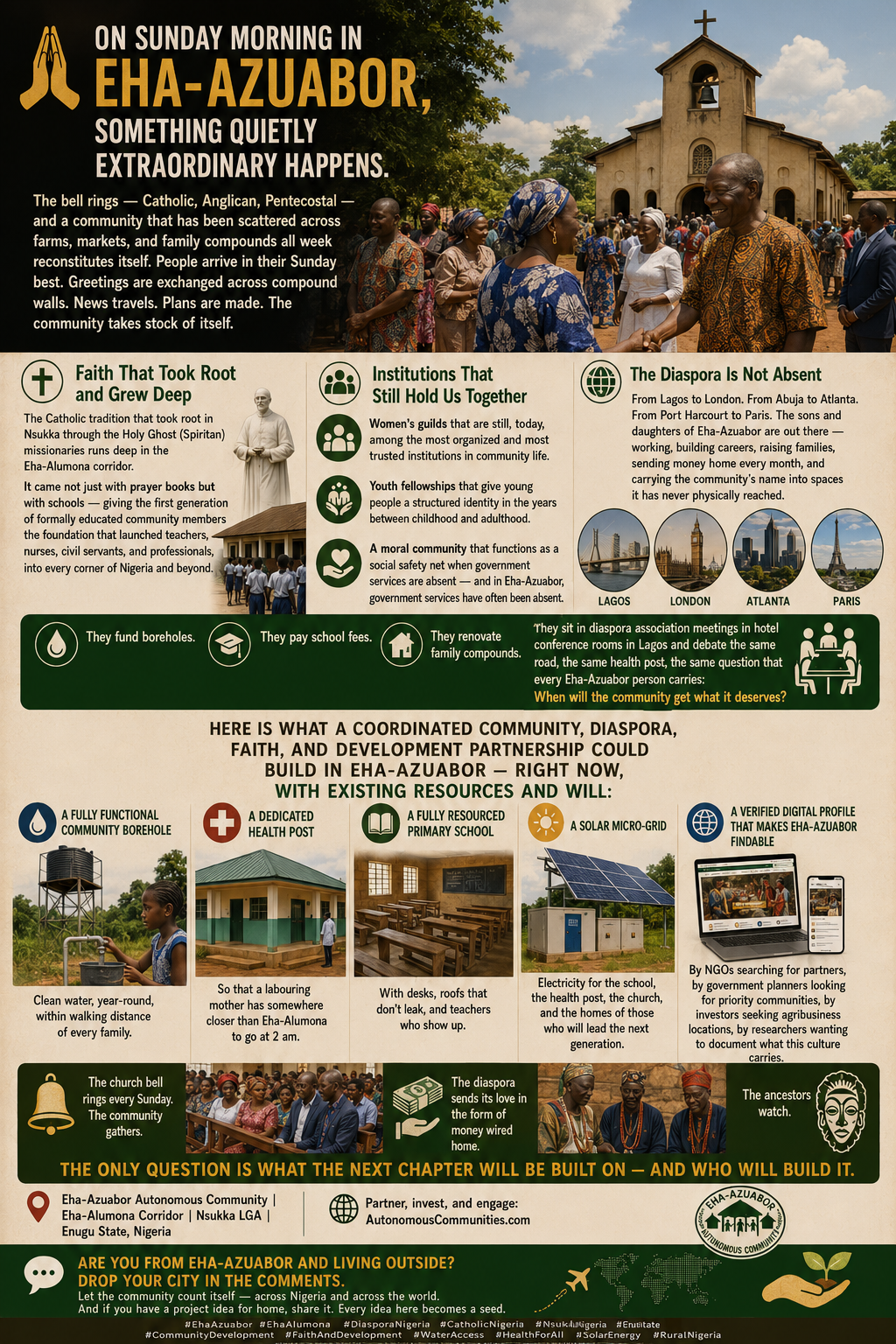
  • πŸ™ ON SUNDAY MORNING IN EHA-AZUABOR, SOMETHING QUIETLY EXTRAORDINARY HAPPENS.

    The bell rings — Catholic, Anglican, Pentecostal — and a community that has been scattered across farms, markets, and family compounds all week reconstitutes itself. People arrive in their Sunday best. Greetings are exchanged across compound walls. News travels. Plans are made. The community takes stock of itself. β›ͺ
    The Catholic tradition that took root in Nsukka through the Holy Ghost (Spiritan) missionaries runs deep in the Eha-Alumona corridor. It came not just with prayer books but with schools — giving the first generation of formally educated community members the foundation that launched teachers, nurses, civil servants, and professionals into every corner of Nigeria and beyond. πŸ“š
    It came with women's guilds that are still, today, among the most organized and most trusted institutions in community life. With youth fellowships that give young people a structured identity in the years between childhood and adulthood. With a moral community that functions as a social safety net when government services are absent — and in Eha-Azuabor, government services have often been absent.
    And speaking of absent — the diaspora is not.
    From Lagos to London. From Abuja to Atlanta. From Port Harcourt to Paris. The sons and daughters of Eha-Azuabor are out there — working, building careers, raising families, sending money home every month, and carrying the community's name into spaces it has never physically reached.
    🌍 They fund boreholes. They pay school fees. They renovate family compounds. They sit in diaspora association meetings in hotel conference rooms in Lagos and debate the same road, the same health post, the same question that every Eha-Azuabor person carries:
    When will the community get what it deserves?
    Here is what a coordinated community, diaspora, faith, and development partnership could build in Eha-Azuabor — right now, with existing resources and will:
    πŸ’§ A fully functional community borehole — clean water, year-round, within walking distance of every family
    πŸ₯ A dedicated health post — so that a labouring mother has somewhere closer than Eha-Alumona to go at 2 am
    🏫 A fully resourced primary school — with desks, roofs that don't leak, and teachers who show up
    ⚑ A solar micro-grid — electricity for the school, the health post, the church, and the homes of those who will lead the next generation
    🌐 A verified digital profile that makes Eha-Azuabor findable — by NGOs searching for partners, by government planners looking for priority communities, by investors seeking agribusiness locations, by researchers wanting to document what this culture carries
    The church bell rings every Sunday. The community gathers. The diaspora sends its love in the form of money wired home. The ancestors watch.
    The only question is what the next chapter will be built on — and who will build it.

    πŸ“ Eha-Azuabor Autonomous Community | Eha-Alumona Corridor | Nsukka LGA | Enugu State, Nigeria
    🌐 Partner, invest, and engage: AutonomousCommunities.com

    ━━━━━━━━━━━━━━━━━━━━━━━━━━━━━━━━━━
    πŸ’¬ Are you from Eha-Azuabor and living outside? Drop your city in the comments. Let the community count itself — across Nigeria and across the world. And if you have a project idea for home, share it. Every idea here becomes a seed. πŸŒπŸ™ŒπŸ‘‡
    ━━━━━━━━━━━━━━━━━━━━━━━━━━━━━━━━━━

    #EhaAzuabor #EhaAlumona #DiasporaNigeria #CatholicNigeria #NsukkaNigeria #EnuguState #CommunityDevelopment #FaithAndDevelopment #WaterAccess #HealthForAll #SolarEnergy #RuralNigeria #AutonomousCommunities #NigeriaRising #BuildTogether
    πŸ™ ON SUNDAY MORNING IN EHA-AZUABOR, SOMETHING QUIETLY EXTRAORDINARY HAPPENS. The bell rings — Catholic, Anglican, Pentecostal — and a community that has been scattered across farms, markets, and family compounds all week reconstitutes itself. People arrive in their Sunday best. Greetings are exchanged across compound walls. News travels. Plans are made. The community takes stock of itself. β›ͺ The Catholic tradition that took root in Nsukka through the Holy Ghost (Spiritan) missionaries runs deep in the Eha-Alumona corridor. It came not just with prayer books but with schools — giving the first generation of formally educated community members the foundation that launched teachers, nurses, civil servants, and professionals into every corner of Nigeria and beyond. πŸ“š It came with women's guilds that are still, today, among the most organized and most trusted institutions in community life. With youth fellowships that give young people a structured identity in the years between childhood and adulthood. With a moral community that functions as a social safety net when government services are absent — and in Eha-Azuabor, government services have often been absent. And speaking of absent — the diaspora is not. From Lagos to London. From Abuja to Atlanta. From Port Harcourt to Paris. The sons and daughters of Eha-Azuabor are out there — working, building careers, raising families, sending money home every month, and carrying the community's name into spaces it has never physically reached. 🌍 They fund boreholes. They pay school fees. They renovate family compounds. They sit in diaspora association meetings in hotel conference rooms in Lagos and debate the same road, the same health post, the same question that every Eha-Azuabor person carries: When will the community get what it deserves? Here is what a coordinated community, diaspora, faith, and development partnership could build in Eha-Azuabor — right now, with existing resources and will: πŸ’§ A fully functional community borehole — clean water, year-round, within walking distance of every family πŸ₯ A dedicated health post — so that a labouring mother has somewhere closer than Eha-Alumona to go at 2 am 🏫 A fully resourced primary school — with desks, roofs that don't leak, and teachers who show up ⚑ A solar micro-grid — electricity for the school, the health post, the church, and the homes of those who will lead the next generation 🌐 A verified digital profile that makes Eha-Azuabor findable — by NGOs searching for partners, by government planners looking for priority communities, by investors seeking agribusiness locations, by researchers wanting to document what this culture carries The church bell rings every Sunday. The community gathers. The diaspora sends its love in the form of money wired home. The ancestors watch. The only question is what the next chapter will be built on — and who will build it. πŸ“ Eha-Azuabor Autonomous Community | Eha-Alumona Corridor | Nsukka LGA | Enugu State, Nigeria 🌐 Partner, invest, and engage: AutonomousCommunities.com ━━━━━━━━━━━━━━━━━━━━━━━━━━━━━━━━━━ πŸ’¬ Are you from Eha-Azuabor and living outside? Drop your city in the comments. Let the community count itself — across Nigeria and across the world. And if you have a project idea for home, share it. Every idea here becomes a seed. πŸŒπŸ™ŒπŸ‘‡ ━━━━━━━━━━━━━━━━━━━━━━━━━━━━━━━━━━ #EhaAzuabor #EhaAlumona #DiasporaNigeria #CatholicNigeria #NsukkaNigeria #EnuguState #CommunityDevelopment #FaithAndDevelopment #WaterAccess #HealthForAll #SolarEnergy #RuralNigeria #AutonomousCommunities #NigeriaRising #BuildTogether
    0 Reacties 0 aandelen 14K Views 0 voorbeeld
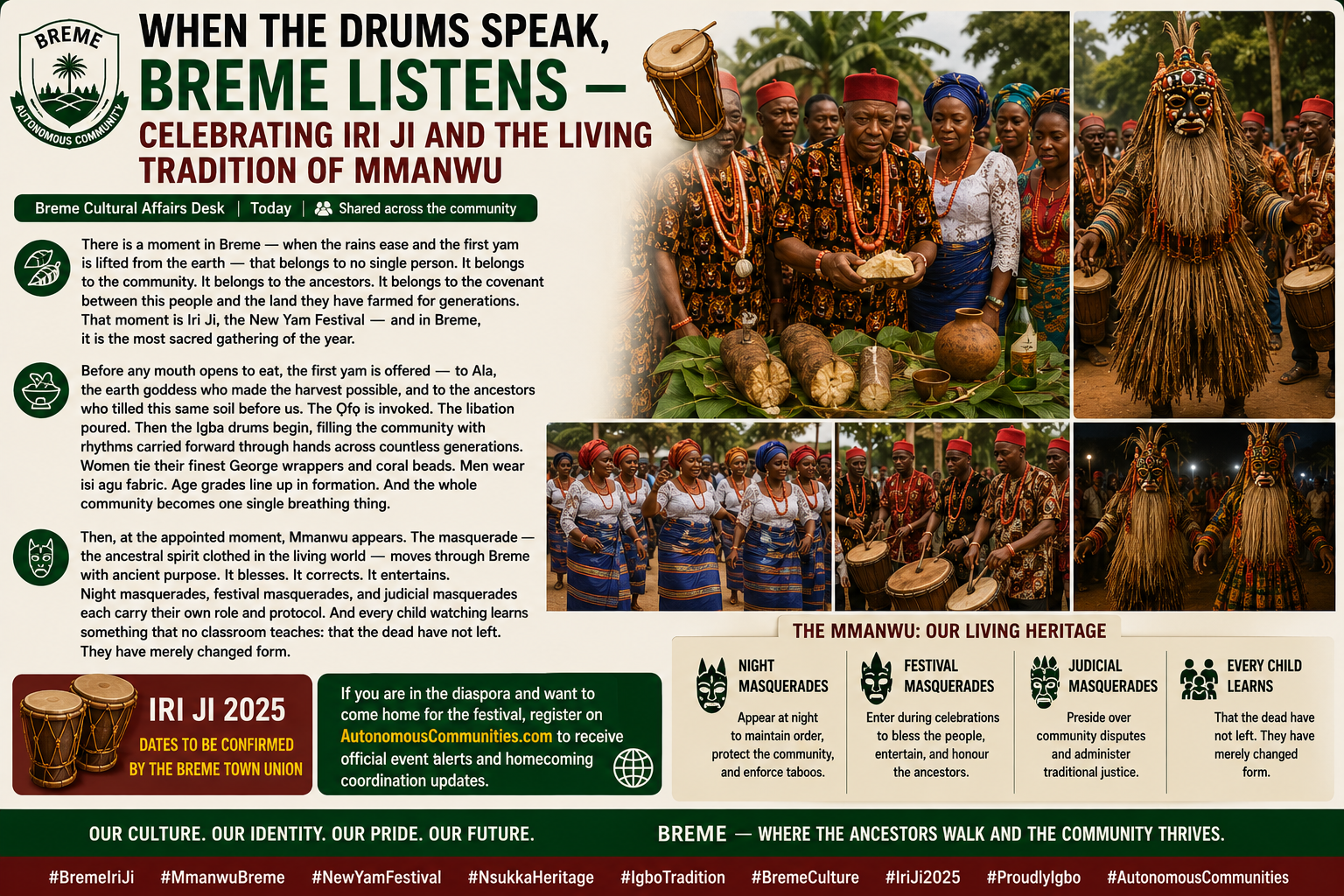
  • WHEN THE DRUMS SPEAKS, BREME LISTENS — CELEBREATING IRI JI AND THE LIVING TRADITION OF MMANWU

    There is a moment in Breme — when the rains ease and the first yam is lifted from the earth — that belongs to no single person. It belongs to the community. It belongs to the ancestors. It belongs to the covenant between this people and the land they have farmed for generations. That moment is Iri Ji, the New Yam Festival — and in Breme, it is the most sacred gathering of the year.

    Before any mouth opens to eat, the first yam is offered — to Ala, the earth goddess who made the harvest possible, and to the ancestors who tilled this same soil before us. The Ọfọ is invoked. The libation poured. Then the Igba drums begin, filling the community with rhythms carried forward through hands across countless generations. Women tie their finest George wrappers and coral beads. Men wear isi agu fabric. Age grades line up in formation. And the whole community becomes one single breathing thing.

    Then, at the appointed moment, Mmanwu appears. The masquerade — the ancestral spirit clothed in the living world — moves through Breme with ancient purpose. It blesses. It corrects. It entertains. Night masquerades, festival masquerades, and judicial masquerades each carry their own role and protocol. And every child watching learns something that no classroom teaches: that the dead have not left. They have merely changed form.

    Iri Ji 2026 — dates to be confirmed by the Breme Town Union

    If you are in the diaspora and want to come home for the festival, register on AutonomousCommunities.com to receive official event alerts and homecoming coordination updates

    #BremeIriJi #MmanwuBreme #NewYamFestival #NsukkaHeritage #IgboTradition #AutoonomousCommunities
    WHEN THE DRUMS SPEAKS, BREME LISTENS — CELEBREATING IRI JI AND THE LIVING TRADITION OF MMANWU There is a moment in Breme — when the rains ease and the first yam is lifted from the earth — that belongs to no single person. It belongs to the community. It belongs to the ancestors. It belongs to the covenant between this people and the land they have farmed for generations. That moment is Iri Ji, the New Yam Festival — and in Breme, it is the most sacred gathering of the year. Before any mouth opens to eat, the first yam is offered — to Ala, the earth goddess who made the harvest possible, and to the ancestors who tilled this same soil before us. The Ọfọ is invoked. The libation poured. Then the Igba drums begin, filling the community with rhythms carried forward through hands across countless generations. Women tie their finest George wrappers and coral beads. Men wear isi agu fabric. Age grades line up in formation. And the whole community becomes one single breathing thing. Then, at the appointed moment, Mmanwu appears. The masquerade — the ancestral spirit clothed in the living world — moves through Breme with ancient purpose. It blesses. It corrects. It entertains. Night masquerades, festival masquerades, and judicial masquerades each carry their own role and protocol. And every child watching learns something that no classroom teaches: that the dead have not left. They have merely changed form. Iri Ji 2026 — dates to be confirmed by the Breme Town Union If you are in the diaspora and want to come home for the festival, register on AutonomousCommunities.com to receive official event alerts and homecoming coordination updates #BremeIriJi #MmanwuBreme #NewYamFestival #NsukkaHeritage #IgboTradition #AutoonomousCommunities
    0 Reacties 0 aandelen 8K Views 0 voorbeeld
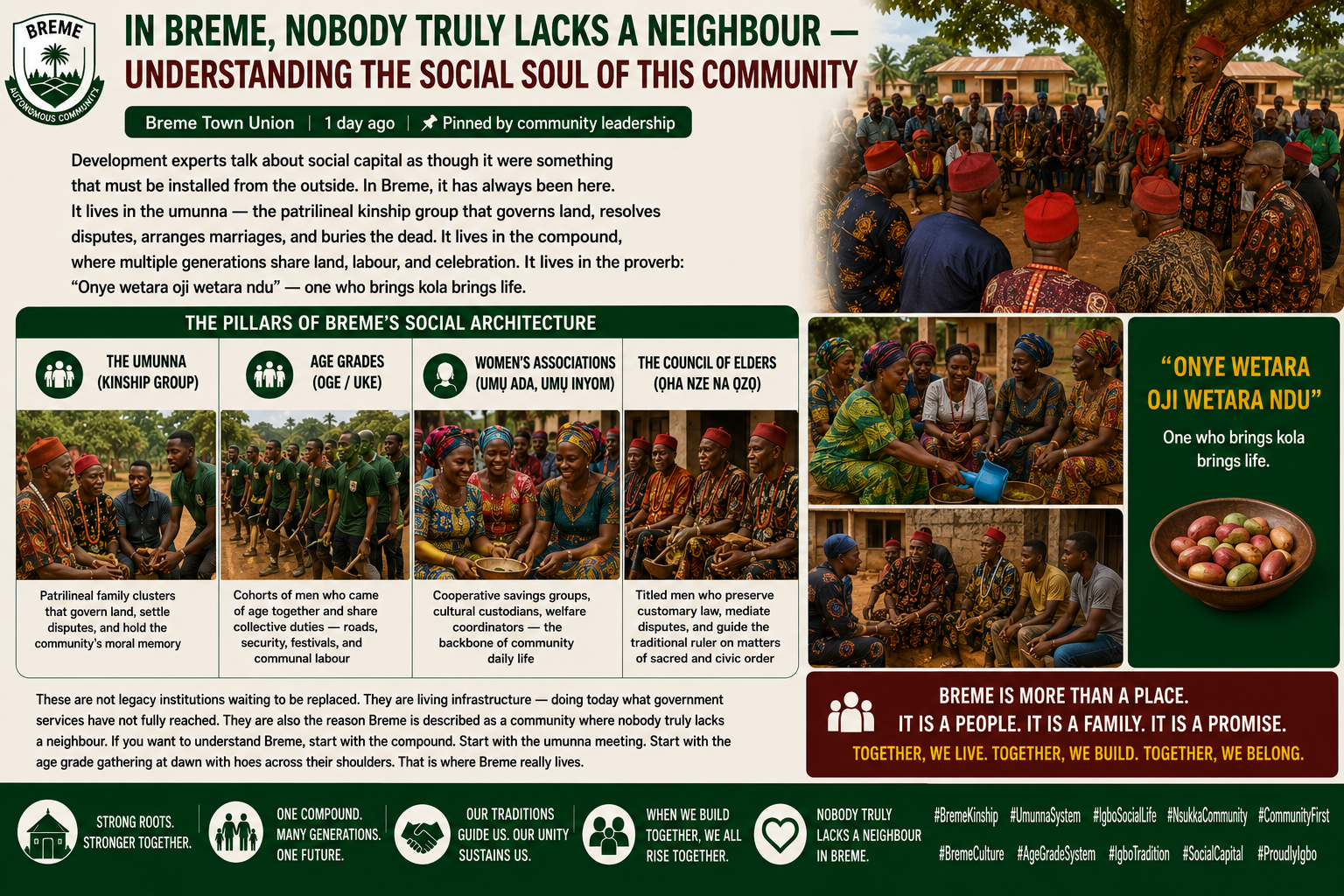
  • IN BREME NOBODY TRULY LACKS A NEIGHBOUR — UNDERSTANDING THE SOCIAL SOUL OF THIS COMMUNITY

    Development experts talk about social capital as though it were something that must be installed from the outside. In Breme, it has always been here. It lives in the umunna — the patrilineal kinship group that governs land, resolves disputes, arranges marriages, and buries the dead. It lives in the compound, where multiple generations share land, labour, and celebration. It lives in the proverb: "Onye wetara oji wetara ndu" — one who brings kola brings life.

    The pillars of Breme's social architecture:

    1. The Umunna (Kinship Group)
    (Patrilineal family clusters that govern land, settle disputes, and hold the community's moral memory)

    2. Age Grades (Oge / Uke)
    (Cohorts of men who came of age together and share collective duties — roads, security, festivals, and communal labour)

    3. Women's Associations (Ềmα»₯ Ada, Ềmα»₯ Inyom)
    (Cooperative savings groups, cultural custodians, welfare coordinators — the backbone of community daily life)

    4. The Council of Elders (Ọha Nze na Ọzọ)
    (Titled men who preserve customary law, mediate disputes, and guide the traditional ruler on matters of sacred and civic order)

    These are not legacy institutions waiting to be replaced. They are living infrastructure — doing today what government services have not fully reached. They are also the reason Breme is described as a community where nobody truly lacks a neighbour. If you want to understand Breme, start with the compound. Start with the umunna meeting. Start with the age grade gathering at dawn with hoes across their shoulders. That is where Breme really lives.

    #BremeKinship #UmunnaSystem #IgboSocialLife #NsukkaCommunity #CommunityFirst #AutonomousCommunities
    IN BREME NOBODY TRULY LACKS A NEIGHBOUR — UNDERSTANDING THE SOCIAL SOUL OF THIS COMMUNITY Development experts talk about social capital as though it were something that must be installed from the outside. In Breme, it has always been here. It lives in the umunna — the patrilineal kinship group that governs land, resolves disputes, arranges marriages, and buries the dead. It lives in the compound, where multiple generations share land, labour, and celebration. It lives in the proverb: "Onye wetara oji wetara ndu" — one who brings kola brings life. The pillars of Breme's social architecture: 1. The Umunna (Kinship Group) (Patrilineal family clusters that govern land, settle disputes, and hold the community's moral memory) 2. Age Grades (Oge / Uke) (Cohorts of men who came of age together and share collective duties — roads, security, festivals, and communal labour) 3. Women's Associations (Ềmα»₯ Ada, Ềmα»₯ Inyom) (Cooperative savings groups, cultural custodians, welfare coordinators — the backbone of community daily life) 4. The Council of Elders (Ọha Nze na Ọzọ) (Titled men who preserve customary law, mediate disputes, and guide the traditional ruler on matters of sacred and civic order) These are not legacy institutions waiting to be replaced. They are living infrastructure — doing today what government services have not fully reached. They are also the reason Breme is described as a community where nobody truly lacks a neighbour. If you want to understand Breme, start with the compound. Start with the umunna meeting. Start with the age grade gathering at dawn with hoes across their shoulders. That is where Breme really lives. #BremeKinship #UmunnaSystem #IgboSocialLife #NsukkaCommunity #CommunityFirst #AutonomousCommunities
    0 Reacties 0 aandelen 6K Views 0 voorbeeld
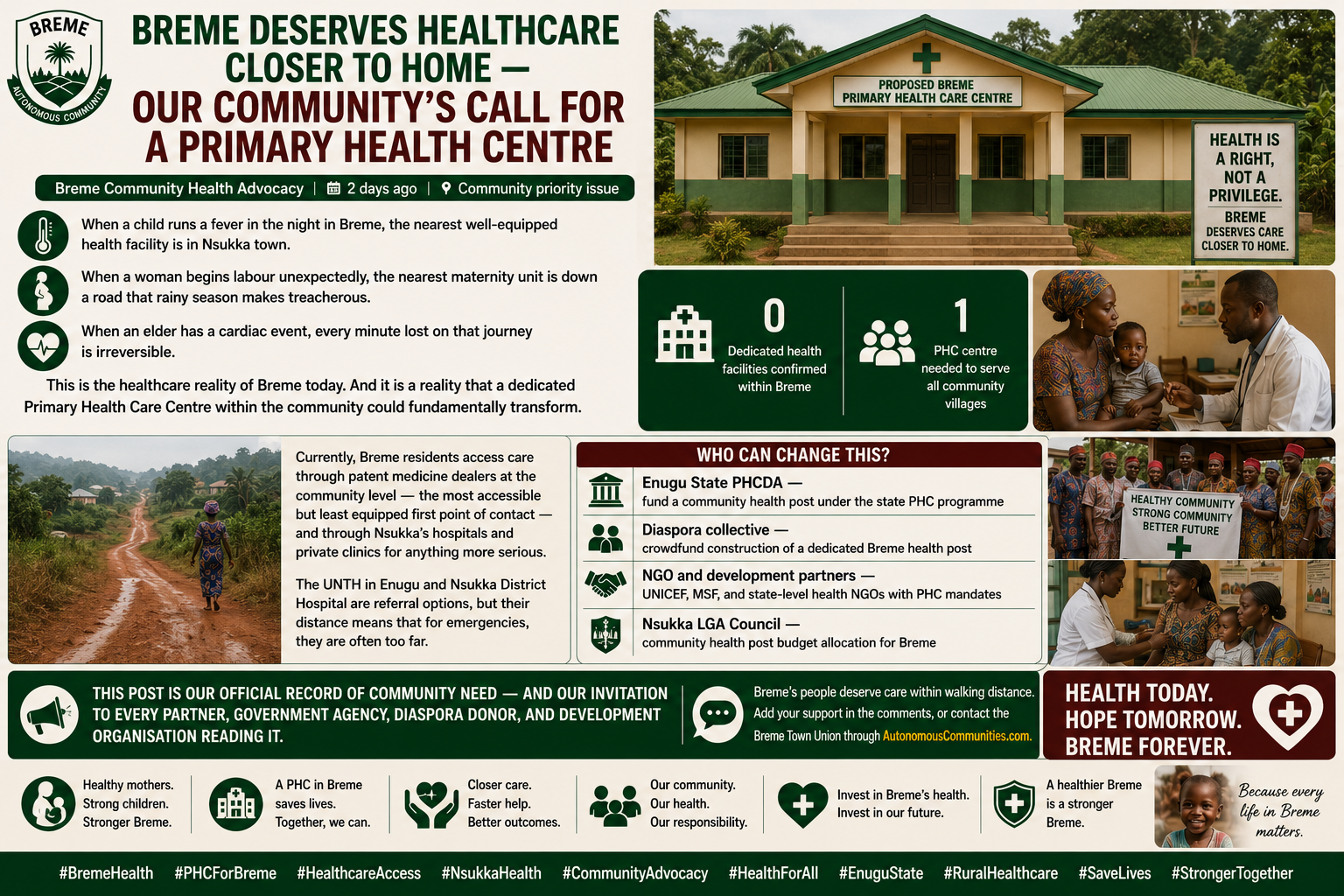
  • BREME DESERVES HEALTH CARE CLOSE TO HOME — OUR COMMUNITY'S CALL FOR A PRIMARY HEALTH CARE

    When a child runs a fever in the night in Breme, the nearest well-equipped health facility is in Nsukka town. When a woman begins labour unexpectedly, the nearest maternity unit is down a road that rainy season makes treacherous. When an elder has a cardiac event, every minute lost on that journey is irreversible. This is the healthcare reality of Breme today. And it is a reality that a dedicated Primary Health Care Centre within the community could fundamentally transform.

    #0 Dedicated health facilities confirmed within Breme
    #1 PHC centre needed to serve all community villages

    Currently, Breme residents access care through patent medicine dealers at the community level — the most accessible but least equipped first point of contact — and through Nsukka's hospitals and private clinics for anything more serious. The UNTH in Enugu and Nsukka District Hospital are referral options, but their distance means that for emergencies, they are often too far.

    Who can change this?

    Enugu State PHCDA — fund a community health post under the state PHC programme
    Diaspora collective — crowdfund construction of a dedicated Breme health post
    NGO and development partners — UNICEF, MSF, and state-level health NGOs with PHC mandates
    Nsukka LGA Council — community health post budget allocation for Breme.

    This post is our official record of community need — and our invitation to every partner, government agency, diaspora donor, and development organisation reading it. Breme's people deserve care within walking distance. Add your support in the comments, or contact the Breme Town Union through AutonomousCommunities.com.

    #BremeHealth #PHCForBreme #HealthcareAccess #NsukkaHealth #CommunityAdvocacy #AutonomousCommunities
    BREME DESERVES HEALTH CARE CLOSE TO HOME — OUR COMMUNITY'S CALL FOR A PRIMARY HEALTH CARE When a child runs a fever in the night in Breme, the nearest well-equipped health facility is in Nsukka town. When a woman begins labour unexpectedly, the nearest maternity unit is down a road that rainy season makes treacherous. When an elder has a cardiac event, every minute lost on that journey is irreversible. This is the healthcare reality of Breme today. And it is a reality that a dedicated Primary Health Care Centre within the community could fundamentally transform. #0 Dedicated health facilities confirmed within Breme #1 PHC centre needed to serve all community villages Currently, Breme residents access care through patent medicine dealers at the community level — the most accessible but least equipped first point of contact — and through Nsukka's hospitals and private clinics for anything more serious. The UNTH in Enugu and Nsukka District Hospital are referral options, but their distance means that for emergencies, they are often too far. Who can change this? Enugu State PHCDA — fund a community health post under the state PHC programme Diaspora collective — crowdfund construction of a dedicated Breme health post NGO and development partners — UNICEF, MSF, and state-level health NGOs with PHC mandates Nsukka LGA Council — community health post budget allocation for Breme. This post is our official record of community need — and our invitation to every partner, government agency, diaspora donor, and development organisation reading it. Breme's people deserve care within walking distance. Add your support in the comments, or contact the Breme Town Union through AutonomousCommunities.com. #BremeHealth #PHCForBreme #HealthcareAccess #NsukkaHealth #CommunityAdvocacy #AutonomousCommunities
    0 Reacties 0 aandelen 8K Views 0 voorbeeld
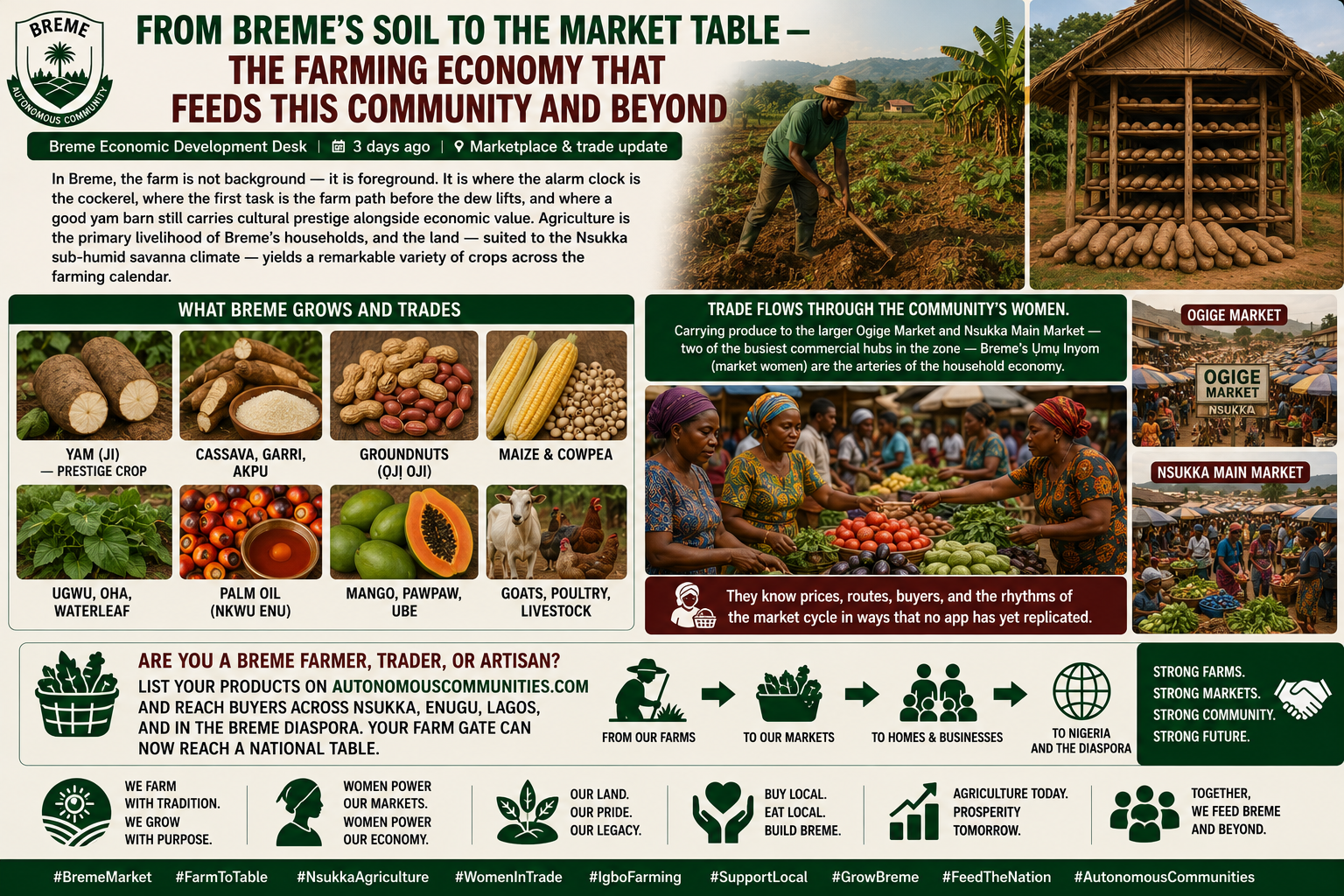
  • FROM BREME'S SOIL TO THE MARKET TABLE— THE FARMING COMMUNITY THAT FEEDS THIS COMMUNITY AND BEYOND

    In Breme, the farm is not background — it is foreground. It is where the alarm clock is the cockerel, where the first task is the farm path before the dew lifts, and where a good yam barn still carries cultural prestige alongside economic value. Agriculture is the primary livelihood of Breme's households, and the land — suited to the Nsukka sub-humid savanna climate — yields a remarkable variety of crops across the farming calendar.

    What Breme Grows and Trades:
    1. Yam (Ji) — prestige crop
    2. Cassava, garri, akpu
    3. Groundnuts (Ọjα»‹ Oji)
    4. Maize & cowpea
    5. Ugwu, oha, waterleaf
    6. Palm oil (Nkwu enu)
    7. Mango, pawpaw, ube
    8. Goats, poultry, livestock

    Trade flows through the community's women. Carrying produce to the larger Ogige Market and Nsukka Main Market — two of the busiest commercial hubs in the zone — Breme's Ềmα»₯ Inyom (market women) are the arteries of the household economy. They know prices, routes, buyers, and the rhythms of the market cycle in ways that no app has yet replicated.

    Are you a Breme farmer, trader, or artisan?

    List your products on AutonomousCommunities.com and reach buyers across Nsukka, Enugu, Lagos, and in the Breme diaspora. Your farm gate can now reach a national table.

    #BremeMarket #FarmToTable #NsukkaAgriculture #WomenInTrade #IgboFarming #AutonomousCommunities
    FROM BREME'S SOIL TO THE MARKET TABLE— THE FARMING COMMUNITY THAT FEEDS THIS COMMUNITY AND BEYOND In Breme, the farm is not background — it is foreground. It is where the alarm clock is the cockerel, where the first task is the farm path before the dew lifts, and where a good yam barn still carries cultural prestige alongside economic value. Agriculture is the primary livelihood of Breme's households, and the land — suited to the Nsukka sub-humid savanna climate — yields a remarkable variety of crops across the farming calendar. What Breme Grows and Trades: 1. Yam (Ji) — prestige crop 2. Cassava, garri, akpu 3. Groundnuts (Ọjα»‹ Oji) 4. Maize & cowpea 5. Ugwu, oha, waterleaf 6. Palm oil (Nkwu enu) 7. Mango, pawpaw, ube 8. Goats, poultry, livestock Trade flows through the community's women. Carrying produce to the larger Ogige Market and Nsukka Main Market — two of the busiest commercial hubs in the zone — Breme's Ềmα»₯ Inyom (market women) are the arteries of the household economy. They know prices, routes, buyers, and the rhythms of the market cycle in ways that no app has yet replicated. Are you a Breme farmer, trader, or artisan? List your products on AutonomousCommunities.com and reach buyers across Nsukka, Enugu, Lagos, and in the Breme diaspora. Your farm gate can now reach a national table. #BremeMarket #FarmToTable #NsukkaAgriculture #WomenInTrade #IgboFarming #AutonomousCommunities
    0 Reacties 0 aandelen 9K Views 0 voorbeeld
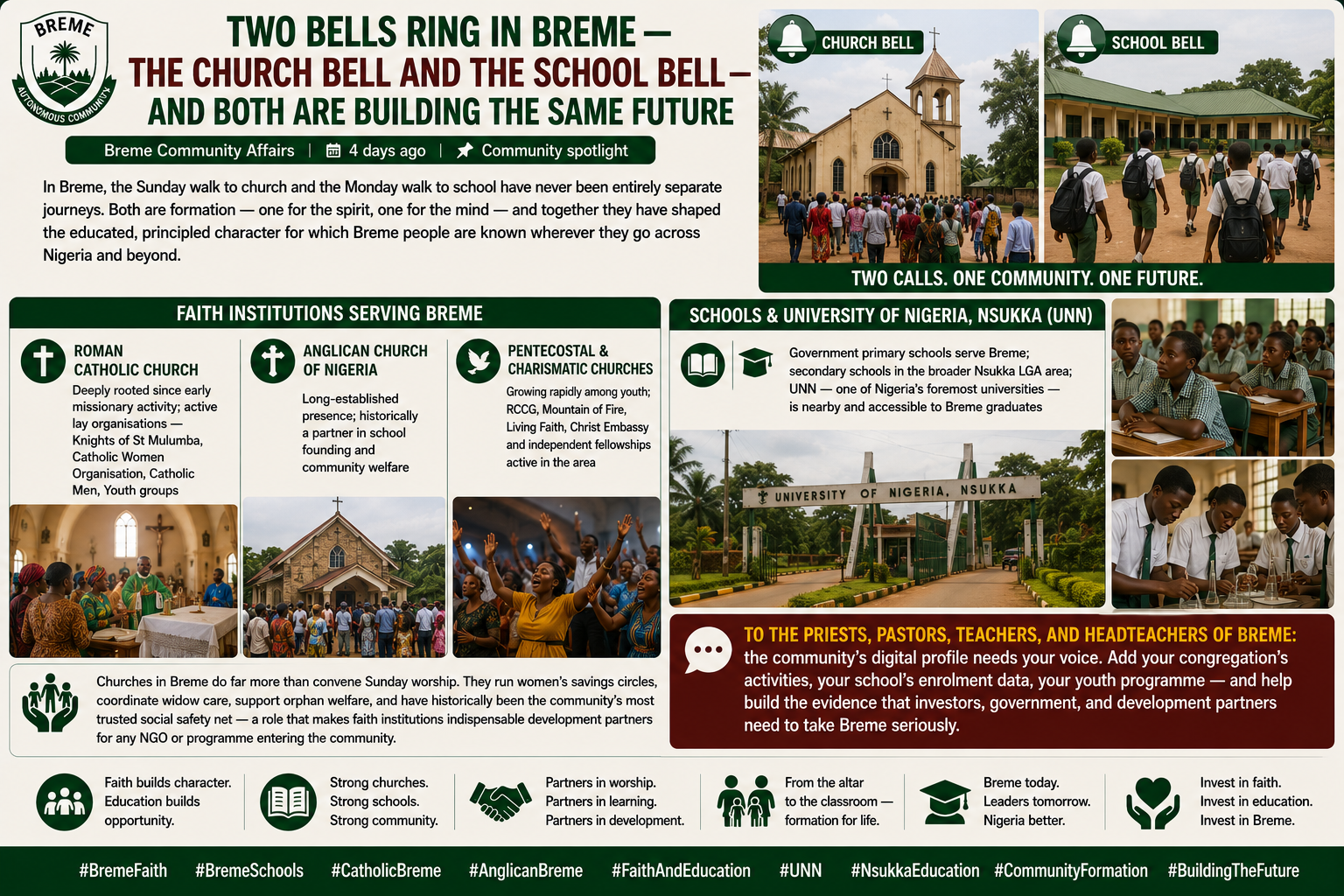
  • TWO BELLS RING IN BREME — THE CHURCH BELL AND THE SCHOOL BELL— AND BOTH ARE BUILDING THE SAME FUTURE

    In Breme, the Sunday walk to church and the Monday walk to school have never been entirely separate journeys. Both are formation — one for the spirit, one for the mind — and together they have shaped the educated, principled character for which Breme people are known wherever they go across Nigeria and beyond.

    Faith Institutions Serving Breme:

    1. Roman Catholic Church
    (Deeply rooted since early missionary activity; active lay organisations — Knights of St Mulumba, Catholic Women Organisation, Catholic Men, Youth groups)

    2. Anglican Church of Nigeria
    (Long-established presence; historically a partner in school founding and community welfare)

    3. Pentecostal & Charismatic Churches
    (Growing rapidly among youth; RCCG, Mountain of Fire, Living Faith, Christ Embassy and independent fellowships active in the area)

    4. Schools & University of Nigeria, Nsukka (UNN)
    (Government primary schools serve Breme; secondary schools in the broader Nsukka LGA area; UNN — one of Nigeria's foremost universities — is nearby and accessible to Breme graduates)

    Churches in Breme do far more than convene Sunday worship. They run women's savings circles, coordinate widow care, support orphan welfare, and have historically been the community's most trusted social safety net — a role that makes faith institutions indispensable development partners for any NGO or programme entering the community.

    To the priests, pastors, teachers, and headteachers of Breme: the community's digital profile needs your voice. Add your congregation's activities, your school's enrolment data, your youth programme — and help build the evidence that investors, government, and development partners need to take Breme seriously.

    #Eha-Breme #BremeFaith #BremeSchools #CatholicBreme #UNN #NsukkaEducation #AutonomousCommunities
    TWO BELLS RING IN BREME — THE CHURCH BELL AND THE SCHOOL BELL— AND BOTH ARE BUILDING THE SAME FUTURE In Breme, the Sunday walk to church and the Monday walk to school have never been entirely separate journeys. Both are formation — one for the spirit, one for the mind — and together they have shaped the educated, principled character for which Breme people are known wherever they go across Nigeria and beyond. Faith Institutions Serving Breme: 1. Roman Catholic Church (Deeply rooted since early missionary activity; active lay organisations — Knights of St Mulumba, Catholic Women Organisation, Catholic Men, Youth groups) 2. Anglican Church of Nigeria (Long-established presence; historically a partner in school founding and community welfare) 3. Pentecostal & Charismatic Churches (Growing rapidly among youth; RCCG, Mountain of Fire, Living Faith, Christ Embassy and independent fellowships active in the area) 4. Schools & University of Nigeria, Nsukka (UNN) (Government primary schools serve Breme; secondary schools in the broader Nsukka LGA area; UNN — one of Nigeria's foremost universities — is nearby and accessible to Breme graduates) Churches in Breme do far more than convene Sunday worship. They run women's savings circles, coordinate widow care, support orphan welfare, and have historically been the community's most trusted social safety net — a role that makes faith institutions indispensable development partners for any NGO or programme entering the community. To the priests, pastors, teachers, and headteachers of Breme: the community's digital profile needs your voice. Add your congregation's activities, your school's enrolment data, your youth programme — and help build the evidence that investors, government, and development partners need to take Breme seriously. #Eha-Breme #BremeFaith #BremeSchools #CatholicBreme #UNN #NsukkaEducation #AutonomousCommunities
    0 Reacties 0 aandelen 8K Views 0 voorbeeld


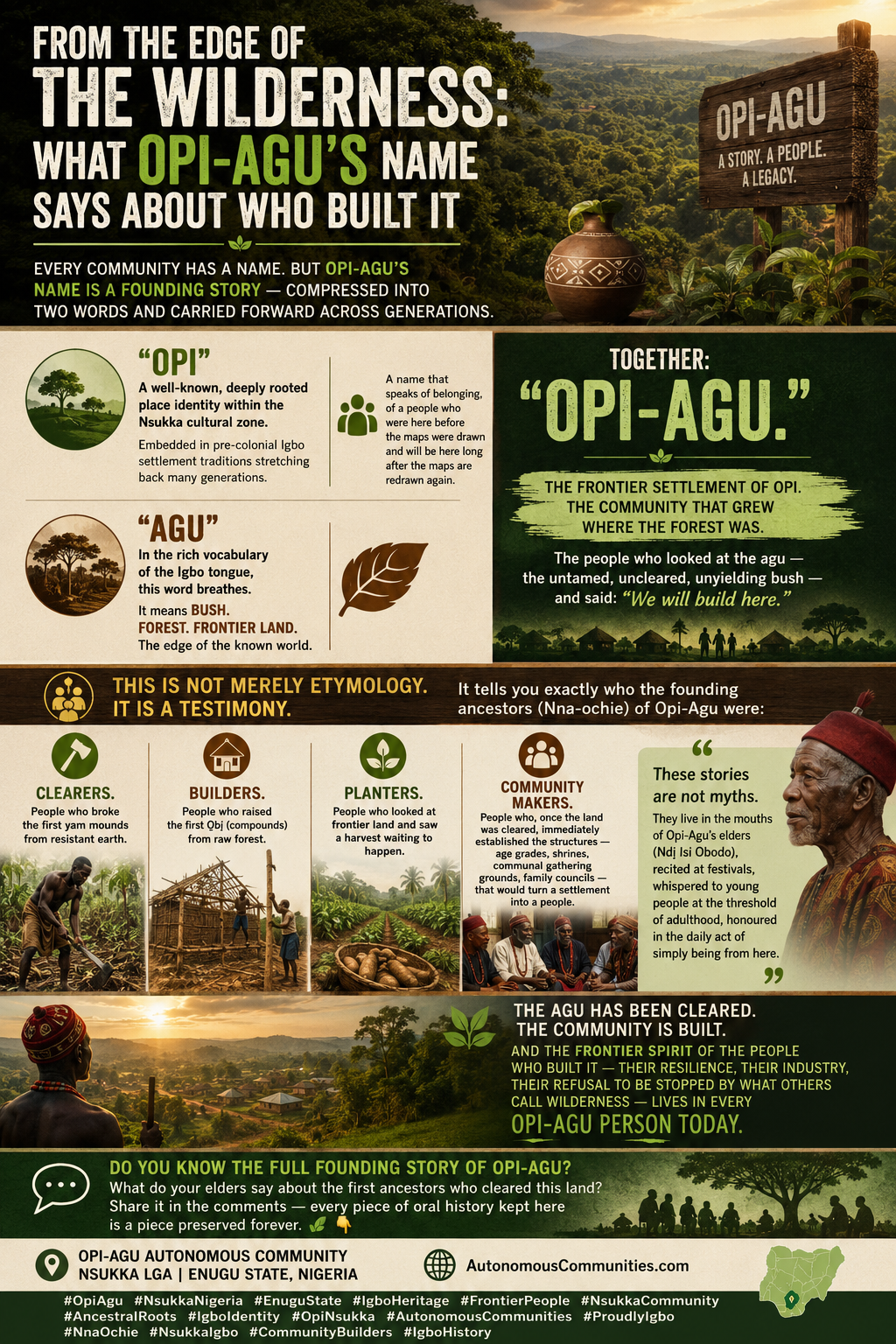
  • 🌿 EVERY COMMUNITY HAS A NAME. BUT OPI-AGU'S NAME IS A FOUNDING STORY — COMPRESSED INTO TWO WORDS AND CARRIED FORWARD ACROSS GENERATIONS.

    'From the Edge of the Wilderness: What Opi-Agu's Name Says About Who Built It'


    Break it apart slowly:
    "Opi" — a well-known, deeply rooted place identity within the Nsukka cultural zone. Embedded in pre-colonial Igbo settlement traditions stretching back many generations. A name that speaks of belonging, of a people who were here before the maps were drawn and will be here long after the maps are redrawn again.
    "Agu" — in the rich vocabulary of the Igbo tongue, this word breathes. It means bush. Forest. Frontier land. The edge of the known world. The place where the cleared field ends and the wild begins.
    Together: "Opi-Agu." 🌿
    The frontier settlement of Opi. The community that grew where the forest was. The people who looked at the agu — the untamed, uncleared, unyielding bush — and said: "We will build here."
    This is not merely etymology. It is a testimony. It tells you exactly who the founding ancestors (Nna-ochie) of Opi-Agu were:
    πŸͺ“ Clearers. People who broke the first yam mounds from resistant earth.
    πŸ—οΈ Builders. People who raised the first Ọbα»‹ (compounds) from raw forest.
    🌾 Planters. People who looked at frontier land and saw a harvest waiting to happen.
    🀝 Community makers. People who, once the land was cleared, immediately established the structures — age grades, shrines, communal gathering grounds, family councils — that would turn a settlement into a people.
    These stories are not myths. They live in the mouths of Opi-Agu's elders (Ndα»‹ Isi Obodo), recited at festivals, whispered to young people at the threshold of adulthood, honoured in the daily act of simply being from here.
    The agu has been cleared. The community is built. And the frontier spirit of the people who built it — their resilience, their industry, their refusal to be stopped by what others call wilderness — lives in every Opi-Agu person today.

    πŸ“ Opi-Agu Autonomous Community | Nsukka LGA | Enugu State, Nigeria
    🌐 AutonomousCommunities.com

    ━━━━━━━━━━━━━━━━━━━━━━━━━━━━━━━━━━
    πŸ’¬ Do you know the full founding story of Opi-Agu? What do your elders say about the first ancestors who cleared this land? Share it in the comments — every piece of oral history kept here is a piece preserved forever. πŸŒΏπŸ‘‡
    ━━━━━━━━━━━━━━━━━━━━━━━━━━━━━━━━━━

    #OpiAgu #NsukkaNigeria #EnuguState #IgboHeritage #FrontierPeople #NsukkaCommunity #AncestralRoots #IgboIdentity #OpiNsukka #AutonomousCommunities #ProudlyIgbo #NnaOchie #NsukkaIgbo #CommunityBuilders #IgboHistory
    🌿 EVERY COMMUNITY HAS A NAME. BUT OPI-AGU'S NAME IS A FOUNDING STORY — COMPRESSED INTO TWO WORDS AND CARRIED FORWARD ACROSS GENERATIONS. 'From the Edge of the Wilderness: What Opi-Agu's Name Says About Who Built It' Break it apart slowly: "Opi" — a well-known, deeply rooted place identity within the Nsukka cultural zone. Embedded in pre-colonial Igbo settlement traditions stretching back many generations. A name that speaks of belonging, of a people who were here before the maps were drawn and will be here long after the maps are redrawn again. "Agu" — in the rich vocabulary of the Igbo tongue, this word breathes. It means bush. Forest. Frontier land. The edge of the known world. The place where the cleared field ends and the wild begins. Together: "Opi-Agu." 🌿 The frontier settlement of Opi. The community that grew where the forest was. The people who looked at the agu — the untamed, uncleared, unyielding bush — and said: "We will build here." This is not merely etymology. It is a testimony. It tells you exactly who the founding ancestors (Nna-ochie) of Opi-Agu were: πŸͺ“ Clearers. People who broke the first yam mounds from resistant earth. πŸ—οΈ Builders. People who raised the first Ọbα»‹ (compounds) from raw forest. 🌾 Planters. People who looked at frontier land and saw a harvest waiting to happen. 🀝 Community makers. People who, once the land was cleared, immediately established the structures — age grades, shrines, communal gathering grounds, family councils — that would turn a settlement into a people. These stories are not myths. They live in the mouths of Opi-Agu's elders (Ndα»‹ Isi Obodo), recited at festivals, whispered to young people at the threshold of adulthood, honoured in the daily act of simply being from here. The agu has been cleared. The community is built. And the frontier spirit of the people who built it — their resilience, their industry, their refusal to be stopped by what others call wilderness — lives in every Opi-Agu person today. πŸ“ Opi-Agu Autonomous Community | Nsukka LGA | Enugu State, Nigeria 🌐 AutonomousCommunities.com ━━━━━━━━━━━━━━━━━━━━━━━━━━━━━━━━━━ πŸ’¬ Do you know the full founding story of Opi-Agu? What do your elders say about the first ancestors who cleared this land? Share it in the comments — every piece of oral history kept here is a piece preserved forever. πŸŒΏπŸ‘‡ ━━━━━━━━━━━━━━━━━━━━━━━━━━━━━━━━━━ #OpiAgu #NsukkaNigeria #EnuguState #IgboHeritage #FrontierPeople #NsukkaCommunity #AncestralRoots #IgboIdentity #OpiNsukka #AutonomousCommunities #ProudlyIgbo #NnaOchie #NsukkaIgbo #CommunityBuilders #IgboHistory
    0 Reacties 0 aandelen 16K Views 0 voorbeeld
Autonomous Communities https://autonomouscommunities.com